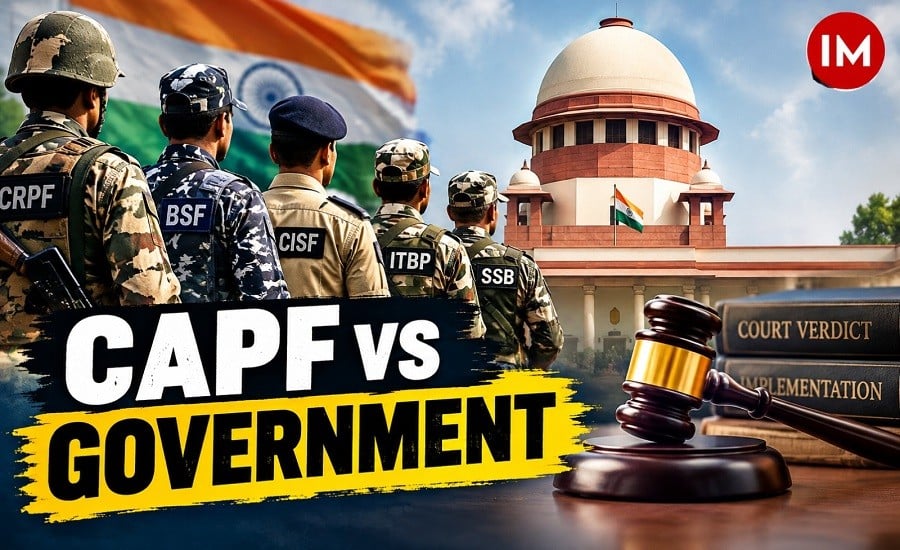
New Delhi: Officers and personnel of India’s Central Armed Police Forces (CAPFs) have increasingly turned to the courts to secure service, pension, promotional and financial benefits that they say have remained unresolved for years.
While personnel have secured important favourable orders from the Delhi High Court and the Supreme Court on several issues, the implementation of some of these verdicts remains contested or pending.
The issues range from restoration of the Old Pension Scheme (OPS) for CAPF personnel and grant of ₹5,400 grade pay to Inspectors to the recognition of the forces as Organised Group ‘A’ Services (OGAS), Non-Functional Financial Upgradation (NFFU), cadre restructuring and the role of IPS officers on deputation.
Former senior CAPF officers and representatives of personnel associations argue that repeated litigation has become necessary because administrative remedies have not resolved these long-standing grievances. The government, on the other hand, has challenged or sought review of some judicial directions and, in the case of OGAS and related issues, Parliament has subsequently enacted a new statutory framework.
A Long-Running Battle Over Service Benefits
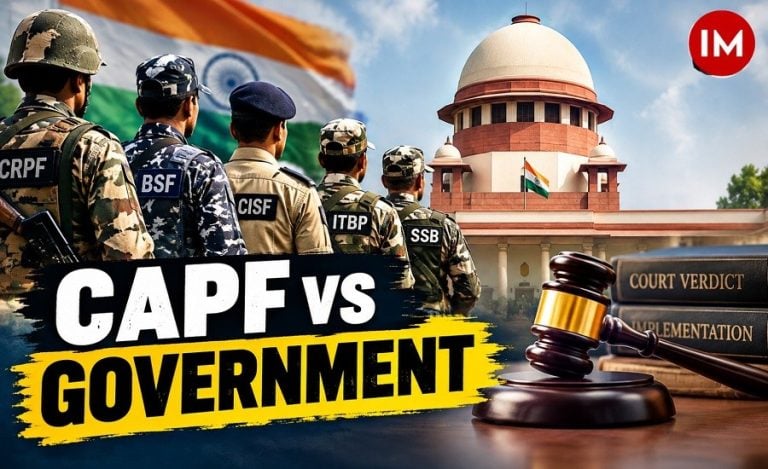
The CAPFs perform a range of border-guarding, internal-security and other national-security responsibilities. The five principal forces include the Central Reserve Police Force (CRPF), Border Security Force (BSF), Central Industrial Security Force (CISF), Indo-Tibetan Border Police (ITBP) and Sashastra Seema Bal (SSB).
For their personnel and officers, however, several service-related questions have remained before the courts for years.
Among the most prominent are the demand for the Old Pension Scheme, the ₹5,400 grade-pay issue for Inspectors, and the broader OGAS dispute involving cadre restructuring, promotions and financial progression for Group-A officers.
The disputes have followed different legal paths. In some cases, the government has challenged High Court decisions before the Supreme Court. In others, personnel have had to approach courts repeatedly even after securing favourable orders.
Read also: CAPF Contempt Case Explained: Why The Supreme Court Is Unhappy With The Listing Process
Verdict No. 1: The Old Pension Scheme Battle
One of the biggest legal battles concerns the pension system applicable to CAPF personnel.
In January 2023, the Delhi High Court delivered a significant judgment concerning the applicability of the Old Pension Scheme to CAPF personnel.
The Court’s ruling treated the CAPFs as the “Armed Forces of the Union of India” for the purpose of the dispute, challenging the distinction relied upon by the government between the CAPFs and the traditional armed forces.
The judgment directed that the National Pension System (NPS), which had been applicable to the affected personnel, should be discontinued and that the Old Pension Scheme should be extended.
According to the account of the litigation presented by CAPF representatives, the judgment covered personnel recruited in the past, present and future.
Government Approached the Supreme Court
The Union Government challenged the Delhi High Court’s decision before the Supreme Court and obtained a stay.
The matter has remained pending before the apex court, leaving the larger question of OPS implementation unresolved for CAPF personnel.
CAPF associations argue that the stay has effectively prevented the personnel from receiving the benefit of the High Court’s ruling.
For the affected personnel, the pension issue remains particularly significant because it concerns their long-term post-retirement financial security.
Verdict No. 2: OGAS, NFFU and Cadre Restructuring
The second major legal battle concerns the career progression of Group-A officers belonging to the CAPF cadres.
On May 23, 2025, the Supreme Court delivered a significant judgment dealing with several issues concerning the organisational and service structure of the CAPFs.
The case covered questions relating to Organised Group ‘A’ Service (OGAS) status, Non-Functional Financial Upgradation (NFFU), cadre reviews, recruitment and the deputation of IPS officers to senior positions.
The Court’s directions were aimed at addressing long-standing concerns regarding career progression and cadre restructuring.
The Ministry of Home Affairs was required to take steps to implement the judgment within the prescribed period.
Government’s Review Petition Dismissed
Following the judgment, the Central Government filed a review petition before the Supreme Court.
The review petition was dismissed on October 28, 2025.
The dismissal meant that the original judgment continued to stand.
However, implementation subsequently became contentious, particularly over cadre restructuring and IPS deputation.
CAPF officers have argued that the Supreme Court judgment was intended to address stagnation and improve career progression within the permanent cadres of the forces.
The government has maintained that operational requirements and the existing administrative framework also need to be considered while implementing the directions.
The New CAPF Act and the Fresh Legal Battle
The dispute took another turn after Parliament enacted the Central Armed Police Forces (General Administration) Act, 2026.
The legislation establishes a statutory framework governing several aspects of administration, recruitment, promotion and deputation in the CAPFs.
Its provisions concerning senior-level deputation have become particularly contentious among CAPF cadre officers.
They argue that the new law could dilute or override the effect of the Supreme Court’s May 2025 judgment, particularly on questions relating to cadre structure and IPS deputation.
A contempt case concerning implementation of the 2025 judgment and a challenge to the 2026 legislation are now pending before the Supreme Court.
The issue has therefore moved beyond the original question of implementation and into a larger constitutional and statutory dispute over the structure of leadership and career progression in the CAPFs.
Verdict No. 3: The ₹5,400 Grade Pay Battle
Another long-running dispute concerns the grant of ₹5,400 grade pay to Inspectors after completing four years in the ₹4,800 grade-pay scale.
In 2008, the Ministry of Finance issued an Office Memorandum providing for enhancement of grade pay from ₹4,800 to ₹5,400 for eligible Central Government employees after four years of service in the lower grade.
CAPF personnel have argued that the benefit was implemented across various Central Government departments but was not automatically extended to Inspectors in the Central Armed Police Forces.
As a result, individual personnel have repeatedly approached courts seeking the same benefit.
ITBP Inspector’s Case Reaches the Supreme Court
One of the notable cases involved ITBP Inspector Sushil Kumar.
He secured a favourable order from the Delhi High Court in his fight for the ₹5,400 grade pay.
However, according to the account provided by CAPF representatives, the benefit was not implemented despite the court order.
Kumar subsequently initiated contempt proceedings and eventually took the matter to the Supreme Court.
His prolonged legal battle ultimately resulted in the benefit being granted.
The case subsequently became an important reference point for other CAPF Inspectors seeking similar treatment.
BSF and CRPF Inspectors Also Approach Courts
Inspectors of the BSF also secured a court order in their favour on the basis of the same grade-pay issue.
Similarly, CRPF Inspectors obtained a favourable order from the Delhi High Court.
Despite these judicial developments, CAPF representatives maintain that the benefit has not been uniformly implemented across the forces.
This has resulted in personnel continuing to approach courts individually or through groups to seek enforcement.
The dispute illustrates one of the central complaints raised by CAPF personnel: even after securing a favourable judicial ruling, the battle may continue over actual implementation.
Former BSF ADG SK Sood on the Cadre Officers’ Concerns
Former BSF Additional Director General S.K. Sood has argued that CAPF cadre officers possess the experience and operational knowledge required to perform senior responsibilities, but are not adequately involved in policy-level decision-making.
According to Sood, cadre officers make significant contributions to border management and internal security but continue to face limitations in career progression.
He has also pointed to the long-running OGAS and NFFU dispute.
Sood said that when the Delhi High Court ruled in favour of cadre officers in 2015, the government challenged the decision before the Supreme Court. The government’s Special Leave Petition was subsequently dismissed in 2019.
However, according to him, important issues concerning OGAS and NFFU remained unresolved.
He also pointed out that cadre reviews in the CRPF and BSF had not been conducted since 2016.
‘Historic’ May 2025 Judgment
Sood described the Supreme Court’s May 23, 2025 judgment as a significant victory for CAPF cadre officers.
However, he alleged that subsequent government action has sought to dilute the effect of the judgment.
According to Sood, when the government’s efforts to alter the position through judicial proceedings did not succeed, Parliament enacted the CAPF (General Administration) Act, 2026.
His contention is that the new legislation effectively seeks to address through statute issues that had previously been decided by the Supreme Court.
These are, however, the views of a former senior CAPF officer and represent one side of an ongoing legal and administrative dispute.
Association Says Personnel Have Sent Hundreds of Memoranda
Ranbir Singh, General Secretary of the Confederation of Ex-Paramilitary Forces Martyrs’ Welfare Association, said that the government’s decision to seek a stay against the Delhi High Court’s OPS judgment raised concerns among personnel about the prospects of restoration of the Old Pension Scheme.
According to Singh, personnel have submitted hundreds of memoranda to the government over various long-pending grievances, but many of these issues remain unresolved.
He also argued that even when personnel or officers obtain favourable court orders, implementation is often delayed or contested.
For personnel associations, this has created a cycle in which service grievances first move through administrative channels, then reach the courts and, even after a favourable judgment, may require further litigation for implementation.
Former CRPF ADG H.R. Singh on OPS and Cadre Issues
H.R. Singh, former Additional Director General of the CRPF and Chairman of the association, has also highlighted the Delhi High Court’s OPS judgment.
He pointed to the Court’s observation that the CAPFs are “Armed Forces of the Union of India” in the context of the pension litigation.
According to Singh, this raises a larger question about the treatment of CAPF personnel in comparison with the Army, Navy and Air Force, particularly on pension-related benefits.
He argued that attempts to challenge or dilute the OPS judgment are now being mirrored in the dispute concerning cadre officers.
Singh also contended that officers who have spent their careers in the CAPFs continue to face uncertainty over promotions and financial benefits despite favourable judicial developments.
He called for Parliament to address the long-pending concerns of CAPF personnel and officers through a comprehensive legislative solution.
Why These Court Battles Matter
Taken together, the three disputes — OPS, ₹5,400 grade pay and OGAS — cover different aspects of service in the CAPFs.
The pension case concerns post-retirement financial security. The grade-pay dispute concerns the pay progression of Inspectors. The OGAS litigation concerns the organisational structure, promotions, cadre reviews and financial progression of Group-A officers.
Although the legal questions in the three cases are different, CAPF associations see a common thread: personnel and officers are being forced to pursue service benefits through prolonged litigation.
The government, meanwhile, has defended its administrative and legislative actions and has challenged or sought review of judicial directions in several instances.
The OGAS dispute has now acquired an additional dimension following the enactment of the 2026 legislation and the pending challenge before the Supreme Court.
A Larger Question Over CAPF Career Progression
The controversy ultimately raises a broader question about how India’s Central Armed Police Forces should manage the careers of officers and personnel who spend decades serving within these organisations.
CAPF officers and personnel argue that specialised forces need a career structure in which their own cadres receive adequate opportunities for promotion, financial progression and senior-level responsibility.
Their associations also maintain that judicial recognition of their claims should result in timely implementation rather than further litigation.
With the OPS case pending in the Supreme Court, the grade-pay issue continuing to generate litigation and the OGAS dispute now linked to the new CAPF legislation, several of these long-standing questions remain unresolved.
For the approximately 1.1 million personnel serving across the CAPF system, the outcome of these legal battles could have implications not only for present benefits but also for the future structure of service, promotion and financial security within the forces.