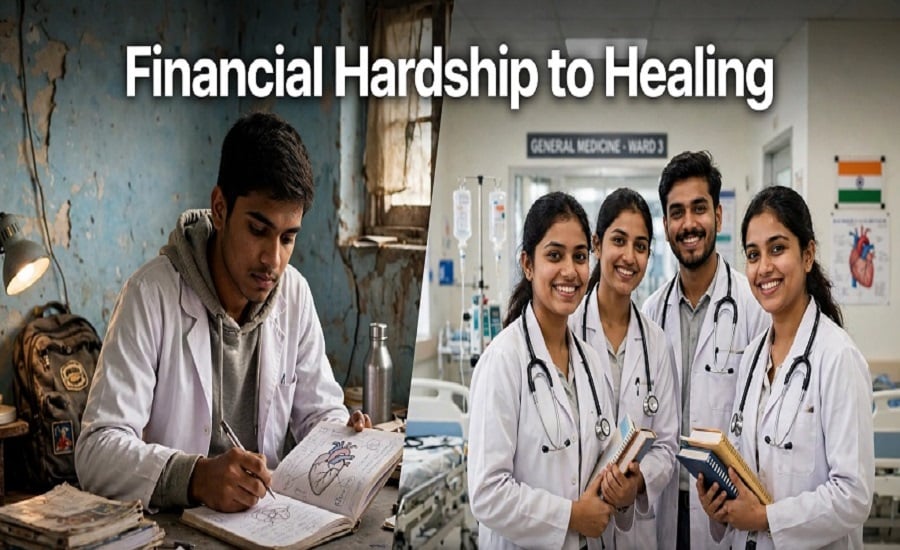
For many young Indians, securing an MBBS seat is the culmination of years of hard work. For students from economically disadvantaged families, however, admission can mark the beginning of another struggle: how to pay for the education they have worked so hard to earn.
Tuition fees are only part of the challenge. There are textbooks, hostel and mess charges, medical instruments, online learning resources and other academic expenses. For families dependent on farming, small businesses or a single salary, these costs can make a medical degree seem almost impossible.
The GSK Scholars Programme was created to bridge precisely this gap—supporting meritorious students from low-income families so that financial circumstances do not stand between them and their ambition to become doctors.
The stories of the scholars featured here show what that support can mean. They come from Karnataka, Kerala, Andhra Pradesh and Maharashtra, from families whose resources were modest but whose aspirations were not. Some borrowed money or took education loans; others studied without expensive coaching or borrowed books from seniors. Yet they persisted.
Today, they are completing internships, working as Resident Medical Officers or preparing for postgraduate entrance examinations, with dreams of becoming surgeons, physicians, radiologists, cardiologists and other specialists.
When admission was only the beginning
For Sahana Mallappa Halingali of Bagalkot, Karnataka, the odds were stark from the beginning. Her father was the sole earning member of a joint family of nine and ran a modest business. Yet Sahana excelled academically, scoring 97 per cent in both Class 10 and Class 12 and earning an MBBS seat.
The problem was not merit. It was affordability. A mentor from her Anatomy Department introduced her to the GSK Scholars Programme during her first year. After clearing the selection process, Sahana received support for essential study resources throughout medical school.
Today, she is interning at ESI Hospital, Gulbarga, and preparing for postgraduate studies, with aspirations of becoming a radiologist. For her, the purpose of becoming a doctor extends beyond professional success. “Success means studying hard enough to earn a good position so we can treat everyone equally,” she says.
Bibin K, whose father is a farmer and whose mother is a homemaker, faced a similar financial reality. With a family income of around Rs 15,000 a month, the cost of medical education was a significant burden after he secured admission to Government Medical College, Thrissur.
He searched online for scholarships and eventually found the GSK Scholars Programme. The scholarship helped him meet tuition and hostel expenses and purchase medical books and instruments.
His next goal is NEET-PG, with an ambition to specialise in General Medicine and eventually pursue super-specialisation in Cardiology. In the longer term, he hopes to work in a government hospital as a physician.
Read also: SECL Launches CSR Project for Integrated Education of Differently-Abled Children in Chhattisgarh
Dreams that survived sacrifice
For Mohammed Fawaz, becoming a doctor demanded sacrifices from the entire family. A first-generation doctor from a middle-class household, Fawaz discovered NEET only in Class 11. Expensive coaching was beyond his family’s means, so he relied largely on self-study and affordable Sunday classes. He cleared the examination and secured an MBBS seat through the rural quota.
But admission brought a new set of expenses—hostel, mess, books, medical instruments and online learning platforms. His family eventually had to take an education loan.
The turning point came when his principal circulated information about the GSK Scholars Programme. The scholarship helped meet fees, hostel expenses, book costs and online learning requirements. Now, after completing his MBBS and internship, Fawaz is preparing for NEET-PG and remains determined to become a surgeon.
For Saamson B A, the support came at a time when his family was already carrying substantial financial commitments. His father, an engineering professor and the family’s sole earning member, was managing household expenses as well as an education loan.
Saamson prepared for NEET during the Covid-19 pandemic from his village, relying largely on a mobile internet connection. Admission to medical college was a proud achievement, but tuition and academic costs soon became a source of anxiety.
The GSK scholarship eased a significant part of those expenses. Today, Saamson has completed his MBBS and works as a Resident Medical Officer while preparing for postgraduate studies.
A doctor for the community
For Omkar K of Belagavi, Karnataka, the motivation to become a doctor came from a deeply personal experience. An elderly relative died following a heart attack, with the nearest cardiac centre nearly 90 kilometres from the family’s village. For Omkar, the distance became a symbol of the healthcare gap faced by rural communities.
He entered medical school with an education loan. His father depended on farming, while his younger brother’s education added to the family’s financial pressures.
The GSK Scholars Programme, which Omkar discovered online, helped provide textbooks, a laptop and clinical learning platforms. With his MBBS now complete, he is preparing for NEET-PG and hopes to specialise in cardiology.
His ambition is clear: to practise close to home and ensure that other families do not have to travel the same 90 kilometres when they need cardiac care.
Perseverance amid personal loss
K Pragathi of Kurnool, Andhra Pradesh, discovered her interest in medicine through a science lesson. The curiosity eventually took her to an MBBS seat at a government medical college. But her family was already stretched. Her father, a farmer, was supporting the education of three daughters. Then tragedy struck when Pragathi’s mother died after falling seriously ill.
There was little room to pause. Pragathi continued her medical education while her father continued to support the family. The GSK Scholars Programme provided assistance with textbooks, hostel charges and other academic expenses. Today, she is working as a house surgeon while preparing for postgraduate studies.
For Pragathi, being a doctor is about more than diagnosis and treatment. She wants patients to receive dignity, compassion and care alongside medical attention.
From borrowed books to bigger ambitions
Bibin K B of Thrissur understood early that education was the route to a better future for his family. His father’s farming income had to support the household while two siblings were also studying.
After seeing a senior clear the medical entrance examination, Bibin began to believe that an MBBS seat was within his reach. But once he entered medical college, financial pressures became acute. During his first year, he borrowed books from seniors simply to keep up.
Rather than give up, he searched for scholarships online and found the GSK Scholars Programme. Alongside financial assistance, he benefited from mentorship that gave him greater stability and allowed him to concentrate on his studies.
He is now interning in Pulmonary Medicine at Government Medical College, Thrissur, and hopes to pursue General Medicine.
His message to other students is rooted in his own journey: “Initially, it may be a struggle, but eventually it will become easier.”
Doctors shaped by the places they came from
For Amol Namdev Sarai of Nashik, Maharashtra, the inspiration came from his village. Families often had to travel 15 to 30 kilometres to reach medical facilities. Watching this from childhood strengthened his determination to become the doctor his community needed.
His father, a farmer, struggled to manage his education expenses. The financial pressure intensified during Covid-19, when rent, books and college fees continued to accumulate.
Seniors introduced Amol to the GSK Scholars Programme. The scholarship helped him manage rent, books and college fees, enabling him to complete his MBBS and internship.
He is now preparing for NEET-PG with the goal of becoming a surgical oncologist.
In Idukki, Kerala, Alex J. was similarly determined to build a medical legacy from scratch. There was no doctor in his family to guide him, but his fascination with biology led him towards medicine.
His father was a farmer, and when Alex’s younger brother also chose medicine, the family’s financial burden effectively doubled. An education loan became necessary.
A batchmate introduced Alex to the GSK Scholars Programme, through which he received support for tuition and essential academic resources, including textbooks, dissection instruments and clinical learning tools.
Today, as he approaches the end of his internship, Alex is preparing for NEET-PG and hopes to specialise in orthopaedic surgery.
Beyond a scholarship
Taken together, these journeys underline a larger point: financial assistance in education can have consequences far beyond the individual beneficiary.
A scholarship may pay for a book, a hostel room, a medical instrument or a tuition bill. But its impact can be much larger. It can give a student the freedom to study instead of worrying about debt; allow a first-generation doctor to enter a profession previously beyond the family’s reach; and, eventually, place a trained medical professional in a community that needs one.
The GSK Scholars Programme’s story is therefore not simply about helping students complete MBBS degrees. It is about enabling talent to survive circumstances.
For these young doctors, the scholarship helped turn admission into opportunity and opportunity into a profession. Their journeys are now moving beyond classrooms and examination halls—to hospitals, clinics and communities where the real measure of their education will be the lives they touch.
And perhaps that is the most enduring return on an investment in education: when one student’s dream of becoming a doctor eventually becomes a source of healing for hundreds, or thousands, of others.
Read also: REC Foundation Signs MoA with PSSC to Skill 2,300 Youths in Smart Meter Technology