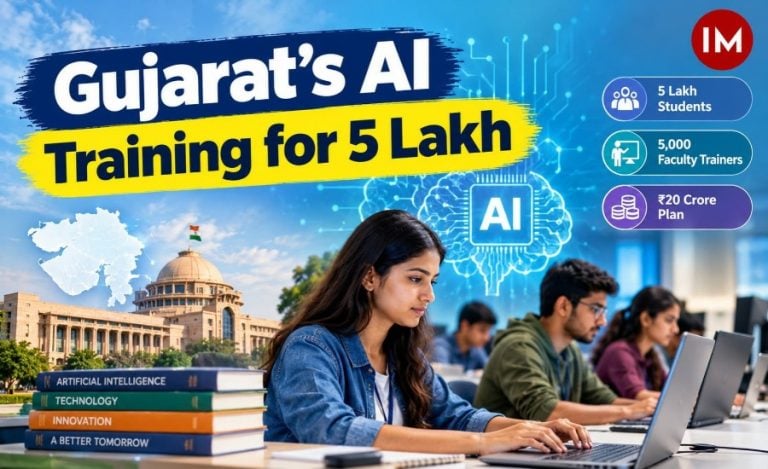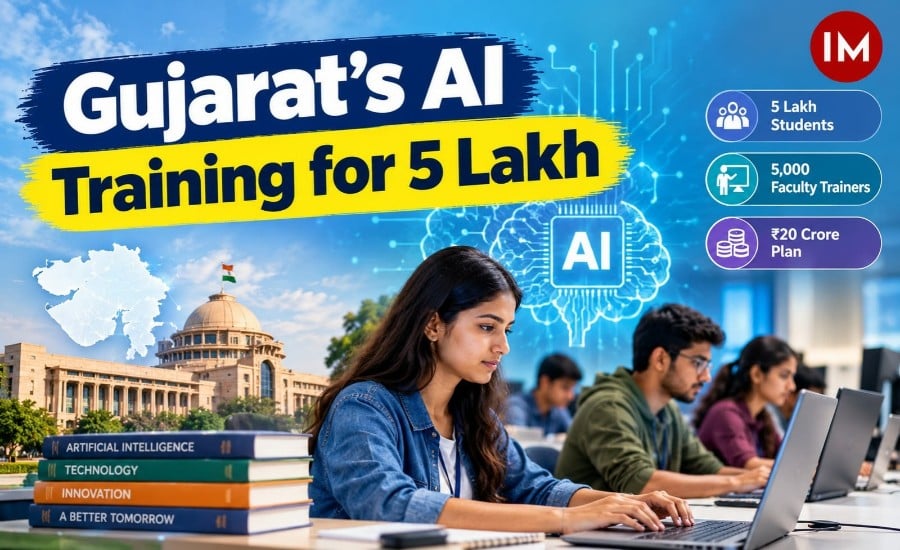
Gandhinagar: The Gujarat government has prepared a draft policy proposing artificial intelligence (AI) training for five lakh students across higher education institutions under the Gujarat AI for Every Student Mission 2026–27. The proposed initiative will introduce students to AI fundamentals, discipline-specific applications and advanced skills aimed at improving employability.
The draft, prepared by the state’s Higher Education Department, envisages a three-tier training structure and the development of a network of 5,000 faculty members as AI Master Trainers within 12 months. A state allocation of ₹20 crore has been proposed for the mission.
However, the policy is yet to receive in-principle administrative and financial clearances.
“The draft of the Gujarat AI for Every Student Mission 2026-27 has been prepared and will be implemented as soon as it receives in-principle administrative and financial clearances,” a source close to the development said.
Three-Tier AI Training to Cover 5 Lakh Students
The proposed mission will allow students to progress from introductory AI literacy to practical applications in their chosen fields and, eventually, advanced project-based training.
Read Also: Gujarat Plans Bet Dwarka Spiritual Corridor, Begins Land Acquisition for Temple Redevelopment
The programme will have three levels, each with a different duration and target group.
Key components of the proposed training programme:
- Level 1 – AI Foundation for Every Student: An eight-hour introductory course targeting five lakh students.
- Level 2 – AI for Domain Applications: A 25-hour course focused on applying AI in specific academic disciplines, targeting one lakh students.
- Level 3 – Advanced AI Skills and Employability: A 50-hour advanced programme for 20,000 students, incorporating projects and practical assessments.
Students progressing to the second and third levels will generally be drawn from those who complete the preceding course or demonstrate equivalent competency.
The structure is intended to provide broad exposure to AI while offering more specialised learning opportunities to students seeking deeper technical or professional skills.
Foundation Course to Cover Generative AI and Prompting
The first level, titled AI Foundation for Every Student, will introduce learners to artificial intelligence and its applications in education and everyday tasks.
The eight-hour course is proposed to be delivered online, primarily using freely available AI learning resources.
Its curriculum will cover:
- Basic concepts of artificial intelligence and its applications.
- Introduction to generative AI tools.
- Prompting fundamentals and effective interaction with AI systems.
- Using AI tools to support learning and productivity.
- Responsible use of AI-generated information.
The introductory course is designed to make basic AI knowledge accessible to a large number of students, regardless of their academic specialisation.
Applied AI Course to Cover Eight Broad Streams
The second level, AI for Domain Applications, will focus on how AI tools can be used within students’ respective disciplines.
The proposed 25-hour course will cover eight broad streams spanning professional, scientific and humanities-based education.
These include:
- Commerce, management and finance.
- Engineering and technology.
- Arts and humanities.
- Science and mathematics.
- Education and teacher training.
- Agriculture and allied sciences.
- Healthcare and life sciences.
- Law, public administration and other disciplines.
The programme is intended to help students understand how AI can be applied to tasks relevant to their fields rather than limiting their learning to general-purpose tools.
For example, students may be introduced to discipline-specific applications and workflows relevant to their academic or professional requirements, depending on the final curriculum.
Advanced Course to Focus on Projects and Employability
The third level, Advanced AI Skills and Employability, will offer 50 hours of blended, project-based training to 20,000 students.
Unlike the introductory course, this level will focus on more advanced concepts, practical application and the development of demonstrable skills.
The proposed curriculum includes:
- Advanced AI concepts and tools.
- Specialisation-specific technical skills.
- Applied workflows and data administration.
- Industry case studies and laboratory-based learning.
- Capstone project development.
- Final assessments.
The course is intended to help participating students develop practical competencies that can be applied in professional settings.
5,000 Faculty Members to Become AI Master Trainers
Alongside student training, the mission proposes building institutional capacity by training 5,000 faculty members as AI Master Trainers within 12 months.
These faculty members are expected to support the delivery of AI education across participating higher education institutions.
The programme’s implementation framework will involve a State Mission Unit to coordinate activities. Universities will nominate nodal officers, while individual colleges will appoint coordinators.
The proposed administrative structure is intended to help institutions coordinate training, monitor participation and track student progress across the state.
Courses to Be Available in English and Gujarati
The proposed learning modules will be bilingual, with support for both English and Gujarati.
The policy also emphasises responsible AI use and the need to verify outputs generated by AI systems rather than accepting them without scrutiny.
“The learning modules will be bilingual with both English and Gujarati support. A key safeguard in the course will be verification of AI-produced outputs rather than accepting them at face value. The curriculum is intended to promote responsible use, secure student and institutional data and incorporate safeguards suited to different disciplines,” said an official associated with the project.
These provisions are intended to familiarise students with AI tools while encouraging critical evaluation of their outputs and attention to data security.
Statewide Dashboard Proposed to Track Student Progress
The draft policy also envisages a statewide monitoring mechanism to track enrolment, certification and progression through the three training levels.
The proposed dashboard will use unique learner IDs to follow students’ progress through the programme. Institutional reviews and independent verification of selected outcomes are also planned.
The monitoring framework is expected to help the state assess participation and track the implementation of the mission across colleges and universities.
Gujarat’s AI Education Mission Awaits Clearances
The Gujarat AI for Every Student Mission 2026–27 proposes to combine large-scale introductory training with specialised and advanced learning opportunities.
Its principal targets are to reach five lakh students, train one lakh learners in applied AI and provide advanced training to 20,000 students, while developing 5,000 faculty members as AI Master Trainers.
The proposed ₹20 crore allocation would support the initiative, subject to the required administrative and financial approvals.
The programme’s final implementation schedule and operational details will depend on the clearances received and the arrangements subsequently made by the Higher Education Department and participating institutions.
Read Also: Gujarat’s Balethi Village to Become Centre of Excellence for Forest Conservation and JFM Training