By Dr. Vivek Saxena, IFS
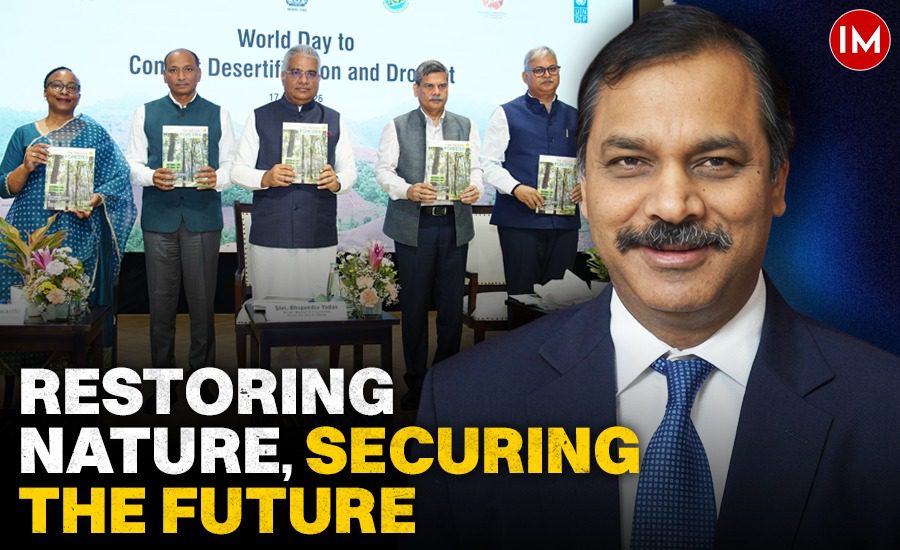
In a milestone that deserves far greater public attention than it has received, India has achieved — fully ten years ahead of schedule — the land restoration target it had pledged to the world under the Bonn Challenge. A progress report released on June 17, 2026 on the occasion of UN Desertification Day at MoEFCC by Union Minister Sh Bhupender Yadav confirms that India brought 21.76 million hectares of degraded and deforested land under restoration by 2020, decisively exceeding the original pledge of 13 million hectares for that year and effectively fulfilling its original 2030 commitment of 21 million hectares a full decade before the deadline. India has since enhanced its Bonn Challenge commitment to 26 million hectares.
The Bonn Challenge, launched in 2011 in Germany, is the world’s foremost global initiative for forest landscape restoration. Its ambition is sweeping: bring 150 million hectares of degraded land into restoration by 2020 and 350 million hectares by 2030. India joined this effort with a pledge to restore 13 million hectares by 2020 — and the country’s performance has since surpassed every expectation.
“India has surpassed its restoration pledge a full decade early — 21.76 million hectares brought under restoration against a target of 13 million, and counting.”
India’s ambition was scaled up further in 2019 when Prime Minister Narendra Modi, addressing the 14th Conference of Parties of the United Nations Convention to Combat Desertification (UNCCD COP14) in New Delhi, enhanced the national commitment from 21 million hectares to 26 million hectares. That gesture of enhanced ambition now looks well-founded: with restoration data compiled only through 2020, India has already crossed the original 21 million hectare mark. A comprehensive compilation extending through 2025 is expected to conclusively demonstrate that the 26 million hectare target too has been met well before 2030.
Also Read – How One IRTS Officer is Redefining Opportunities for Women in Indian Railways
The IUCN — the International Union for Conservation of Nature — serves as the Global Reporting Secretariat for the Bonn Challenge, providing the methodological framework and verification architecture that gives these numbers their credibility. The Bonn Challenge reporting platform for India was launched in 2019 at Vigyan Bhawan, New Delhi, in collaboration with the Ministry of Environment, Forest and Climate Change (MoEFCC) — an initiative that gave India’s restoration journey the rigour and visibility it needed on the global stage.
This achievement is the result of several converging policy streams. Mission LiFE — Lifestyle for Environment — has reoriented citizen behaviour towards sustainable choices. Ek Ped Maa Ke Naam (One Tree for Mother), Prime Minister Modi’s personal call for mass tree planting, mobilised millions of Indians in an act that was as much cultural as ecological. Project MISHTI — Mangrove Initiative for Shoreline Habitats and Tangible Incomes — brought targeted mangrove restoration along India’s 7,500-kilometre coastline, protecting ecosystems that are disproportionately important for carbon storage, biodiversity, and coastal community livelihoods. Complementing these is the Aravalli Green Wall initiative, a landscape-scale greening effort across the ecologically stressed Aravalli range spanning Rajasthan, Haryana, Delhi, and Gujarat.
The implications for India’s climate commitments are significant. Land restoration contributes directly to India’s Nationally Determined Contributions (NDCs) under the Paris Agreement — specifically the target of creating an additional carbon sink of 2.5 to 3 billion tonnes of CO₂ equivalent through forest and tree cover by 2030. It also moves the needle on India’s overarching goal of achieving carbon neutrality by 2070. Restored forests and grasslands sequester carbon, regulate water cycles, prevent soil erosion, and sustain biodiversity — benefits that compound over decades.
“Land restoration is not merely an environmental act — it is an act of civilisational responsibility, binding together climate, biodiversity, food security, and the livelihoods of rural India.”
What makes this achievement particularly noteworthy is the institutional architecture behind it. The MoEFCC, under Union Minister Bhupender Yadav, has provided the policy direction and inter-ministerial coordination that restoration at this scale demands. State governments, forest departments, community institutions, and civil society organisations have all played a part. The data gathered through the Bonn Challenge reporting framework has not only provided accountability but has built a national baseline for monitoring future progress.
India’s story deserves to be read against a broader backdrop of global underperformance. Globally, the Bonn Challenge’s 2020 target of 150 million hectares was not met. Against this context, India’s delivery — 21.76 million hectares against a pledge of 13 million, on time and then some — stands as a rare instance of a developing nation not merely meeting but meaningfully exceeding its international environmental commitment.
With the next Bonn Challenge Progress Report set to capture data through 2025, India is well-positioned to present an even more compelling account of its restoration trajectory. If current trends continue, India is expected to bring 26 million hectares of degraded and deforested land under restoration before the decade is out, five years ahead of schedule, making it one of the world’s leading national restoration success stories.
Milestones of this magnitude — measured in millions of hectares, thousands of species, and the slow, patient work of ecological recovery — rarely command the headlines they deserve. But they define, more than almost anything else, whether a nation is truly serious about its future. India, on this count, is serious. This is a milestone worth celebrating.
About The Author : Dr. Vivek Saxena, IFS is a 1991-batch Indian Forest Service officer (Haryana cadre). He served as Country Representative, IUCN India, and was instrumental in launching the Bonn Challenge reporting project in India in 2019. Views are personal.
Also Read – From Disappointment to Destiny: How an IFS Officer Found His Purpose in Bihar