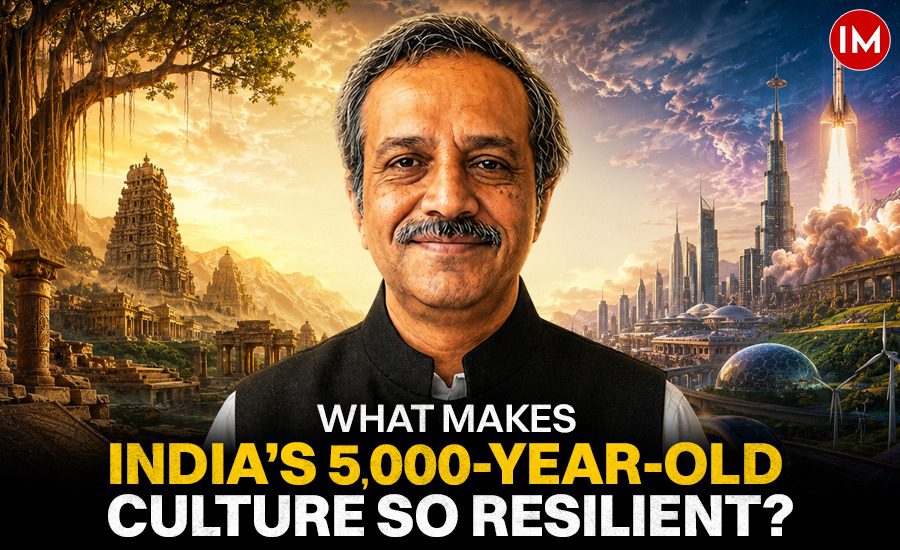
What keeps a civilisation alive for thousands of years? Is it political power, military victories, or economic strength? For Madhukar Kumar Bhagat, the answer lies elsewhere—in culture. In a conversation with Indian Masterminds, the senior IRS officer, author, and Joint Secretary in the Ministry of Health & Family Welfare reflected on how India’s ability to absorb change without losing its core identity has helped its civilisation survive and thrive.
Bhagat believes that Indian culture is not a static relic of the past. It is a living, evolving tradition that continuously adapts while remaining rooted in timeless values. His three-volume illustrated series, Unravelling Indian Culture, is an attempt to capture that journey.
A BOOK THAT TURNED INTO A LONG JOURNEY
Bhagat admitted that when he started the project, he thought it would take only a few months. He imagined that collecting information and putting it together would be a straightforward task. But the deeper he went into Indian history and culture, the more he realised that understanding a civilisation requires patience and honesty.
Soon, the project that looked manageable began demanding years of research, travel, reading, photography, and reflection. Like many writers, he wondered if the effort would be worth it. Would the books find readers? Would they be appreciated? Was it practical to spend years on a single idea?
The answer, he says, came from an unexpected source—his own research on Lord Buddha.
Watch the interview here :
THE LESSON HE FOUND IN BUDDHA’S STORY
While writing the chapter on Buddha, Bhagat was deeply moved by the episode where Mara tries to distract the meditating Buddha with promises of power, wealth, luxury, and fame. Buddha rejects them all, even saying that he has no desire for fame.
Bhagat found this striking because Buddha eventually became one of the most revered figures in human history. Yet, at the moment of enlightenment, recognition was not his goal.
“For a moment, I realised that the purpose of life cannot be only about receiving. Somewhere, it must also include giving something back to society,” Bhagat told Indian Masterminds.
He explained that this thought changed the way he looked at his own writing. Instead of worrying only about success, recognition, or rewards, he began to see the books as his contribution to society and to the preservation of India’s cultural memory.
Also Read – How an IRS Officer Spent Five Years Decoding 4,000 Years of Indian Culture
WHY DOES INDIAN CULTURE SURVIVE?
During the conversation, Bhagat was asked why so many Indian traditions continue to survive despite centuries of change, foreign influence, and modernisation. Why do ancient rituals still exist alongside scientific thinking? Why do folk music and pop music both thrive? Why do mainstream cinema and parallel cinema coexist?
According to him, the answer lies in India’s extraordinary diversity.
He pointed out that moving even a few hundred kilometres within the country changes the language, cuisine, clothing, customs, and local traditions. Rather than creating conflict, this diversity creates space for many different cultural expressions to grow together.
For him, Indian culture is dynamic. It is constantly changing, but it does not abandon its roots. New ideas are not rejected simply because they are new. They are absorbed, adapted, and evaluated according to whether they benefit society.
THE IDEA OF UNITY IN DIVERSITY
Bhagat believes that diversity alone does not explain India’s cultural continuity. The deeper reason lies in the philosophical foundations of Indian civilisation.
He referred to the ancient concept of Vasudhaiva Kutumbakam from the Mahopanishad, explaining that it goes beyond the popular phrase “the world is one family.” The original idea, he said, asks people to rise above the narrow distinction of “mine” and “yours.”
He also spoke about the teachings of the Upanishads, where all existence is seen as part of the same universal consciousness. When every individual is viewed as carrying the same divine essence, differences become less important than shared humanity.
“This is not just tolerance. Indian culture creates space, then acceptance, and finally respect. When we see the same divinity in everyone, there is no place left for discrimination,” he said.
Bhagat argues that this idea of inclusiveness is the reason Indian civilisation has survived for thousands of years while continuing to evolve.
CULTURE THROUGH THE LENS OF CINEMA
One of the most unique aspects of Bhagat’s trilogy is its use of visual storytelling. The books contain a vast collection of paintings, photographs, and archival images that help readers experience history rather than merely read about it.
His chapter on Indian cinema is a good example. Instead of treating films as entertainment alone, he uses them as cultural documents that reflect social change across different periods.
Drawing from material collected with the help of the National Film Archive, Bhagat includes posters and discussions around nearly twenty iconic films. The collection spans classics such as Mughal-e-Azam, the socially rooted works of Satyajit Ray, the parallel cinema movement led by filmmakers like Shyam Benegal and Ritwik Ghatak, and landmark films like Ankur. He also touches upon the emergence of Amitabh Bachchan and how his performances reshaped mainstream Hindi cinema.
For Bhagat, every film, painting, or monument is a window into the society that created it.
A MESSAGE TO THE YOUNGER GENERATION
As the conversation drew to a close, Bhagat offered a message that was both simple and thought-provoking. He urged young Indians to take pride in belonging to one of the world’s oldest living cultures, but at the same time to avoid cultural arrogance.
He believes that Indians have inherited thousands of years of civilisational wisdom, but that inheritance should inspire confidence, not superiority. The right approach, he says, is the “middle path”—to remain rooted in one’s own traditions while remaining open to new ideas and influences from across the world.
He encouraged young people to welcome fresh perspectives, carefully examine whether they are beneficial, and then integrate them into their own lives without losing touch with their cultural foundations.
In many ways, that philosophy is also the central message of Unravelling Indian Culture. The books argue that India’s greatest strength has never been resisting change. It has been the ability to embrace change while preserving the timeless ideas that define its civilisational identity.
Also Read – From AI Cameras to Boom Barriers: The Policing Innovations That Transformed Pune’s Ganeshotsav