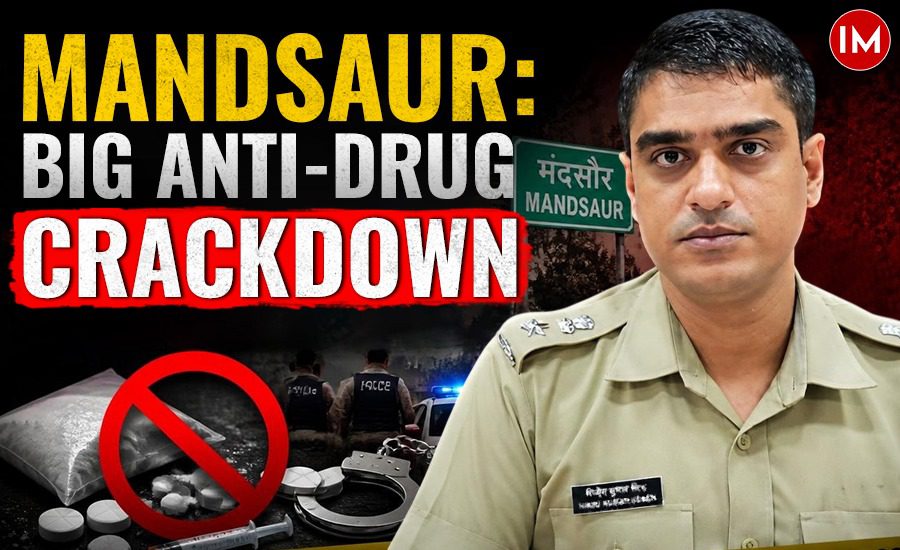
The crackdown led by Vinod Kumar Meena in Mandsaur, Madhya Pradesh, 2019 batch IPS officer, has emerged as a major anti-narcotics operation, with ₹20 crore worth of drugs seized and ₹362 crore in illegal assets targeted. The action targets interstate trafficking network and highlighted Mandsaur’s role as a key narcotics hub. A strong focus on financial disruption, technology, and intelligence-led policing: including initiatives like Project KAVACH, has strengthened enforcement.
Backed by laws like the NDPS Act, the operation shows a shift from isolated seizures to systemic crackdown on the entire drug ecosystem.
In an exclusive conversation with Indian Masterminds, Mandsaur SP, Vinod Kumar Meena , talks about the operation and process within.
District Operation with National Implications
“This is not an isolated action, but part of a larger effort to dismantle the entire narcotics ecosystem.”
The crackdown in Mandsaur has rapidly evolved into one of the most significant district-level crackdowns in recent years, aligning closely with India’s broader anti-narcotics push. Under the leadership of SP Vinod Kumar Meena, the operation has not only resulted in the seizure of drugs worth ₹20 crore but also the identification and attachment of illegal assets valued at ₹362 crore. With 74 NDPS cases registered and a multi-state trafficking syndicate busted, the scale of the action is an example of a systemic approach rather than a one-off enforcement exercise. Investigations have traced networks spanning more than six States, indicating how deeply embedded such rackets are in India’s socio-economic fabric. This positions Mandsaur as a critical node in the national narcotics map and elevates the crackdown as a case study in coordinated enforcement.
Read Also: How Punjab Became India’s Best-Performing State in School Education
National Drug Crisis: Why Mandsaur Matters
“The magnitude of this action must be seen against the scale of the national drug problem.”
India’s narcotics challenge has grown both in scale and complexity, with annual drug seizures ranging between I.N.R. 16,000 and I.N.R. 23,000 crore in recent years and over one lakh NDPS cases registered annually. Law enforcement agencies routinely seize between 10 to 16 lakh kilograms of narcotics across the country, underscoring the vastness of the illicit trade. Against this backdrop, the I.N.R. 362 crore asset seizure in Mandsaur stands out as a high-impact intervention at the district level, showingh how localized action can yield nationally significant outcomes. It exhibits a shift toward targeted, intelligence-driven enforcement capable of delivering disproportionate results relative to the scale of operation.
Geography and Vulnerability: Making of a Narcotics Hub
“The region’s geography and connectivity have made it a natural hotspot for drug networks.”
Situated in the Malwa belt, Mandsaur lies close to areas known for licensed opium cultivation, where diversion into illegal channels has long been a concern. The district’s location at the crossroads of major states like Rajasthan, Gujarat, and Maharashtra further enhances its vulnerability, turning it into a crucial transit corridor for narcotics moving across northern and western India. This geographical advantage for traffickers has gradually transformed the district into a convergence point for supply, distribution, and logistics. As a result, criminal networks have leveraged both natural and infrastructural factors to build resilient trafficking routes, making enforcement particularly challenging and necessitating a multi-dimensional response.
Fields to Factories: Expanding Drug Economy
“Mandsaur today is not just a transit point but a source and production hub.”
Recent cases have revealed the evolving nature of the narcotics trade in the region, with seizures of large quantities of opium and poppy straw accompanied by the busting of synthetic drug manufacturing units. The discovery of MD drug factories and chemical precursor networks highlights a transition from traditional, agriculture-based narcotics to lab-driven synthetic production. Arrests of traffickers operating across states, including seizures of mephedrone worth crores in Maharashtra linked back to Mandsaur, confirm the district’s role in a wider distribution network. This transformation marks a critical shift in the drug economy, where higher profits, easier concealment, and scalable production have made synthetic drugs the new frontier of organized crime.
Financial Warfare: Targeting the Economic Backbone
“Financial crackdown is what we focus on; we have seized properties worth ₹360 crore linked to narcotics.”
One of the defining features of the Mandsaur model is its emphasis on dismantling the financial infrastructure of drug syndicates. By targeting assets such as land, residential properties, and commercial establishments acquired through illicit proceeds, the police have shifted the focus from mere arrests to long-term disruption. This approach aligns with the evolving enforcement philosophy under the NDPS Act, which increasingly prioritizes asset forfeiture as a deterrent. The seizure of ₹362 crore worth of assets represents not just a financial blow to traffickers but also a strategic effort to cripple their ability to reinvest and rebuild networks, thereby ensuring sustained impact.
Nationwide Pattern of Intelligence-Led Crackdowns
“Across India, enforcement is moving toward dismantling networks rather than targeting individuals.”
The Mandsaur operation shows a pattern emerging across the country, where agencies are focusing on intelligence-based interventions to break organized drug syndicates. Similar crackdowns, including large-scale ganja seizures in Nagpur and multi-district operations like Rajasthan’s Anti-Venom campaign, demonstrate a consistent shift toward coordinated, data-driven policing. These operations increasingly rely on surveillance, inter-agency cooperation, and real-time intelligence sharing to track and intercept traffickers. The emphasis is no longer on isolated seizures but on identifying and neutralizing entire supply chains, marking a significant evolution in India’s narcotics enforcement strategy.
Technology and Coordination: New Policing Backbone
“Technology keeps us ahead in the cat-and-mouse race; coordination platforms like NCORD are critical.”
The integration of technology has played a crucial role in enhancing the efficiency of operations in Mandsaur. Platforms like the Narcotics Control Bureau’s NCORD system have enabled seamless coordination between agencies, while local innovations have brought real-time monitoring and AI-driven analysis into everyday policing. These systems allow better tracking of suspects, mapping of crime patterns, and faster deployment of resources, ensuring that enforcement remains proactive rather than reactive.
Project KAVACH: AI-Driven Policing on the Ground
“Project KAVACH helps us monitor crime and criminal hotspots in real time, strengthening both patrolling and intelligence.”
Among the most notable innovations emerging from Mandsaur is Project KAVACH, an AI-driven policing initiative designed to enhance surveillance, coordination, and accountability. Developed by the Mandsaur Police, the application enables real-time tracking of patrolling units, digital mapping of assigned beats, and immediate alerts to the control room if any patrol deviates or becomes inactive. By integrating live monitoring with data analytics, the system allows officers to identify both crime hotspots and criminal hotspots, areas with frequent offences as well as zones associated with habitual offenders. The technology has significantly improved night patrolling efficiency and strengthened urban security, while also enabling smoother coordination during high-sensitivity situations such as VIP movements. Its success has led to its adoption in neighbouring districts like Ratlam and Neemuch, indicating its scalability as a policing model.
Legal Arsenal: Strengthening the Fight Against Organized Crime
“Drug trafficking is organized crime, and the law provides robust mechanisms to tackle it.”
India’s legal framework, including the NDPS Act and the Prevention of Illicit Traffic in Narcotic Drugs and Psychotropic Substances Act, provides extensive powers to enforcement agencies to combat narcotics networks. Provisions allowing preventive detention, monitoring of precursor chemicals, and cancellation of illegally obtained opium cultivation licenses have been actively used in the Mandsaur crackdown. Additionally, newer provisions under the Bharatiya Nyaya Sanhita addressing organized crime have further strengthened the legal toolkit. The emphasis on thorough investigation, rather than mere application of law, has been key to improving conviction rates and ensuring that cases stand up in court.
Community and Coordination: The Human Element
“We have received strong support from society, which is deeply affected by drug abuse.”
Beyond enforcement and technology, community participation has emerged as a critical pillar of the anti-drug strategy. Public awareness and cooperation have aided intelligence gathering, while coordination between bordering districts in Madhya Pradesh, Rajasthan, and Gujarat has strengthened interstate action. The tri-junction geography of the region necessitates continuous information sharing, and the establishment of such networks has significantly enhanced the ability to track and dismantle cross-border rackets. This collaborative approach highlights the importance of societal engagement in addressing complex criminal challenges like narcotics trafficking.
Structural Shift in Policing
“The goal is not just seizure, but dismantling the entire ecosystem.”
The Mandsaur crackdown ultimately represents a transformation in Indian policing, moving from reactive, seizure-based operations to proactive, intelligence-led strategies focused on network disruption and financial targeting. By combining legal enforcement, technological innovation, financial investigation, and community engagement, the model offers a comprehensive framework for tackling organized crime. The integration of initiatives like Project KAVACH further strengthens this approach, demonstrating how local innovation can complement national policy. As drug networks continue to evolve, such integrated strategies are likely to define the future of law enforcement in India, making Mandsaur not just a success story, but a blueprint for systemic change.
Read Also: Why UPSC Prelims 2026 Has Sparked a Debate on Fairness and Inclusivity