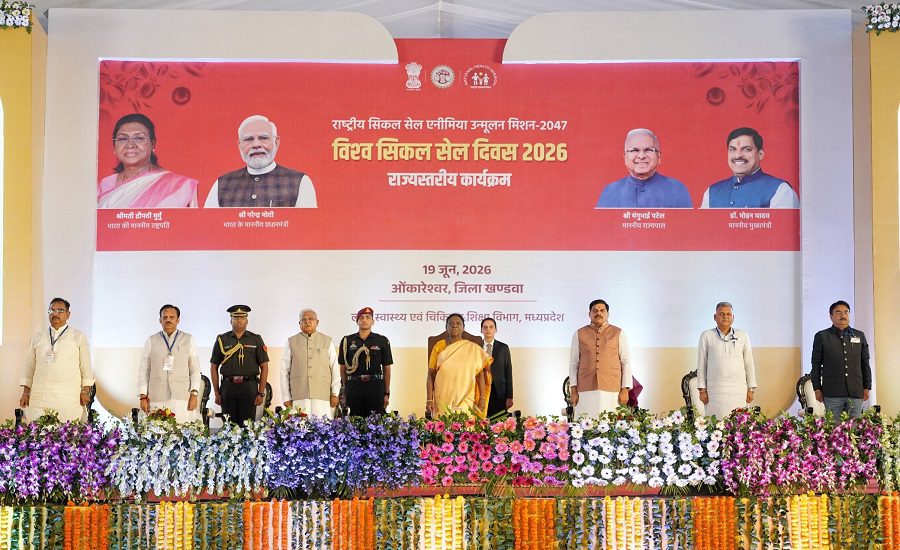
Omkareshwar: The state-level celebration of World Sickle Cell Day was held in Omkareshwar on Friday, where President Droupadi Murmu highlighted the significant progress made under the National Sickle Cell Anaemia Elimination Mission. The event was attended by Governor Mangubhai Patel and Chief Minister Mohan Yadav.
The President inaugurated the programme by lighting a ceremonial lamp and praised the coordinated efforts of the central and state governments in addressing the genetic disorder.
National Sickle Cell Mission Reaches Major Screening Milestone
President Murmu noted that the national mission, launched in 2023 by Prime Minister Narendra Modi from Shahdol, has already achieved its screening target ahead of schedule.
According to data shared at the event:
- Nearly 70 million people have been screened nationwide
- Around 2.5 lakh patients identified with sickle cell disease
- Over 20 lakh carriers detected
The President described this as one of the largest genetic screening initiatives globally, combining public health, tribal welfare, and digital monitoring systems.
Madhya Pradesh’s Major Contribution to the Mission
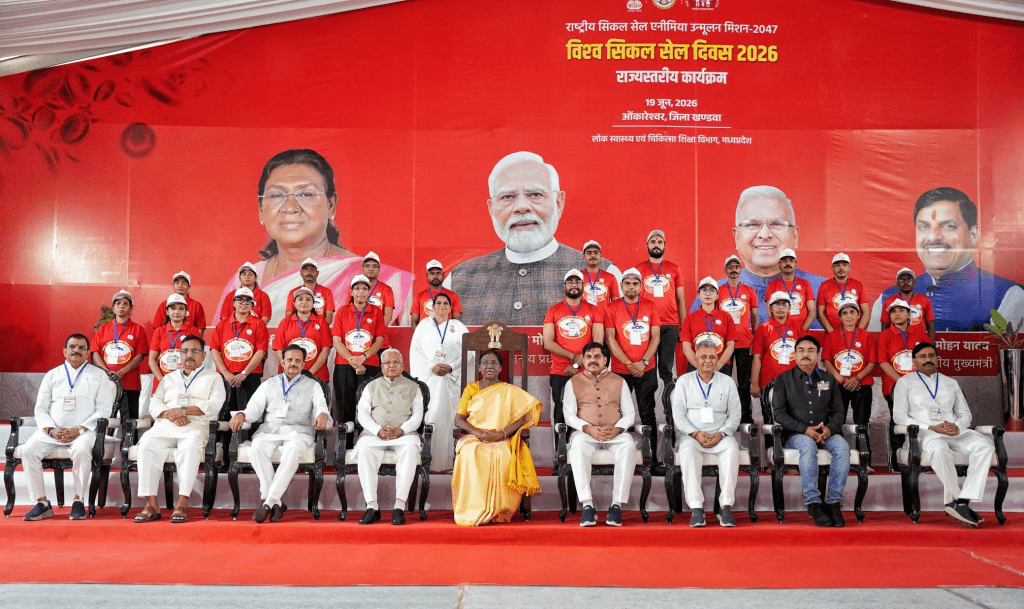
The President emphasized the crucial role of Madhya Pradesh in the mission’s success. The state has screened more than 1.25 crore people, with large-scale genetic counselling cards distributed to beneficiaries.
Key initiatives highlighted include:
- Point-of-care testing expanded to Ayushman Arogya Mandirs
- Screening of pregnant women and newborns
- Mobile Medical Units (MMUs) in remote tribal regions
- “Healthy Women, Empowered Families” campaign screening over 4 lakh women
- School-based screening programmes
She also appreciated the “Sickle Mitra” initiative, which trains volunteers, NCC cadets, and NGOs to support awareness and patient care.
Multi-Ministry Approach and Scientific Collaboration
The mission is jointly implemented by the Ministry of Health and Family Welfare and the Ministry of Tribal Affairs. It involves collaboration with institutions such as:
- Indian Council of Medical Research (ICMR)
- AIIMS hospitals
- WHO-supported research bodies
- Tribal health research institutes
The integrated approach combines genetic science, preventive healthcare, and digital tracking to address the disease in tribal-dominated regions where prevalence is significantly higher.
Government Focus on Awareness, Screening, and Long-Term Care
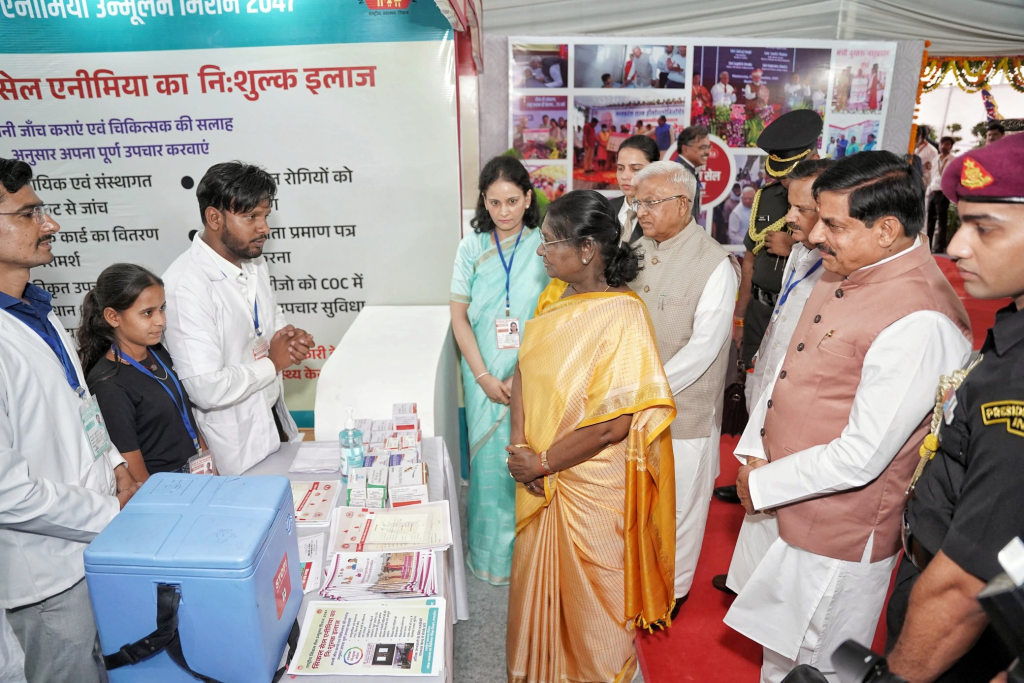
President Murmu outlined three key pillars of the mission:
- Large-scale awareness and pre-marital genetic counselling
- Mass screening for early detection
- Continuous and integrated treatment and care
She emphasized that carriers often remain unaware of their condition, making early screening essential to prevent transmission to future generations.
Expansion of Healthcare Infrastructure in Madhya Pradesh
Chief Minister Mohan Yadav stated that the campaign is a long-term commitment aimed at securing future generations from genetic diseases.
He highlighted:
- Increase of medical colleges in the state from 5 to 32
- Deployment of over 3,700 “Sickle Mitras”
- Expansion of genetic counselling and antenatal screening
- Strong focus on tribal welfare and healthcare accessibility
He reaffirmed that the state aims to become “sickle-cell-free” through community participation.
Governor Highlights Genetic Card Importance
Governor Mangubhai Patel compared genetic counselling cards to a “life blueprint,” stressing their importance in marriage decisions. He also advocated for combining allopathic and Ayurvedic treatments for better management outcomes.
He stated that over 1.32 crore people have already been screened in the state, with coverage nearing completion.
National Vision for Elimination by 2047
Officials reiterated the mission’s long-term goal of eliminating sickle cell disease in India by 2047. The programme is now being implemented across 17 states with increasing public participation.
The President expressed confidence that coordinated national efforts could achieve the target even before the deadline.
Recognition of Outstanding Contributions and Exhibition Visit
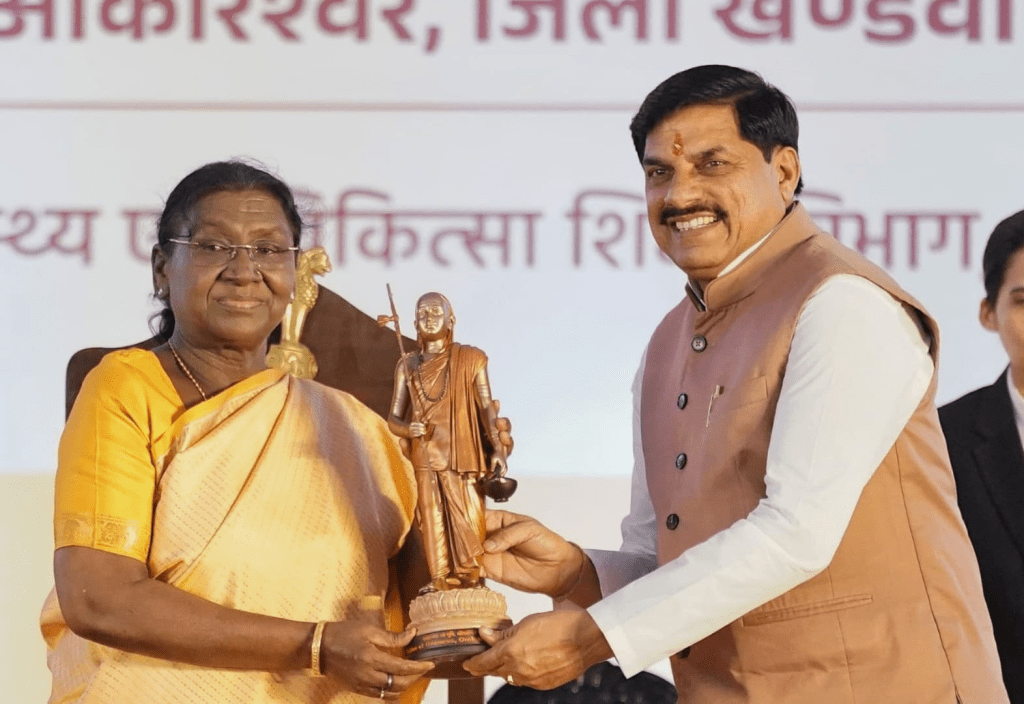
At the event, President Murmu also honoured representatives of gram panchayats and officials for outstanding performance in the mission.
She later visited an exhibition showcasing:
- Screening technologies
- Awareness campaigns
- Treatment and counselling models
- State-level innovations in tribal healthcare delivery
Officials demonstrated how digital tools and field-level outreach are improving early detection and treatment coverage.
Leadership Presence at State Programme
The event was attended by:
- Governor Mangubhai Patel
- Chief Minister Dr. Mohan Yadav
- Deputy Chief Minister Rajendra Shukla
- Senior state ministers and MPs
- Health department officials and Sickle Mitras