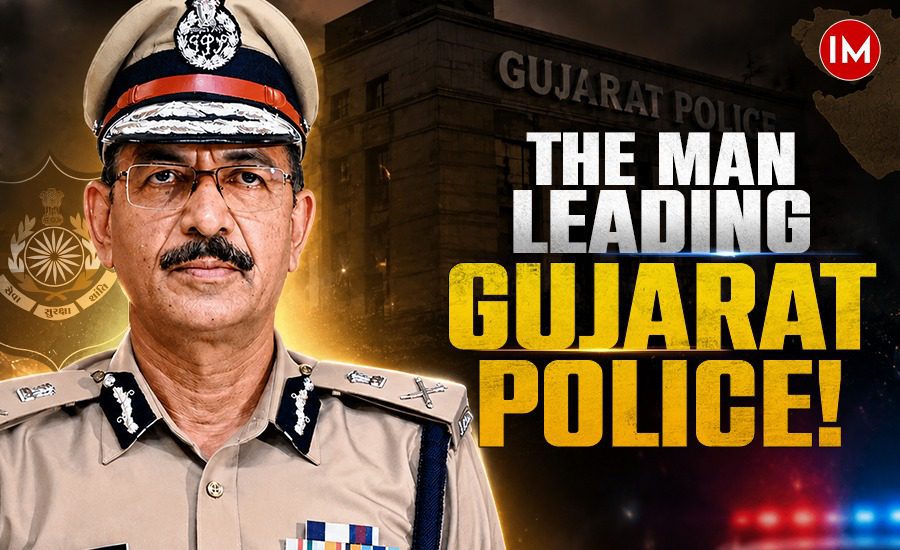
When GS Malik took charge as the 41st Director General of Police (DGP) of Gujarat, he brought with him more than three decades of experience across some of India’s toughest policing and security assignments. From guarding the India-Pakistan border and tackling organised crime to modernising urban policing and focusing on the welfare of police personnel, his career has been defined by a mix of field action and institution-building.
Speaking to Indian Masterminds soon after assuming office, the 1993-batch Gujarat cadre IPS officer made his priorities clear. “Policing today is changing rapidly. Technology, intelligence and public participation have become as important as traditional law enforcement. We have to strengthen all three together,” he said.
He also stressed that people must remain at the heart of policing. “A strong police force is one that earns the trust of citizens. Our effort is to ensure that complaints are resolved quickly and that people feel the police are accessible, responsive and fair,” Malik told Indian Masterminds.
A CAREER BUILT ON DIVERSE EXPERIENCE
Originally from Faridabad, Haryana, GS Malik’s professional journey began outside policing. A B.Tech graduate in Electrical Engineering from Banaras Hindu University, he worked with ONGC and later with the Indian Railways before joining the Indian Police Service in 1993. He also went on to complete a law degree from Gujarat University.
His first posting was as Assistant Superintendent of Police in Bhuj. Over the next three decades, he served as Superintendent of Police in Dangs, Porbandar, Surendranagar, Ahmedabad Rural, Bharuch and Kutch, gaining extensive experience in district policing. He later headed important police ranges including Border, Ahmedabad, Vadodara and Surat, besides serving in the CID (Crime), CID (Intelligence), Anti-Corruption Bureau, Prohibition and Excise Department, and the Home Department.
AN OFFICER KNOWN FOR TOUGH DECISIONS
Throughout his career, Malik has built a reputation as a firm and decisive officer. During his tenure as SP, Bharuch, he ordered action against influential political figures when the law demanded it, reinforcing the principle that no one is above the law.
As Ahmedabad Police Commissioner, he led one of Gujarat’s biggest anti-encroachment operations around Chandola Lake. The massive drive reclaimed large stretches of government land and removed thousands of illegal structures without any major law-and-order disturbance. The operation later became a model for similar drives elsewhere in the state.
His approach has consistently focused on combining careful planning with strong execution, ensuring that difficult operations are carried out efficiently while maintaining public order.
Also Read – Mandsaur’s War on Drugs: IPS Vinod Kumar Meena Leads ₹362 Crore Crackdown on Narcotics Networks
STRENGTHENING BORDER SECURITY
Malik’s experience extends well beyond state policing. During nearly five years on Central deputation, he served as Inspector General of the Border Security Force (BSF), Gujarat Frontier, overseeing one of India’s most sensitive border sectors.
One of the most significant operations under his leadership was a helicopter-supported mission in the Harami Nala area of Kutch. Conducted in coordination with the Army and the Air Force, the operation led to the seizure of 11 Pakistani boats and the capture of six intruders, strengthening security in a strategically important region.
He later served as Additional Director General in the Central Industrial Security Force (CISF), where he was responsible for the security of key airports and critical national infrastructure. Earlier in his career, he also served with the United Nations Peacekeeping Mission in Kosovo, working on war-crime investigations, giving him valuable international policing experience.
MAKING TECHNOLOGY A FORCE MULTIPLIER
One of the defining features of Malik’s career has been his emphasis on technology-driven policing. As Ahmedabad Police Commissioner, he actively promoted the use of surveillance systems and community participation to improve public safety.
Under his leadership, thousands of CCTV cameras were integrated into the city’s security network, with many linked directly to police stations and control rooms. The initiative improved crime detection, strengthened investigations and enabled faster response during emergencies.
Now, as DGP, he wants to build on that experience. Expanding surveillance networks, improving intelligence gathering and strengthening cybercrime capabilities are expected to remain key focus areas for Gujarat Police under his leadership.
PUTTING THE SPOTLIGHT ON POLICE WELFARE
For Malik, modern policing is not only about fighting crime but also about taking care of the people responsible for maintaining law and order.
He launched Mission Fit Khaki, a unique initiative aimed at improving the health and fitness of police personnel. The programme introduced regular health check-ups, yoga sessions, fitness activities and awareness campaigns to address lifestyle-related health issues within the force.
The initiative reflected his belief that a healthy and motivated police force is essential for effective policing. By focusing on the physical and mental well-being of officers, he sought to strengthen the institution from within.
BUILDING STRONGER INSTITUTIONS
Apart from operational policing, Malik has also played an important role in strengthening police administration. As the head of the Gujarat Police Recruitment Board, he oversaw transparent and time-bound recruitment drives that brought nearly 24,000 constables into the force between 2014 and 2018.
His contributions to policing have earned him the Police Medal for Meritorious Service and the President’s Police Medal for Distinguished Service, recognising his long and impactful career.
THE ROAD AHEAD
As Gujarat’s new police chief, GS Malik takes charge at a time when the nature of policing is rapidly evolving. Traditional law-and-order challenges now exist alongside cybercrime, digital fraud, narcotics networks and increasingly complex security threats.
His vision for the force is built around three pillars—technology, accountability and public trust. He believes that local policing must become more responsive, complaints should be resolved quickly, and technology should help officers work more effectively rather than replace human judgment.
From the border outposts of Kutch to the headquarters of Gujarat Police, Malik’s career has been shaped by adaptability and innovation. Now, as the 41st DGP of Gujarat, he carries that experience into the state’s top policing role, with the task of preparing one of India’s leading police forces for the challenges of the future.