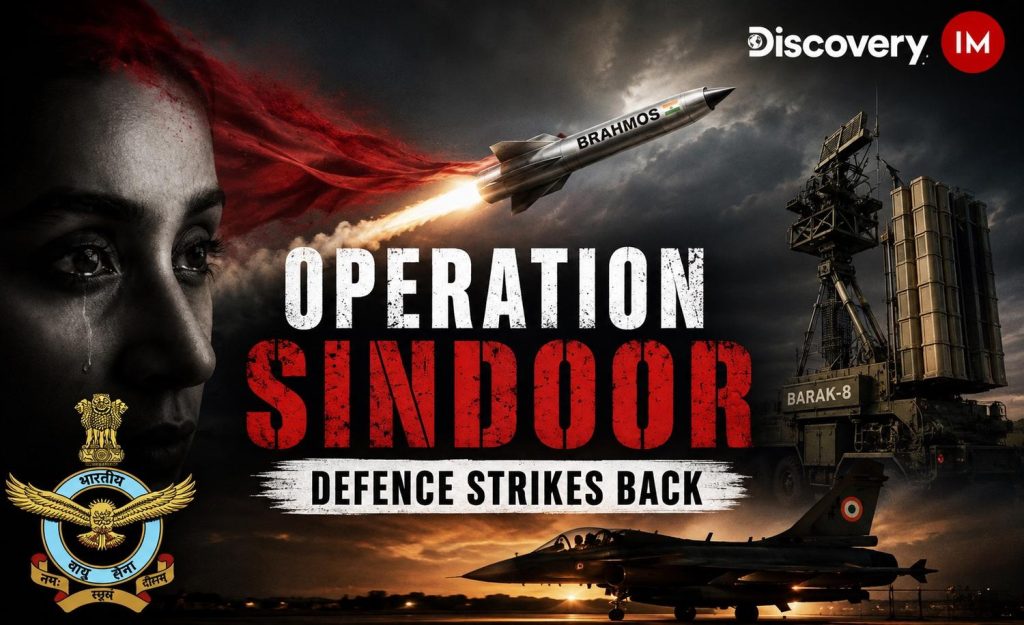
New Delhi: Pakistan’s last major offensive during Operation Sindoor involved the launch of a high-speed missile aimed at New Delhi, which was successfully intercepted by India’s Barak-8 surface-to-air missile system at Sirsa, Haryana, according to a new Discovery documentary on the 2025 India-Pakistan military confrontation.
The revelation has emerged from Declassified: Operation Sindoor, a two-part military documentary that premiered on August 15, 2026, on Discovery Channel India and the discovery+ streaming platform.
The documentary provides first-hand accounts from senior Indian military and national security officials about the 88-hour tri-services operation launched by India in May 2025 following the Pahalgam terror attack.
Pakistan Missile Targeted Delhi, Documentary Says
According to national security analyst Nitin Gokhale, Pakistan launched the high-speed missile approximately 71 hours into Operation Sindoor, with the weapon reportedly aimed at Delhi.
“At about 1:30 or 1:45, one high-speed missile was launched by Pakistan, aimed at Delhi, which was intercepted at Sirsa in Haryana,” Gokhale said in the documentary.
The interception was carried out using the Barak-8 air defence system, preventing the incoming missile from reaching its reported target.
The account provides additional details about the final phase of the military confrontation. The Ministry of Defencehad earlier stated that Pakistan’s attacks targeted Indian Air Force bases and other military installations, but had not publicly identified New Delhi as the intended target.
Read also: Operation Sindoor vs Kargil War: How Indian Air Power Evolved Over 26 Years
Interception Triggered India’s Final Retaliatory Attack
The documentary says the attempted strike on Delhi triggered what was described as India’s final retaliatory attackagainst Pakistani military infrastructure.
The Indian Air Force was given full responsibility for launching BrahMos cruise missiles against a series of Pakistani airbases.
According to Gokhale, the first phase targeted Rafiqui, Sukkur, Rahim Yar Khan and Nur Khan, while the second wave struck Sargodha, Bholari and Jacobabad.
The objective, according to Air Marshal Awadesh Bharti, was to deliver a calibrated but unmistakable message about India’s ability to strike Pakistani military targets.
“The intent was to keep it calibrated and measured and drive home a message that, look, we can hit you at will, and you have no answer to it,” Bharti said.
The documentary claims the strikes caused extensive damage to Pakistan’s air defence infrastructure, including runways, hangars and parked aircraft.
Indian Weapons Reached Their Intended Targets
The scale of the operation was also described by Air Chief Marshal AP Singh, who was Chief of the Air Staff during the operation.
According to Singh, Indian forces engaged Pakistani targets across a front extending nearly 1,200 kilometres, with strikes reaching approximately 200 kilometres inside Pakistani territory.
“Things were really happening the way we wanted it to… All our weapons were reaching the correct places,” Singh said in the documentary.
The strikes were led by high-speed BrahMos-A cruise missiles, putting significant pressure on Pakistan’s military leadership and contributing to Islamabad’s decision to seek an immediate halt to hostilities.
Pakistan Seeks Ceasefire Through Military Hotline
The documentary also provides details of how Pakistan sought an end to the escalation.
Pakistan’s Director General of Military Operations (DGMO) contacted his Indian counterpart through the established military hotline the following morning.
At the same time, Pakistan Army Chief General Asim Munir reportedly contacted then-US Secretary of State Marco Rubio, seeking Washington’s intervention to stop the rapidly escalating conflict.
Rubio subsequently spoke to India’s External Affairs Minister S. Jaishankar, conveying Pakistan’s request for the fighting to stop.
India’s then-DGMO, Lt Gen Rajiv Ghai, recalled receiving a message around 9 am local time that the Pakistani DGMO wanted to speak.
Ghai said the Ministry of External Affairs also informed him that Pakistani officials were “frantically trying to call.”
‘Now It’s Enough’: Pakistan DGMO’s Message
According to Ghai’s account, Pakistan DGMO Maj Gen Kashif Abdullah appealed for the conflict to be brought to an end.
The Pakistani military official reportedly told his Indian counterpart: “Sir, having hit so many BrahMos missiles at us, you should now be satisfied, and we can bring this to a stop.”
India eventually agreed to the request after determining that its military objectives had been achieved.
National Security Advisor Ajit Doval said Pakistan repeatedly requested a ceasefire after the damage caused by the Indian strikes.
According to Doval, India was also clear that it did not intend to prolong the confrontation.
At around 5:30 pm on May 10, 2025, both sides agreed to cease hostilities.
Operation Sindoor Followed Pahalgam Terror Attack
Declassified: Operation Sindoor traces the military campaign back to the April 22, 2025, Pahalgam terror attack, in which 26 people were killed.
The documentary says the Indian response was personally named Operation Sindoor by Prime Minister Narendra Modi and was designed to target terrorist infrastructure across the border.
India initially identified a larger list of potential targets before narrowing it down to nine high-value precision targets, including Bahawalpur, associated with Jaish-e-Mohammed, and Muridke, associated with Lashkar-e-Taiba.
The operation subsequently expanded into a wider military confrontation between the two nuclear-armed neighbours.
Documentary Features Top Indian Military Leadership
The two-part documentary features interviews with several senior Indian national security and military officials who were involved in or closely associated with Operation Sindoor.
Among those featured are NSA Ajit Doval, Chief of Defence Staff General Anil Chauhan and Chief of Naval Staff Admiral Dinesh K. Tripathi.
Their accounts cover India’s intelligence gathering, surveillance, target identification, precision strikes and the subsequent military escalation.
The series also examines the use of social media and other sources for battle-damage assessment.
According to the documentary’s account, Indian assessments indicated that more than 100 terrorists were eliminatedduring the strikes.
88-Hour Military Operation
The documentary describes Operation Sindoor as an 88-hour tri-services military operation, involving coordinated action by India’s Army, Navy and Air Force.
The campaign demonstrated India’s ability to combine intelligence, surveillance, precision weapons and air defence systems during a rapidly evolving military confrontation.
The use of the Barak-8 system to intercept the reported missile aimed at Delhi also highlights the importance of India’s layered air-defence architecture during the conflict.
Operation Ended With Calibrated Military Response
The documentary’s account portrays the final stages of Operation Sindoor as a combination of military pressure and calibrated escalation.
India responded to Pakistani attacks with increasingly powerful strikes against military infrastructure while stopping short of an open-ended conflict.
The eventual Pakistani request for a halt and the agreement to cease hostilities on May 10, 2025, brought the 88-hour confrontation to an end.
Declassified: Operation Sindoor has now provided a detailed public account of several aspects of the operation, including the reported missile attempt against Delhi, the Barak-8 interception at Sirsa and the BrahMos strikes that followed.
Read also: The Untold Story of Operation Sindoor: How ‘Ghost Targets’ May Have Fooled Chinese PL-15 Missiles