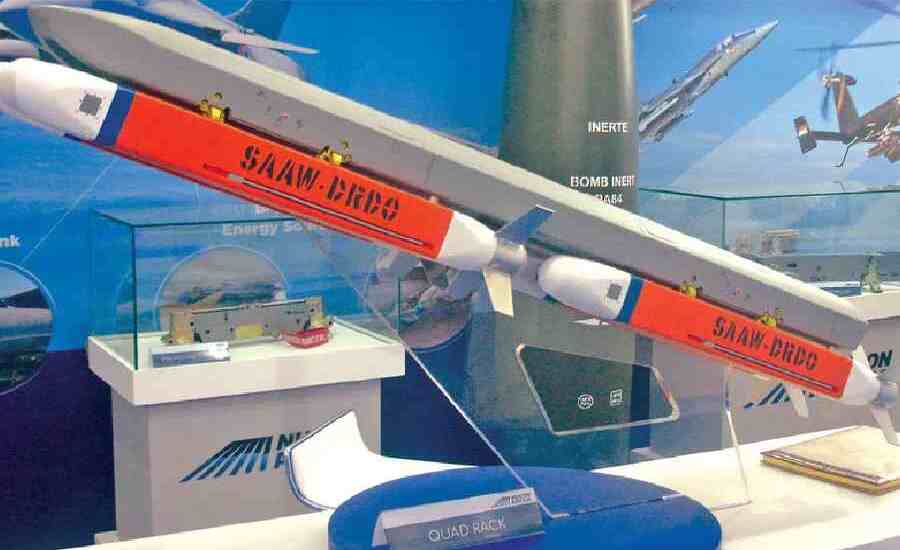
New Delhi: India has achieved a significant milestone in its precision weapons push with an upgrade to the Electro‑Optical Smart Anti‑Airfield Weapon (EO-SAAW) seeker system. Developed by Defence Research and Development Organisation (DRDO) for the Indian Air Force (IAF), the weapon now boasts advanced seeker technologies — both cooled and uncooled variants — enabling stand-off strikes against enemy runways, command nodes and hardened installations without risking aircraft in hostile airspace.
Background of EO-SAAW Seeker Technology
The EO-SAAW belongs to a new class of long-range air-launched munitions optimised to ” disable enemy runways, command centres, and hardened installations” while allowing the aircraft to release outside heavily defended zones.
In 2024, three flight tests of the seeker variant “Cooled Seeker MK-1” validated its ability to lock on to ground targets under diverse environmental conditions, combining thermal and optical imaging with inertial navigation and electro-optical targeting modules.
The current developmental push centres on the “Cooled Seeker MK-2”, with enhanced image processing, thermal management and longer seeker life. DRDO is working on a cost-effective uncooled seeker variant aimed at mass production and wider platform compatibility.
Importance of the EO-SAAW Seeker Technology
Strategic autonomy: The dual-track seeker strategy (cooled + uncooled) underlines India’s ambition for self-reliance in precision guided weapons and reduces dependence on foreign supplier kits.
Operational flexibility & reach: With a claimed engagement range of up to approximately 100 km (depending on release altitude/aircraft) the EO-SAAW can strike deep into enemy airfield/hardened target zones while the launching aircraft remains outside high risk airspace.
Force multiplier for IAF: Integration with multiple fighter platforms gives India’s air force a credible stand-off strike package, enhancing deterrence and operational depth.
Technology spill-over: Advances in seeker cooling, imaging algorithms and modular weapon design are likely to benefit other indigenous systems such as glide bombs and tactical long-range munitions.
Key Challenges to Watch
Production scalability: Moving from prototype/trial to mass production (especially of the cooled seeker variant) is a complex task that involves industrial supply-chain maturity, thermal management reliability, and quality control.
Integration across platforms: Ensuring seamless integration with IAF’s diverse aircraft fleet (Tejas, Su-30MKI, Jaguar) demands avionics adaptation, mission software updates, and flight-testing in operational envelopes.
Environmental & operational robustness: The seeker must perform reliably under hostile environments, counter-measures, high temperatures, vibrations, and high speed release. While the MK-1 trials validated some of these, the MK-2’s enhanced thermal management will be critical.
Timelines & cost-effectiveness: Balancing advanced features (cooled seeker) vs cost and maintenance burdens, while rolling out the cheaper uncooled variant, requires careful programme management.
Targeting hardened runways and installations: Enemy airfields are often heavily defended; achieving effective strike without aircraft exposure requires extremely high accuracy, robustness against anti-access / area-denial (A2/AD) threats and resilient guidance systems.
Key Implications
Regional deterrence: With this enhanced strike capability, India strengthens its deterrence posture, especially in contested air-space scenarios and in adversarial scenarios with neighbouring states.
Operational doctrine changes: The IAF may evolve its strike doctrine to emphasise stand-off airfield denial, joint missions with long-range munitions, and dynamic targeting.
Export potential: As India increasingly seeks to position itself as a defence exporter under its “Make in India” initiative, an indigenous smart weapon like EO-SAAW will have appeal to friendly countries seeking cost-competitive long-range strike capability.
Industrial growth: The dual seeker track and modular design creates opportunities for Indian industry (private companies, MSMEs) to enter the high-end sensors, imaging algorithms and precision weapons supply chain.
Technology cascade: The lessons learned in cooling systems, seeker image processing and electro-optical modules will have spill-over benefits in other domains (loitering munitions, smart bombs, missile seekers).
Way Forward
- Complete the development, testing and validation of the Cooled Seeker MK-2, including full mission-profile flight tests in realistic operational conditions.
- Ramp up production readiness, drive down unit cost, and begin induction schedules for the IAF on multiple platforms.
- Simultaneously accelerate the uncooled seeker variant to allow broader deployment and faster fielding.
- Undertake integration trials with IAF aircraft (Tejas, Su-30MKI, Jaguar) in realistic threat-environment scenarios to validate seamless release, guidance, target acquisition and terminal strike.
- Strengthen logistics, maintainability and life-cycle support frameworks for the smart weapon system — ensuring high readiness, low downtime and sustained performance.
- Focus on export certification, partner nation engagement, and offset-friendly production frameworks to leverage the weapon’s commercial potential.
- Monitor adversarial counter-measure developments, and enhance the seeker’s resistance to jammers, decoys, and evolving enemy air-defence systems.
- Facilitate further research into next-gen seekers (such as multi-spectral imaging, AI aided target recognition), greater ranges, and modular payloads to stay ahead in the precision-weapons domain.