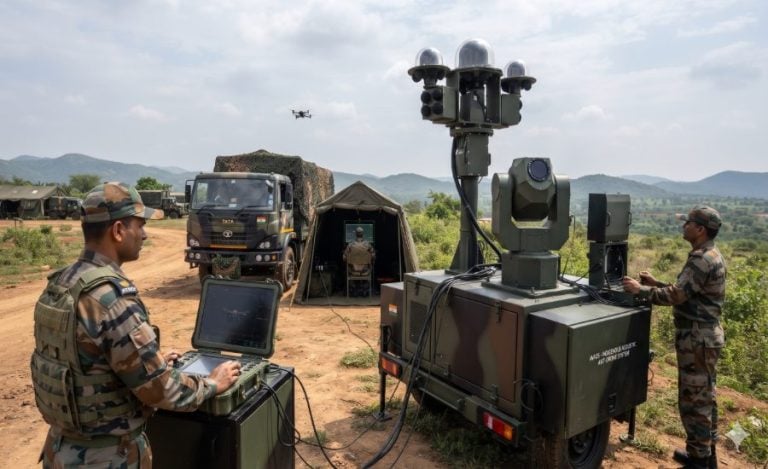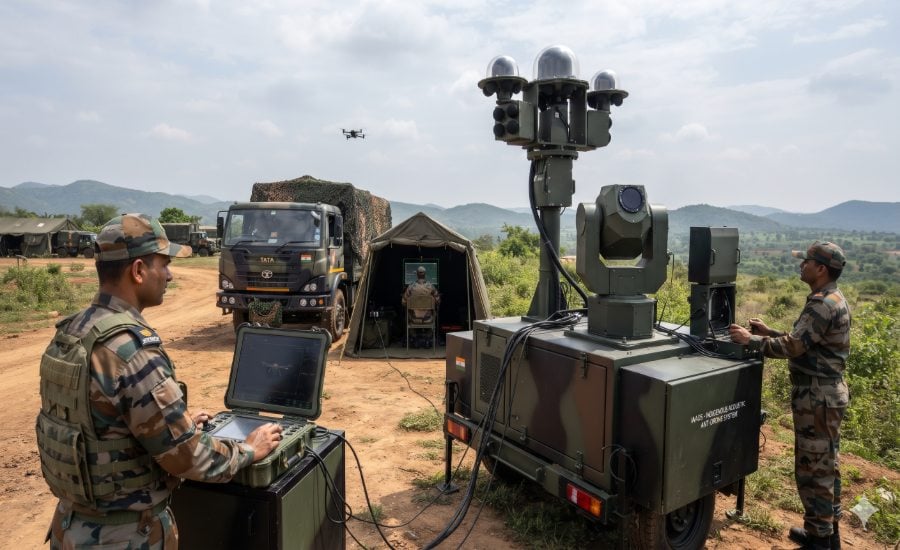
New Delhi: India is developing a new sound-based anti-drone technology to tackle the growing threat of unmanned aerial vehicles (UAVs). Scientists at the Chandigarh-based Council of Scientific and Industrial Research–Central Scientific Instruments Organisation (CSIR-CSIO) have developed an indigenous system that uses acoustic resonance to disrupt and neutralise hostile drones.
Unlike traditional anti-drone systems that depend on radio-frequency jamming or physical interception, this technology uses sound-based mechanisms to target a drone. CSIR-CSIO has also taken steps towards finding industry partners to manufacture the system on a larger scale.
What Is India’s New Sound-Based Anti-Drone Technology
The new technology is an indigenous counter-drone system developed by scientists at CSIR-CSIO, Chandigarh.
Its main purpose is to neutralise small unmanned aerial vehicles without directly hitting them with bullets, missiles or other physical weapons.
The technology is based on acoustic resonance. In simple words, it uses specially generated sound waves to affect the working of sensitive components inside a drone.
How Does The Acoustic Anti-Drone System Work
The system uses sound waves to affect the internal components of a drone. Its technology is linked to acoustic resonance, which can disturb the operation of sensitive electronic sensors.
Targeting The Drone’s Internal Sensors
Small drones use electronic sensors to understand their position, direction and movement.
One important component is the Micro-Electromechanical System (MEMS) gyroscope. It helps the drone maintain balance and remain stable while flying.
The research associated with CSIR-CSIO examines how acoustic signals can interfere with MEMS-based inertial sensors.
Creating False Sensor Readings
When targeted acoustic energy affects sensitive sensors, the sensors may produce incorrect movement or position readings.
The drone’s flight control system depends on these readings to maintain stable flight.
If the sensor information becomes unreliable, the flight controller may struggle to keep the drone balanced.
Disrupting Drone Stability
As a result of sensor disruption, the drone may lose its flight stability and become difficult to control.
This approach aims to neutralise a drone through acoustic interference rather than physically destroying it with a missile or bullet.
An Important Technical Difference: CSIR-CSIO’s work also involves identifying drones through sound signatures generated by their motors, propellers and other vibrating components. Detection and acoustic neutralisation are related but distinct functions of the technology.
Why Is Indigenous Acoustic Anti-Drone System Different From Traditional Anti-Drone Systems
Traditional counter-drone systems generally use radar, radio-frequency (RF) jammers, lasers or physical interceptors.
RF jammers attempt to interrupt communication between a drone and its remote controller. However, some modern drones can follow pre-programmed flight routes and operate with limited dependence on continuous communication with a pilot.
This creates a challenge for systems that depend only on disrupting radio signals. The CSIR-CSIO acoustic approach offers another option because it focuses on sound detection and the physical response of sensitive drone components.
What are the Advantages Of The Indigenous Acoustic Anti-Drone System
No Dependence On Radio Jamming: Acoustic detection and resonance-based disruption do not rely solely on blocking communication signals.
Non-Contact Neutralisation: The system is designed to affect drones without physically hitting them.
Indigenous Development: The technology has been developed by an Indian scientific research organisation.
Potentially Lower Operating Costs: It could reduce dependence on expensive ammunition-based interception for suitable short-range threats.
Additional Defence Layer: It can complement radar, surveillance and existing counter-drone equipment.
How Can Indigenous Acoustic Anti-Drone System Help India’s Defence Forces
The growing use of small drones has created new security challenges for military installations, border areas and important infrastructure.
Low-cost UAVs can be used for surveillance, illegal activities and other hostile operations.
India needs different types of counter-drone technologies to deal with these threats. The CSIR-CSIO system could provide another option for security agencies, particularly when dealing with small drones at short distances.
Border Security
The technology could support security personnel in detecting and responding to suspicious drones near sensitive border areas.
Military Bases
Military installations could use acoustic counter-drone systems as an additional protective layer against small UAVs.
Critical Infrastructure
Power plants, government facilities, airports and other sensitive locations could potentially benefit from additional drone protection.
Police And Paramilitary Forces
Police and paramilitary organisations could also become potential users of the technology, depending on its final operational capabilities.
What Are The Limitations Of Indigenous Acoustic Anti-Drone System
Although the technology offers a different approach to counter-drone defence, it also has some limitations.
Sound waves can be affected by environmental conditions, which may influence the system’s detection and neutralisation performance.
Some important challenges include:
Limited Range: Acoustic systems are generally more suitable for short-range operations.
Background Noise: Traffic, machinery and other environmental sounds can affect detection accuracy.
Strong Winds: Wind and changing weather conditions can influence acoustic performance.
Operational Environment: Open areas and noisy locations may create different challenges for the system.
Therefore, this technology should not be considered a complete replacement for existing air defence systems. Instead, it could work alongside radar, electronic warfare systems and other counter-drone technologies.
CSIR-CSIO Invites Industry Partners For Commercial Production
The development of this technology has now moved towards industrial collaboration. CSIR-CSIO has published an Expression of Interest (EOI) titled “Anti-Drone System for Resonance-Based Attack on UAV and Mitigating Mechanism.”
The purpose is to identify suitable industry partners who can help manufacture and commercialise the technology. The official CSIR-CSIO website listed the EOI and an extension notice in August 2026.
A related government e-procurement notice was published on March 24, 2026, showing that the organisation had started the process of seeking industry participation.
Read also: How Can This Hidden Threat Can Ruin India’s Next Gen Advanced Missile and Anti-Drone Programme
FAQs
The system uses sound signatures to detect drones and explores acoustic resonance to interfere with sensitive internal components, including MEMS-based inertial sensors. This can affect the drone’s ability to maintain stable flight.
India’s new sound-based anti-drone technology is being developed by CSIR-CSIO Chandigarh. It uses acoustic detection and resonance-based techniques to identify and disrupt small unmanned aerial vehicles.
CSIR-CSIO has initiated an industry-partner selection process for commercial production. However, wider military deployment will depend on manufacturing, further testing and operational evaluation.