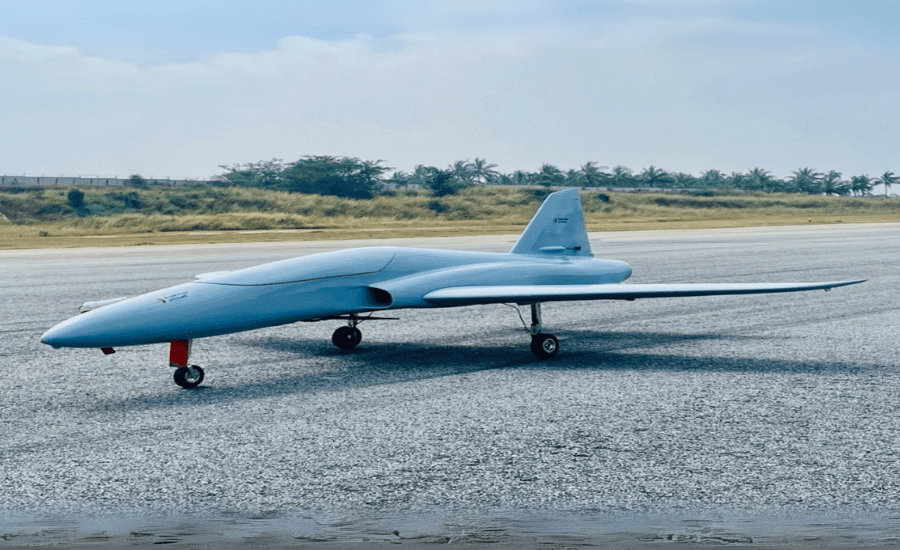
Bengaluru: In a significant move for India’s defence-tech ecosystem, Bengaluru-based Dynauton Systems — a division of Dynamatic Technologies Limited — has developed the loitering munition KAATIL.
Why KAATIL is Unique
Traditionally, loitering munitions in India and abroad have relied on propeller-driven or electric motors. KAATIL moves ahead of that curve with a mini-jet turbo engine, enabling speeds up to 600 km/h, compact size (MTOW ~12 kg, wingspan ≈2 m) and modular warhead (~1 kg).
Read Also: India Maritime Week 2025 Sets Sail for 2047 — Green Ports and Global Partnerships Take Center Stage
With battlefield dynamics shifting to fast precision strikes, electronic warfare zones, and contested GPS/GNSS environments, KAATIL’s ability to loiter for ~16 minutes, execute top-attack / side‐strike / reverse-attack modes and operate in GNSS-denied conditions positions it as a bold step in India’s strike doctrine.
Key Specifications & Capabilities of KAATIL
Weight & size: ~12 kg MTOW, ~2 m wingspan.
Propulsion & speed: Jet-powered engine enabling ~600 km/h – markedly higher than typical electric loiterers.
Payload / Warhead: Modular ~1 kg warhead configurable for anti-armour, fragmentation or shaped-charge roles.
Launch flexibility: Catapult launch or short-runway take-off, enabling forward-deployment with minimal logistics footprint.
Guidance & autonomy: Optical seeker + onboard processing allows “fire-and-forget” operation even in GNSS-denied / EW-intense zones. Circular Error Probable (CEP) reported as ~2 metres.
Attack geometries: Supports top-attack, side-strike, reverse-attack profiles to target vulnerable aspects of enemy assets.
Strategic Context: India’s Defence Landscape
India’s defence manufacturing push, led by the “Make in India” mantra, emphasises indigenously designed, developed and manufactured (IDDM) systems. With rising threats along its borders and evolving air-defence networks of adversaries, India seeks systems that are rapid-strike capable, networked, electronic-warfare resilient.
Read Also: India’s Sky Shield: IAF ASPJ Pods Procurement Enhances Su-30MKI’s Survival Edge
KAATIL fits into this paradigm as a private-sector contribution to the growing defence-drone ecosystem. Analysts point out that India’s loitering-munition architecture is becoming graduated — from low-cost infantry-portable units to heavy ISR-strike hybrids; KAATIL occupies the high-speed precision-strike tier.
Implications for India’s Defence Ecosystem
Enhanced strike capability: With jet speed and precision, KAATIL is tailor-made for high-value targets such as radars, air-defence nodes, armoured convoys, thereby raising India’s tactical and operational deterrence.
Swarm and networked operations: As India explores swarm-munition doctrines and manned–unmanned teaming, assets like KAATIL may integrate into larger clusters of autonomous loiterers, enabling distributed lethality.
Domestic manufacturing & export potential: A high-tech private-sector UAV/munition strengthens India’s IDDM pipeline, helps reduce reliance on foreign systems, and opens export avenues to friendly countries.
Battlefield relevance in contested zones: GNSS-denied capability and high speed make KAATIL suitable for electronic-warfare theatres where conventional drones face vulnerabilities.
Challenges & Outlook
Endurance trade-off: With loitering endurance around 16 minutes, KAATIL is optimised for rapid-strike rather than prolonged surveillance.
Integration & training: Effective deployment will require integration into command-and-control networks, training of operators and alignment with doctrines of autonomous strike and precision targeting.
Regulatory & export hurdles: Exporting lethal loitering munitions will involve arms-control, international regulations and geopolitical sensitivities.
Scaling & mass production: Transition from prototype to serial production, cost optimisation and supply-chain robustness will determine operational rollout pace.
Way Forward?
Dynauton Systems is expected to move from development to field trials and possible induction of KAATIL into Indian armed services in the near term.
Potential for variants → Modular warhead configurations, swarm-capable models, extended endurance versions or integration of AI-based target recognition.
Wider ecosystem effect → Other Indian drone startups and defence-manufacturing firms may build on KAATIL’s success to deliver the next generation of loitering-munitions and networked UAVs.