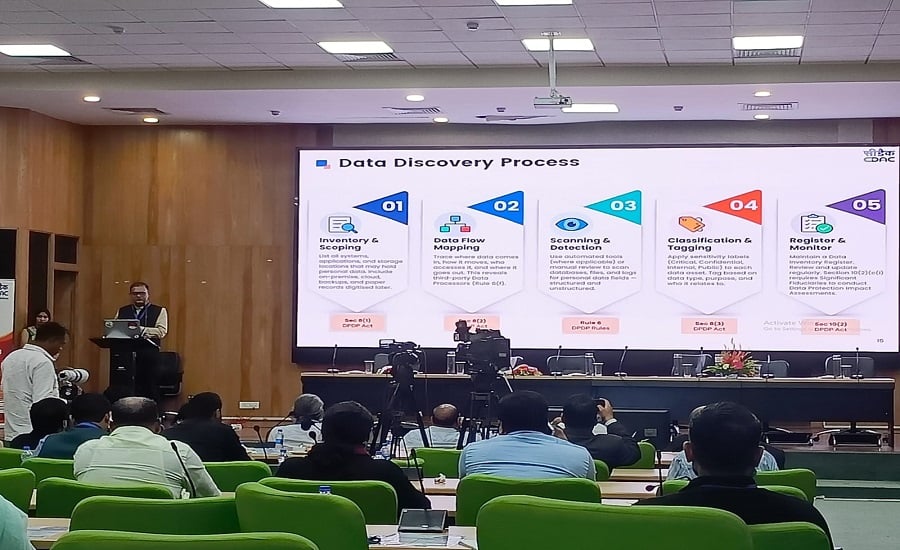
Ranchi: A workshop on the Digital Personal Data Protection (DPDP) Act, 2023 and Digital Personal Data Protection Rules, 2025 was organised at the New Auditorium in Project Bhawan, Dhurwa, Ranchi, with a focus on strengthening the protection of citizens’ personal data and privacy governance in government services.
The workshop was organised by C-DAC, Kolkata, under the Ministry of Electronics and Information Technology (MeitY), Government of India, in coordination with the Department of Information Technology and e-Governance, Government of Jharkhand.
Workshop Focuses on Data Protection and Privacy Governance
The programme focused on helping government officials understand the legal, administrative and technical aspects of protecting personal data.
With the expansion of digital governance and online public services, government departments handle increasing volumes of citizens’ personal information. The workshop highlighted the need for effective data management practices and stronger privacy safeguards.
Key areas covered during the workshop included:
- Data Fiduciary responsibilities
- Rights of Data Principals
- Consent Management
- Grievance redressal
- Data breach management
- Privacy by Design
- Data protection and legal compliance
- Cybersecurity risks associated with personal data
Read also: Jharkhand’s Ranchi Reimagined: ₹1,795 Crore Plan to Transform Key City Spaces
Government Responsible for Protecting Citizens’ Data
Addressing the workshop, IT Director Madhavi Mishra said that citizens share their personal information with the government based on trust, and protecting this trust is an important responsibility of the government.
She highlighted that the growing adoption of digital governance is also creating new challenges related to data security and privacy.
According to her, continuous training of government officials is necessary to ensure that departments understand data protection requirements, privacy safeguards and legal compliance under the evolving digital environment.
Data Fiduciary and Data Principal Rights Explained
During the workshop, experts explained the responsibilities of a Data Fiduciary and the rights available to a Data Principal.
Officials were briefed on various aspects related to personal data processing, including:
- Legal requirements related to data processing
- Obtaining and managing citizens’ consent
- Grievance redressal mechanisms
- Handling data breaches
- Measures to protect personal information
- Data management responsibilities of government departments
Experts also highlighted that as the use of digital platforms increases, the responsibility to protect personal data becomes more important.
Departments were encouraged to establish stronger security systems and clear data management processes to address potential cyber risks and data breaches.
Case Studies and Interactive Sessions Provide Practical Training
The workshop went beyond theoretical discussions and included case studies, presentations and interactive sessions to provide practical training to participating officials.
The sessions covered practical aspects of:
- Consent Management
- Data protection procedures
- Legal compliance
- Response to data breaches
- Privacy by Design
- Data policy and privacy governance
The interactive format was aimed at helping officials understand how data protection principles can be applied in government departments and digital services.
C-DAC and MeitY Experts Share Insights
Experts and senior officials from C-DAC, MeitY and various government departments participated in the workshop.
C-DAC Executive Director Mrinmoy Das and Executive Director Dr Chas Murthy, associated with Hyderabad, shared their perspectives on various aspects of data policy and privacy governance.
Dr Sandeep Chatterjee, former GC Cyber Law, MeitY, also joined the programme online and shared insights on issues related to cyber law and data protection.
The workshop brought together technical experts, senior government officials and administrative officers to discuss the implementation of data protection principles in public administration.
Strengthening Privacy in Digital Governance
The workshop highlighted the growing importance of privacy governance as government services increasingly move to digital platforms.
The discussions emphasised that effective implementation of the DPDP Act, 2023 and DPDP Rules, 2025 requires coordination between policy, technology, administration and cybersecurity practices.
Through such capacity-building initiatives, government officials can develop a better understanding of their responsibilities in handling citizens’ personal data and strengthen privacy safeguards across government services.
Read also: Karam Parv 2026: Hemant Soren Highlights Jharkhand’s Bond With Nature, Culture and Tradition