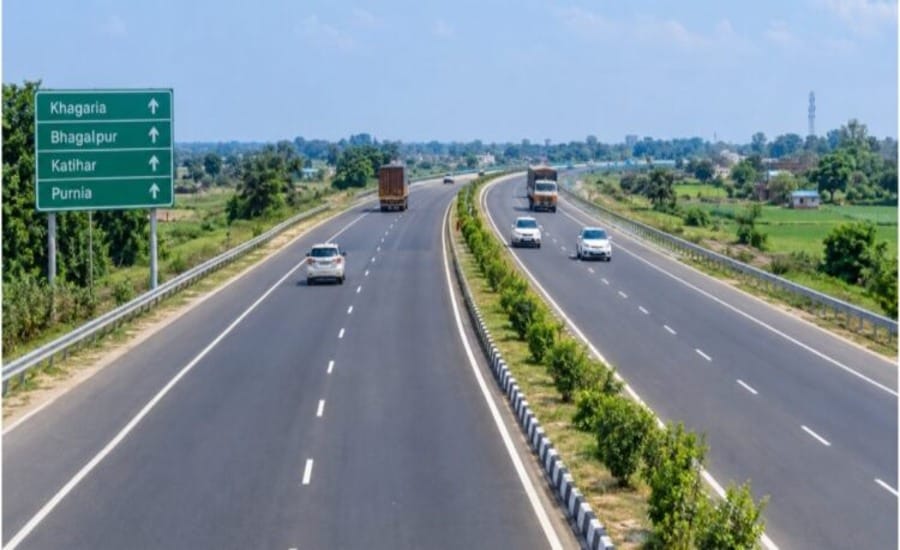
Patna: A major road infrastructure project has been approved in Bihar to upgrade the 143.529-km Khagaria-Purnia section of National Highway-31 and National Highway-231 to four lanes. The project, estimated to cost ₹3,936.05 crore, will pass through Khagaria, Bhagalpur, Katihar and Purnia districts.
Approved by the Cabinet Committee on Economic Affairs, the project will be developed under the Build-Operate-Transfer (BOT) toll model. It is designed to address sharp curves, geometric deficiencies and congestion in built-up areas along the existing corridor.
The project also includes a 6.729-km greenfield bypass for Purnia city. Together, the highway upgrade and bypass are expected to improve traffic movement, road safety and connectivity across this part of Bihar.
143-Km Corridor to Get Four-Lane Upgrade
The Khagaria-Purnia section forms an important road link between several districts in eastern and north-eastern Bihar. The approved project will upgrade the existing corridor to a four-lane standard while retaining the existing road for most of the alignment.
According to the project details, the corridor covers 143.529 km. It includes around 134.21 km of widening, a 2.59-km realignment and the 6.729-km greenfield Purnia bypass. The project also includes service roads and slip roads at different stretches.
The upgrade is aimed at improving movement through areas where traffic congestion, sharp curves and existing road limitations affect travel.
Read also: India Expands Patient-Safety Net as Centre Approves Biovigilance Programme
New Purnia Bypass to Ease City Traffic
A major component of the project is the proposed 6.729-km greenfield Purnia bypass.
The bypass is intended to provide an alternative route around Purnia city and reduce the pressure of through-traffic on the existing urban road network. This can be particularly important for passenger and freight vehicles travelling through the region.
The government expects the upgraded corridor to increase average vehicle speeds and bring travel time on the route to about two hours. It also projects improvements in fuel efficiency, vehicle operating costs and overall road safety.
Five Economic Nodes and 11 Logistics Hubs
The highway project is not limited to improving road movement between four districts. It is also designed to strengthen connections with important economic, transport and logistics locations.
The upgraded corridor will connect five PM Gati Shakti economic nodes, comprising one textile cluster, two mega food parks and two fishing and seafood parks.
It will also connect 11 logistics nodes, including four major railway stations, one airport, four national highways and two state highways.
This network is expected to support the movement of agricultural produce, industrial goods, passengers and other freight across the region.
Better Links to Highways, Railways and Airport
The four-lane corridor will connect with four major national highways — NH-27, NH-13, NH-131A and NH-231 — along with SH-95 and SH-77.
It will also improve road access to Purnia Airport and railway stations in Khagaria, Bhagalpur, Katihar and Purnia.
These links can make the corridor more useful for both local travel and longer-distance movement, particularly for businesses and freight operators using multiple modes of transport.
Push for Agriculture, Trade and Tourism
The four districts covered by the project have significant agricultural and commercial activity. Better road connectivity can help reduce travel barriers between production centres, markets, railway stations and other transport facilities.
The government has linked the project with wider socio-economic development in the region, including movement related to agriculture, trade, industry and tourism.
For farmers and businesses, improved highway connectivity can provide more direct access to markets and logistics facilities. For passengers, better road standards and reduced congestion are expected to make inter-district travel more efficient.
Employment During Construction
The project is also expected to generate employment during its construction phase.
Government estimates put the employment potential at 32.59 lakh direct person-days and 40.55 lakh indirect person-days. These figures represent the estimated volume of employment generated through the project rather than the number of individual permanent jobs.
Construction activity is expected to create work across road building, transportation, material supply, equipment operation and related services.
BOT Model for Project Development
The project will be implemented under the Build-Operate-Transfer (BOT) toll model, under which the private concessionaire develops and operates the highway for the agreed concession period before transferring it back according to the project terms.
The approved project has a total capital cost of ₹3,936.05 crore. Of this, the government project details list ₹2,467.77 crore as total civil cost and ₹290.16 crore as land acquisition cost.
The project is therefore being planned not merely as a road-widening exercise but as a larger connectivity upgrade linking major towns, highways, railway stations, an airport and economic clusters.
A Wider Connectivity Push for Bihar
The Khagaria-Purnia four-laning project is expected to strengthen road connectivity across Khagaria, Bhagalpur, Katihar and Purnia while improving links with important economic and logistics centres.
With the new Purnia bypass, four-lane upgrade and connections to multiple national and state highways, the project could provide a more efficient route for both passenger and freight movement.
For Bihar’s eastern and north-eastern districts, the focus on road connectivity, logistics and access to economic nodes gives the project significance beyond traffic improvement. It is intended to strengthen the movement of people and goods while supporting agriculture, trade, industry and tourism across the region.
Read also: ₹285 Crore Push for India’s Indigenous ePlane as Ubifly Targets TRL-9