New Delhi: The Centre is expected to announce the next Chairman of the Defence Research and Development Organisation (DRDO) shortly after the conclusion of Parliament’s Monsoon Session, with the appointment file understood to be awaiting approval from the Appointments Committee of the Cabinet (ACC). The decision will determine who leads India’s premier defence research organisation at a time when it is driving self-reliance in defence manufacturing, expanding exports and undertaking major organisational reforms.
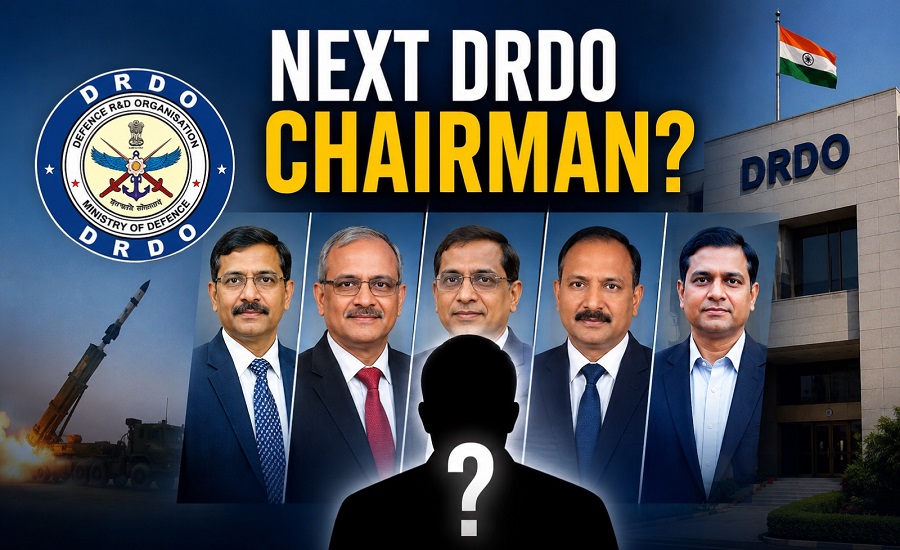
The post has remained vacant since Dr. Samir V. Kamat retired on May 31, 2026, with Defence Secretary Rajesh Kumar Singh holding additional charge in the interim. Sources indicate that the Search-cum-Selection Committee has already completed interviews of five senior DRDO scientists and forwarded its recommendations to the ACC for final approval.
Appointment Comes at a Crucial Time for DRDO
The new DRDO Chairman will take charge during one of the organisation’s most significant transformation phases.
Beyond developing strategic missile systems, electronic warfare capabilities and next-generation defence technologies, DRDO is expected to play a larger role in strengthening India’s defence manufacturing ecosystem under the Aatmanirbhar Bharat initiative. The organisation is also expanding defence exports, particularly after the successful export of the BrahMos supersonic cruise missile to Southeast Asian countries.
Equally important will be implementing structural reforms, including laboratory rationalisation, closer collaboration with private industry, greater involvement of startups, and faster transition of indigenous technologies from laboratories to production.
Read aslo: DRDO Cyber Breach: What The Defence Ministry’s Investigation Actually Found
Selection Process Already Completed
The high-powered Search-cum-Selection Committee conducted interviews for the post on July 3.
The committee comprised:
- Cabinet Secretary T.V. Somanathan
- Defence Secretary Rajesh Kumar Singh
- Principal Scientific Adviser to the Government of India Prof. Ajay Kumar Sood
- Former ISRO Chairman Dr. A.S. Kiran Kumar
According to sources, five senior DRDO scientists were interviewed, and the final recommendations have already been forwarded to the ACC.
Meet the Five Contenders
Dr. B.K. Das: Electronics and Communication Specialist
Dr. B.K. Das currently serves as Distinguished Scientist and Director General of the Electronics and Communication Systems (ECS) cluster.
Widely respected within DRDO, he has played a major role in strengthening India’s defence electronics capabilities. Earlier, he headed the Instruments Research & Development Establishment (IRDE) and the Defence Electronics Applications Laboratory (DEAL).
Over the years, he has contributed extensively to the development of advanced electro-optics, quantum communication systems, sensor technologies and passive stealth radar systems. He is also associated with promoting the Develop-cum-Production Partner (DCPP) model, which encourages private industry participation from the initial design stage itself.
His expertise in electronics, surveillance systems and defence manufacturing makes him one of the strongest contenders.
Dr. Jagannath Nayak: Missile Technology Expert
Currently heading the Missiles and Strategic Systems (MSS) cluster, Dr. Jagannath Nayak has spent more than three decades working on India’s strategic missile programmes.
An alumnus of the Indian Institute of Science (IISc), Bengaluru, he holds a Ph.D. in Electrical Communication Engineering and joined DRDO in 1992.
Among his notable contributions is the development of the Fibre Optic Gyro (FOG) guidance system used in the Akash missile programme.
He also led the successful testing of India’s first Directed Energy Weapon (DEW) anti-drone system while heading the Centre for High Energy Systems and Sciences (CHESS), a milestone that placed India among a select group of nations working on directed-energy weapons.
His vast experience in missile systems and strategic technologies makes him another leading candidate.
Anindya Biswas: Missile Guidance Specialist
Anindya Biswas, Director of the Research Centre Imarat (RCI), Hyderabad, has built his career around missile guidance, avionics and tactical electronics.
An M.Tech graduate in Electronics and Communication Engineering from IIT Kharagpur, Biswas has played an important role in indigenising several critical technologies.
Among his significant achievements is the development of miniature Terminal Guidance Systems for Anti-Tank Guided Missiles (ATGMs) and precision-guided munitions.
He received the prestigious DRDO Young Scientist Award in 2002 for his contributions to defence research.
Given RCI’s central role in India’s missile programmes, Biswas is regarded as a strong contender.
Prateek Kishore: Champion of Future Warfare Technologies
Distinguished Scientist Prateek Kishore presently heads DRDO’s Armament and Combat Engineering Systems (ACE) cluster.
He previously served as Director of the Terminal Ballistics Research Laboratory (TBRL) and also held the position of Director (Planning and Coordination) at DRDO Headquarters.
Kishore has been actively promoting emerging defence technologies including drone weaponisation, hypersonic systems, quantum materials and futuristic combat platforms.
Under his leadership, DRDO recently established the Centre for Electromagnetic Launch Technology (CEMaLT) to develop indigenous electromagnetic railgun technology.
His broad experience in armament systems and future combat technologies strengthens his candidature.
Anupam Sharma: The Strategic Projects Specialist
Among the five contenders, Anupam Sharma is perhaps the least publicly visible because of the highly classified nature of his work.
He currently heads DRDO’s Special Projects Directorate (SPS), where he oversees several strategic national security programmes.
His expertise lies in managing complex multidisciplinary engineering projects linked to advanced strategic defence platforms.
Although details of his work remain confidential, officials consider him one of DRDO’s most experienced project leaders in the strategic systems domain.
Challenges Await the Next DRDO Chief
The incoming Chairman will inherit an ambitious agenda.
Some of the major priorities include:
- Accelerating indigenous defence manufacturing under Aatmanirbhar Bharat.
- Expanding India’s defence exports.
- Strengthening partnerships with private industry, MSMEs and defence startups.
- Implementing laboratory restructuring and organisational reforms.
- Driving research in strategic missile systems, electronic warfare, unmanned platforms, artificial intelligence, quantum technologies and directed-energy weapons.
The new chief will also be expected to ensure faster conversion of DRDO research into deployable military platforms while improving collaboration with India’s armed forces and defence industry.
Delay Raises Questions
Although the tenure of a DRDO Chairman is fixed and known well in advance, the government did not appoint a successor before Dr. Samir V. Kamat retired on May 31, resulting in the organisation functioning under an interim arrangement.
Sources familiar with the process indicated that intense lobbying and the importance of the appointment may have contributed to the delay.
A similar situation had occurred in 2015, when the government took nearly four months to appoint Dr. S. Christopherafter the tenure of Dr. Avinash Chander was curtailed.
Final Decision Awaited
With interviews completed and the selection panel’s recommendations already before the ACC, the government is expected to announce the next DRDO Chairman soon after Parliament’s Monsoon Session concludes.
The appointment is expected to shape the future direction of India’s defence research ecosystem, particularly at a time when the country is focusing on technological self-reliance, expanding defence exports and developing next-generation military capabilities.