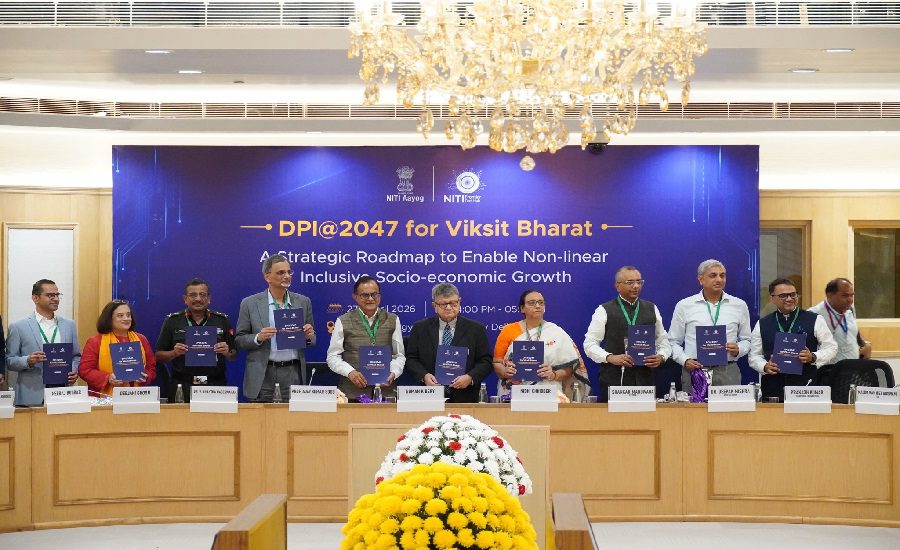
New Delhi: NITI Aayog has launched the DPI@2047 roadmap for Viksit Bharat, a strategic framework aimed at transforming India’s Digital Public Infrastructure (DPI) into a key driver of inclusive, productivity-led and large-scale economic growth.
The roadmap was unveiled on April 27, 2026, by senior dignitaries including Vice Chairman Suman Bery and Principal Scientific Adviser Prof. Ajay Kumar Sood, in the presence of top government officials, industry leaders, start-ups, and development partners.
DPI@2047 Focuses on Next Phase of Digital Transformation
The roadmap outlines India’s next phase of digital evolution, moving beyond identity, payments, and welfare systems to broader economic applications.
It emphasizes that future growth will depend not only on innovation but also on the ability to:
- Connect innovation across sectors and institutions
- Scale digital solutions at population level
- Enable faster diffusion of technology-driven services
- Strengthen digital infrastructure (“digital rails”)
Two-Phase Strategy for Digital Growth
The DPI@2047 framework is structured into two major phases:
DPI 2.0 (2025–2035)
Focused on:
- Livelihood-driven growth
- MSME and agriculture transformation
- Education and healthcare improvements
- Credit access and decentralized energy systems
DPI 3.0 (2035–2047)
Focused on:
- Broad-based prosperity
- Long-term economic transformation
- Advanced digital ecosystem integration
Eight Key Sectoral Transformations Identified
Under DPI 2.0, the roadmap identifies eight key transformation areas aimed at addressing structural challenges in:
- MSME sector
- Agriculture
- Education
- Healthcare
- Credit systems
- Energy access
- Welfare delivery systems
- Market access mechanisms
Four Execution Priorities for Implementation
To ensure effective execution, the roadmap highlights four core action areas:
- District-level demand aggregation
- Expansion of technology entrepreneurship
- Large-scale use of Artificial Intelligence (AI)
- Cross-sector digital integration using data and interoperability
AI and Digital Infrastructure at the Core of Growth Strategy
Officials stated that DPI 2.0 will extend India’s digital ecosystem beyond basic services into areas that directly impact:
- Employment and livelihoods
- Productivity enhancement
- Market connectivity for small businesses
- Large-scale AI adoption across sectors
The initiative aims to ensure that innovation reaches citizens and enterprises more efficiently through strong digital infrastructure.
Leadership Emphasises Productivity and Innovation
Vice Chairman Suman Bery stated that India’s development focus is shifting from GDP growth to productivity-led growth, where higher incomes and better living standards depend on efficiency and innovation.
Prof. Ajay Kumar Sood highlighted that India’s strength lies in combining science, innovation, and scalable digital systems to deliver trusted public outcomes.
State-Level Adoption and Inclusive Growth Strategy
NITI Aayog CEO Nidhi Chhibber emphasised that the roadmap will support states in adopting DPI-based solutions tailored to local needs.
She noted that faster state-level growth will directly contribute to national economic progress.
India Positioned for Global AI and Digital Leadership
Industry leaders highlighted that India’s Digital Public Infrastructure gives it a strategic advantage in the global AI race.
By combining:
- DPI systems
- Artificial Intelligence
- Entrepreneurship ecosystems
India can build a scalable and inclusive model of digital transformation.
About DPI@2047 Roadmap
The DPI@2047 roadmap is developed in partnership with EkStep Foundation and Deloitte. It provides a long-term vision for using Digital Public Infrastructure as a foundation for non-linear, inclusive, and productivity-driven economic growth towards Viksit Bharat 2047.
About NITI Aayog Frontier Tech Hub
The NITI Frontier Tech Hub is an initiative designed to track emerging technologies and prepare India for future economic and strategic opportunities. It works with experts from government, industry, and academia to develop long-term technology roadmaps across sectors.