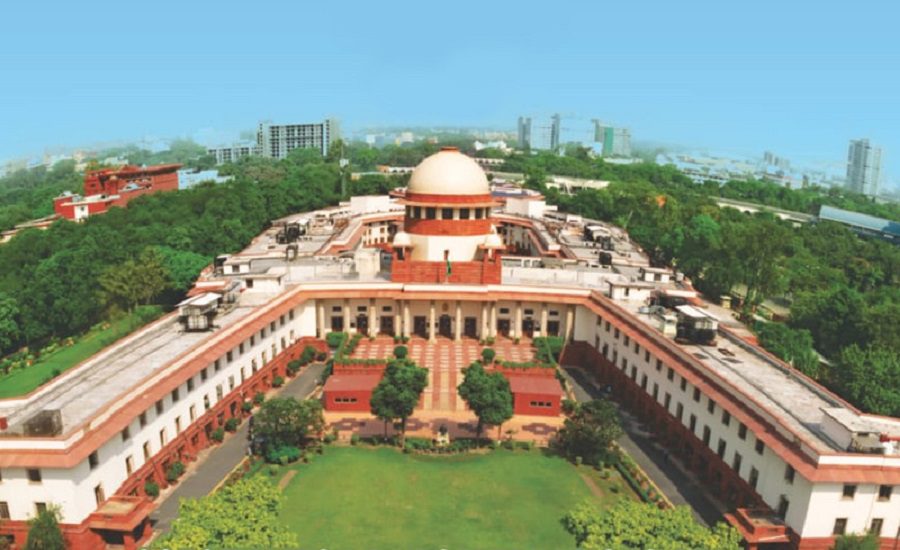
New Delhi: On August 14, the Supreme Court told the Centre that the situation in Jammu and Kashmir, including the recent Pahalgam terror attack, could not be ignored while deciding on restoring statehood to the region. The case has been adjourned for eight weeks as the Centre seeks further instructions.
A Bench of Chief Justice of India B.R. Gavai and Justice K. Vinod Chandran was hearing a plea for the restoration of J&K’s statehood. Addressing Senior Advocate Gopal Sankaranarayanan, representing the petitioners, the CJI observed: “You can’t ignore what happened in Pahalgam.”
Centre Opposes Timing of Plea, Seeks More Time
The Union government, represented by Solicitor General Tushar Mehta, opposed the plea and reminded the Court of its earlier assurance. “We assured statehood after elections. There is a peculiar position of this part of our country. I don’t know why this issue is agitated now. This particular State is not the correct State to muddy the water. I will still seek instructions. Eight weeks may be given,” Mehta told the Bench.
Sankaranarayanan argued that in 2023, when the Supreme Court upheld the abrogation of Article 370, it had accepted the Centre’s word that statehood would be restored. Because of that assurance, the Court had chosen not to decide the statehood question at that time. “The judgment had trusted the government to grant Statehood. Restoration of Statehood was to be done after elections (in J&K). It has been 21 months since that judgment…,” he said.
Petitioners Challenge Delay in Statehood Restoration
The plea was filed by Zahoor Ahmed Bhat, a college teacher, and activist Khurshid Ahmad Malik. It contends that delaying statehood is affecting the rights of the people in the region. Jammu and Kashmir was split into two Union Territories—J&K and Ladakh—in 2019 after the removal of Article 370, which had earlier given the state special status.
The petitioners believe that holding Assembly elections before granting statehood goes against the federal structure of the Constitution. This plea was filed during the Assembly elections held in the region last year. Currently, the Union Territory has a National Conference-led government supported by the Congress party and independent MLAs.
Court’s Earlier Directions and Case Timeline
In May 2024, the Supreme Court rejected review petitions against its December 2023 judgment upholding the scrapping of Article 370. In that 2023 verdict, the Constitution Bench did not rule on the validity of the 2019 law that split J&K into two Union Territories. Instead, it recorded the statement of Solicitor General Tushar Mehta that the Union Territory status of J&K was temporary and that statehood would be restored.
On August 5 this year, the Supreme Court had said it would hear a fresh application on August 8, 2025—though it was not taken up—that asked the Centre to restore J&K’s statehood within a fixed time frame. This application was part of the writ petition titled In Re: Article 370 of the Constitution, decided in December 2023 when the Court upheld the Centre’s decision to abrogate the provision.
Also Read: Supreme Court Questions NHAI’s Toll Collection Amid Neglected Paliyekkara Highway and Traffic Jams
Assurances Recorded in 2023 Judgment
Earlier, while upholding the removal of Article 370, the Court had clearly ordered: “Restoration of statehood shall take place at the earliest and as soon as possible.” This observation was based on Mehta’s assurance that the Centre intended to restore statehood to J&K, except for Ladakh.
Because of this assurance, the Court had decided it was unnecessary to rule on whether dividing the former state into two Union Territories was valid under Article 3 of the Constitution. The petitioners now point out that despite this direction, ten months have passed since the December 11, 2023 judgment and statehood has not been restored.
Plea Cites Federalism and Democracy Concerns
The plea states: “Even after passing of 10 months of the order dated 11.12.2023, till date the status of statehood of Jammu and Kashmir has not yet been restored which is gravely affecting the rights of the citizens of Jammu and Kashmir and also violating the idea of federalism.”
It also notes the recent Legislative Assembly elections in J&K after a gap of ten years, conducted in three phases to elect 90 members. The plea warns that announcing results on October 8, 2024, and forming a government before restoring full statehood would undermine democracy.
“The results of the said elections are to be pronounced on 08.10.2024. It is submitted that the formation of the Legislative Assembly before the restoration of Statehood would cause serious reduction of democratically elected government in Jammu and Kashmir causing grave violation of the idea of federalism which forms part of the basic structure of the Constitution of India…,” the plea states.
Call for Strong Federal Structure
Filed by one of the original petitioners in the Article 370 case, Zahoor Ahmad Bhat, the plea asserts that failing to promptly restore statehood undermines the federal principle: “Jammu and Kashmir being an individual state having gone through many struggles and hardships require a strong federal structure to help in developing the area and also celebrating its unique culture.”
The 2023 judgment marked a turning point in J&K’s constitutional status, holding that Article 370 was a temporary provision for transitional purposes due to war-like conditions at its introduction. The 476-page verdict upheld the validity of carving out Ladakh as a separate Union Territory under Article 3(a) and Explanation I.
Court Keeps Scope for Future Examination
In its verdict, the Constitution Bench said it was alive to the territory’s security concerns and noted that direct elections to Legislative Assemblies, a “paramount feature of representative democracy,” cannot be delayed until statehood is restored. The Bench left open the question of whether Parliament can permanently remove a state’s status by converting it into Union Territories, to be examined in a suitable future case.
It observed: “This Court… would construe the scope of powers under Article 3 in light of the historical context for the creation of federating units, and its impact on the principles of federalism and representative democracy.”
The Court also recommended creating a commission to study and report on human rights violations in Jammu and Kashmir since the 1980s.