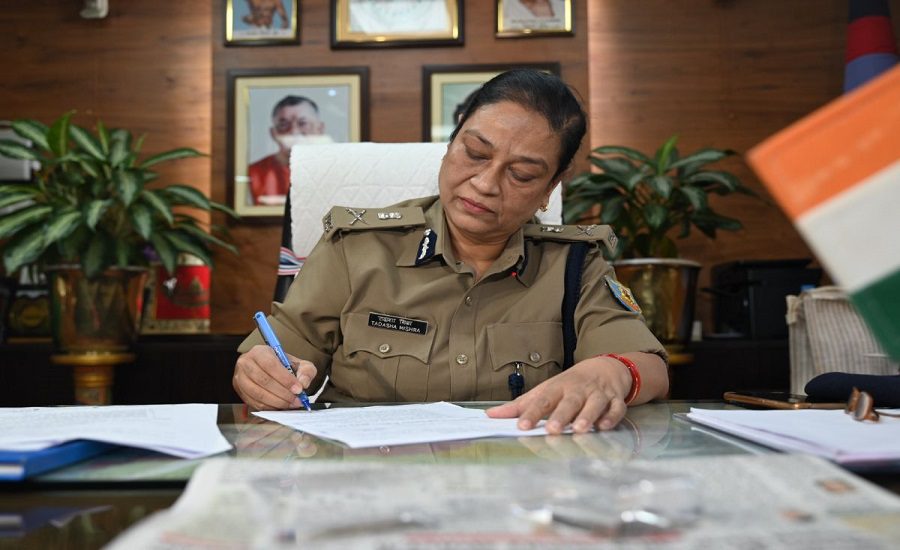
New Delhi: The Supreme Court has raised questions over the appointment of Tadasha Mishra, IPS (1994: Jharkhand), as Director General of Police (DGP) of Jharkhand, after the officer was appointed to the post just one day before her scheduled retirement.
The matter will now be heard on September 29 by a bench headed by Chief Justice of India Surya Kant. The case came up in the context of the proceedings concerning DGP appointments, including the ongoing matter relating to the appointment of the Odisha DGP.
SC Questions Appointment a Day Before Retirement
Mishra was appointed as Jharkhand DGP on December 30, 2025, while her scheduled date of retirement was December 31, 2025.
During the proceedings, the Supreme Court questioned the appointment being made just one day before her retirement. The issue is linked to the court’s earlier directions concerning the minimum residual service required for consideration for appointment as a state DGP.
The Supreme Court’s 2019 clarification in the Prakash Singh case stated that the UPSC’s recommendation and preparation of the panel for appointment as DGP should be based on merit among officers having at least six months of residual service before retirement. The court said this was intended to prevent appointments on the eve of retirement and ensure a reasonable residual tenure.
Read also: J&K DGP Pushes Technology-Enabled Policing, Reviews Kashmir Security Preparedness
Amicus Curiae Had Raised Objections
Senior advocate Raju Ramachandran, assisting the Supreme Court as amicus curiae, had earlier raised objections to Mishra’s appointment.
According to the amicus report, appointing an officer as DGP one day before retirement was inconsistent with the principles laid down by the Supreme Court in the Prakash Singh judgments, particularly the requirement relating to residual service.
The issue is part of a broader challenge concerning Jharkhand’s rules governing appointment of the Head of Police Force.
Jharkhand’s 2025 DGP Appointment Rules
The case also concerns the Selection and Appointment of Director General and Inspector General of Police, Jharkhand (Head of Police Force) Rules, 2025.
The state had framed its own rules governing the appointment process. A key issue before the Supreme Court is the amendment to Rule 5 and its implications for calculating the residual service of an officer being considered for the DGP post.
According to the proceedings reported from the court, the state government’s position was that the rules had been framed in accordance with the Supreme Court’s directions. The government also defended the amendment that enabled Mishra to be considered for the post.
Babulal Marandi Challenged the Rules and Appointment
Former Jharkhand Chief Minister and BJP leader Babulal Marandi had challenged the state’s DGP appointment rules as well as Mishra’s appointment.
The litigation questions whether the state government’s rule-making framework is consistent with the Supreme Court’s directions governing the appointment of state police chiefs.
The matter had earlier been before the Jharkhand High Court before the proceedings were brought before the Supreme Court. The challenge also raised the issue of whether the appointment process was consistent with the requirement of considering eligible officers through the prescribed mechanism.
Question Over Rule-Making Authority
Another issue raised before the Supreme Court concerns the legal basis on which Jharkhand framed its DGP appointment rules.
The court was told that the rules had been framed without a specific legislation dealing with appointment of the Head of Police Force. The state government’s position was that the rules were framed under the Police Act, 1861.
During the proceedings, a question was raised over whether the state could use that statutory framework to make rules concerning officers of the All India Services.
September 29 Hearing
The Supreme Court has now fixed September 29 for the next hearing in the Jharkhand DGP appointment matter.
The development followed proceedings in the Odisha DGP appointment case, during which Solicitor General Tushar Mehta indicated that he would present the Central Government’s position. A request was subsequently made for the Jharkhand matter to be heard on the same date, which the court accepted.
The September 29 hearing is therefore expected to further examine the legality of Mishra’s appointment, the state’s 2025 rules and their compatibility with the Supreme Court’s directions on appointment of state DGPs.
What the Prakash Singh Judgment Says
The Supreme Court’s 2019 clarification in the Prakash Singh case specifically addressed the issue of residual tenure.
The court held that recommendations for appointment as DGP should be made from among officers with at least six months of service remaining before retirement. It also explained that this requirement was intended to prevent appointments being made on the eve of retirement and to support a reasonable tenure for the officer appointed as police chief.
The Jharkhand case will now require the Supreme Court to examine how that principle applies to the state’s amended rules and the appointment of Tadasha Mishra one day before her scheduled superannuation.
Read also: Goa DGP Orders Swift Action as Fake Call Centres Resurface Across State