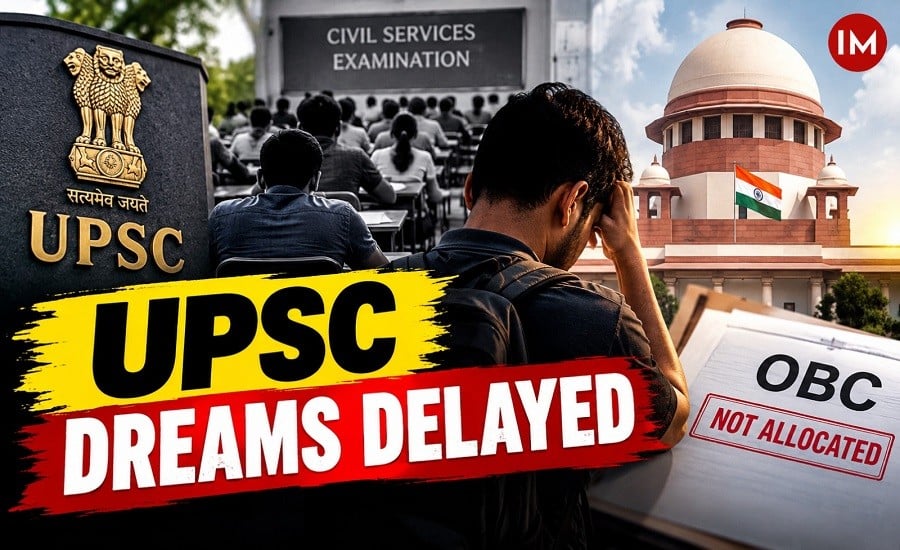
New Delhi: For a UPSC aspirant, clearing the Civil Services Examination is supposed to be the culmination of years of preparation and the beginning of a career in public service. But for a group of OBC candidates, clearing the examination did not lead to the government posting they had expected.
One such candidate, referred to as Satej in an interview with BBC Marathi, cleared the Civil Services Examination in 2022. His family and relatives celebrated the achievement, expecting that the result would soon be followed by a government appointment. But when the service allocation list was published nearly three months later, his name was missing.
The question that followed was difficult: how could a candidate who had cleared one of India’s toughest competitive examinations and had been recommended for appointment still be left without a service allocation?
Satej’s case is part of a wider dispute involving nearly 100 OBC candidates whose claims of non-creamy-layer status were rejected after their parents’ employment and income were examined under the prevailing interpretation of the creamy-layer rules.
The dispute eventually reached the Supreme Court. On March 11, 2026, in Union of India v. Rohith Nathan and others, the Court held that parental salary or income cannot, by itself, determine whether an OBC candidate falls within the creamy layer. It directed the authorities to reconsider the affected candidates’ claims in accordance with the principles laid down in the judgment and implement the decision within six months. The Court also made it clear that supernumerary posts could be created where necessary to accommodate eligible candidates.
Yet, even as the six-month implementation period approaches its September 11 deadline, the dispute has not completely ended.
Read also: UPSC Finalises 22 Recruitment Cases for July 2026 Across Government Departments
They Cleared UPSC, But the Appointment Did Not Follow
The problem faced by candidates like Satej did not arise because they failed the UPSC examination.
They had already cleared the examination and were recommended for appointment. The controversy arose at the subsequent stage of service allocation, when their OBC Non-Creamy Layer status was scrutinised.
The Supreme Court’s judgment records the cases of candidates whose parents were employed in PSUs, banks or private-sector organisations. In several such cases, the equivalence of the parents’ posts with corresponding government posts had not been formally established.
The Department of Personnel and Training subsequently applied the income/wealth test and included parental salary while determining creamy-layer status. Where the prescribed income threshold was crossed, the candidates were treated as belonging to the creamy layer and were consequently denied service allocation against OBC-reserved vacancies.
This meant that clearing the examination and securing a service allocation became two separate hurdles.
For candidates who had spent years preparing for the UPSC examination, the distinction proved consequential. They had crossed the examination barrier, but their reservation status became the reason they could not receive the service allocation they had expected.
What Exactly Was the Dispute?
At the heart of the dispute were two sets of instructions governing the determination of OBC creamy-layer status.
The original framework was contained in the DoPT’s Office Memorandum dated September 8, 1993. The framework included different categories for determining who would be excluded from OBC reservation as part of the creamy layer.
The dispute particularly concerned Category II(C), dealing with employees of public-sector undertakings, banks and similar organisations where equivalence between their posts and government posts had not been established.
The Supreme Court judgment notes that, where such equivalence had not been established, the authorities applied the income/wealth test under Category VI. Parental salary for the preceding three years was then taken into account. Candidates whose parents’ income crossed the prescribed ceiling were treated as falling within the creamy layer.
The controversy was intensified by a DoPT clarification dated October 14, 2004.
The candidates argued that the 1993 framework did not permit salary income to be treated in the manner subsequently adopted for PSU and private-sector employees. They contended that this created an unequal situation in which the children of similarly placed government and PSU/private-sector employees could be treated differently merely because their parents worked in different sectors.
Why Parents’ Employment Became Crucial
The Supreme Court proceedings highlighted the difference in treatment that could result from the interpretation of the rules.
For certain government employees, particularly those falling within specified categories, salary was not treated in the same manner for the income/wealth test. But when parents worked in PSUs, banks or private-sector organisations and equivalence of their posts with government positions had not been established, salary could become decisive under the interpretation being applied.
The Court examined whether such an approach was constitutionally sustainable.
In the Rohith Nathan case, the lead respondent had secured All India Rank 174 in CSE 2012 under the OBC category. His father worked in a private organisation, HCL Technologies, and earned above the prescribed creamy-layer limit. Rohith Nathan was nevertheless recommended by UPSC as a General Merit candidate and allocated the Indian Police Service against an unreserved vacancy. He sought the benefit of his OBC status for allocation to the Indian Foreign Service against an OBC-reserved vacancy.
Another candidate, G. Babu, had appeared in CSE 2013 and secured Rank 629. His father worked as a Senior Executive Engineer in Neyveli Lignite Corporation, a PSU. His salary exceeded the applicable limit, and he was also treated as falling within the creamy layer.
The wider batch of cases also involved candidates from CSE 2015 whose parents worked in PSUs, banks or other organisations covered under Category II(C). UPSC had recommended these candidates for service allocation, but their creamy-layer status was subsequently verified by DoPT. When parental salary was included and the prescribed ceiling was exceeded, their OBC claims were rejected and they were denied allocation under the OBC category.
What Did the Supreme Court Rule?
The Supreme Court delivered its judgment on March 11, 2026, in Union of India and Others v. Rohith Nathan and Another, Etc., along with connected matters involving Ketan and others and Dr Ibson Shah.
The Court rejected the Union government’s appeals and upheld the legal position requiring reconsideration of the candidates’ claims.
The central issue was whether salary income could be treated as a standalone basis for determining creamy-layer status in cases involving parents employed in PSUs or the private sector, particularly where equivalence with government posts had not been established.
The Court held that treating the children of PSU or private-sector employees as excluded from OBC reservation solely because of their parents’ salary, without considering the nature and status of the parents’ posts, could result in unequal treatment of similarly situated candidates.
In effect, the judgment moved the determination away from a simplistic approach in which parental salary alone became decisive.
The Court emphasised that the nature and status of the parent’s post must also be considered within the framework of the 1993 DoPT Office Memorandum.
The 1993 OM and the 2004 Clarification
The legal dispute cannot be understood without examining the relationship between the 1993 Office Memorandum and the 2004 clarification.
The Supreme Court judgment records that the CAT had held that salary and agricultural income were excluded from the income/wealth test under the 1993 OM. It also found that the 2004 clarification, insofar as it required salary income of PSU and private-sector employees to be considered under Category II(C), created unequal treatment between children of government servants and those of PSU/private-sector employees.
The Delhi High Court subsequently set aside the 2004 clarification and directed the authorities to verify the creamy-layer status of the candidates strictly under the 1993 OM. The Union government challenged that decision before the Supreme Court.
The Supreme Court’s March 2026 judgment ultimately addressed the competing interpretations and required the authorities to reconsider the affected candidates’ claims.
Court Orders Reconsideration and Supernumerary Posts
The Supreme Court did not merely clarify the legal principle.
It directed the authorities to reconsider the claims of the respondent candidates and intervenors in accordance with the principles laid down in the judgment and to implement the decision within six months from the date of the judgment.
The Court also addressed the question of candidates who would need to be accommodated if they were found eligible after reconsideration.
It recorded that the DoPT had already assured the creation of supernumerary posts and directed that such posts be created where required to accommodate candidates who satisfy the non-creamy-layer criteria, subject to their otherwise meeting the eligibility conditions.
Thus, the judgment opened a route for candidates who had been denied service allocation to have their cases reconsidered rather than simply treating the matter as a closed recruitment exercise.
Why the Creamy-Layer Rule Exists
The creamy-layer principle has its roots in the Supreme Court’s landmark judgment in Indra Sawhney v. Union of India in 1992.
The basic principle behind excluding the creamy layer is that the relatively advanced sections within the OBC category should not continue to receive reservation benefits, so that the benefits of affirmative action reach those who remain socially and educationally disadvantaged.
However, determining who falls within the creamy layer involves more than looking at a single income figure.
The framework takes into account categories based on the status of parents and, in specified circumstances, an income/wealth test. The controversy in the present case arose because the treatment of salary differed depending on the nature of the parent’s employment and whether the parent’s post had been formally equated with a government post.
The Supreme Court’s ruling therefore has implications beyond the individual candidates who were parties to the litigation. It addresses how the creamy-layer framework should be applied where parents work outside the government and their posts have not been formally assessed for equivalence.
The CSE 2025 Complication
The Supreme Court judgment also became significant for candidates from subsequent examination cycles.
UPSC declared the final result of the Civil Services Examination 2025 on March 6, 2026. The Commission’s official records show that the result was uploaded on that date.
Just five days later, on March 11, the Supreme Court delivered its judgment in Rohith Nathan.
This timing created a fresh question for the government: how should the judgment be applied to the CSE 2025 recruitment process and to candidates whose category decisions had already been made under the rules and interpretations prevailing when they applied?
The Centre has sought clarification from the Supreme Court on the application of the ruling, particularly in relation to subsequent examination cycles.
One of the government’s concerns is that candidates may have made decisions about their category and eligibility based on the prevailing rules when they applied.
Some candidates whose parents worked in PSUs or private organisations may have chosen to appear as General category candidates because they believed they would be treated as creamy layer under the then-prevailing interpretation. Others may not have claimed OBC benefits at all.
That distinction matters because OBC candidates can receive benefits beyond reservation in service allocation, including age relaxation and additional attempts under the applicable UPSC rules.
If the legal interpretation changes after an examination has been conducted, the question becomes whether candidates who did not claim OBC benefits because of the earlier understanding can subsequently seek those benefits.
The Centre has therefore approached the Supreme Court seeking clarity on the scope and application of the March judgment.
Why Candidates Are Still Waiting
For the candidates affected by the earlier interpretation, the Supreme Court judgment was a major legal victory. But a favourable judgment did not automatically put appointment letters in their hands.
Their claims still have to be examined under the principles laid down by the Court.
This is particularly significant because the Court’s direction involves reconsideration of individual claims, verification of eligibility and, where necessary, creation of supernumerary posts.
Recent reporting indicates that the government has been preparing to implement the judgment, while the Centre’s request for clarification has added another layer to the process. The six-month period prescribed by the Supreme Court runs up to September 11, 2026.
For candidates who have already waited for years, however, the issue is not simply administrative.
They have already cleared the examination that is widely regarded as one of India’s most competitive selection processes. Their names appeared among successful candidates, but their journey towards public service became entangled in the subsequent determination of their reservation status.
A Result That Did Not Become an Appointment
The story of candidates like Satej highlights a difficult gap between clearing the UPSC examination and actually entering government service.
For an aspirant, the final result is normally expected to bring closure to years of study, repeated attempts, financial sacrifices and personal uncertainty. The next step is supposed to be training and joining the service allocated to the candidate.
For those caught in the OBC creamy-layer dispute, the result instead became the beginning of another battle involving certificates, departmental scrutiny, court proceedings and questions about the interpretation of reservation rules.
The Supreme Court’s March 2026 judgment recognised that candidates could not be treated differently merely because their parents worked in the PSU or private sector when the relevant post status had not been properly considered.
But the legal victory has not yet brought an immediate end to the uncertainty.
For candidates still waiting, the question is no longer whether they can clear the Civil Services Examination. They already have.
The question is whether that achievement will finally translate into the government service for which they qualified.
Read also: UPSC Civil Services Prelims 2026: Aspirants Approach Rahul Gandhi Over Alleged Exam Irregularities