By Dr. Ramesh Pandey
For centuries, India has proudly celebrated elephants as symbols of wisdom, strength and divinity. From Lord Ganesha to royal processions and temple traditions, the animal occupies a unique place in the country’s cultural consciousness. Yet, hidden beneath this rich cultural association lies a remarkable intellectual tradition that has almost vanished from public memory.
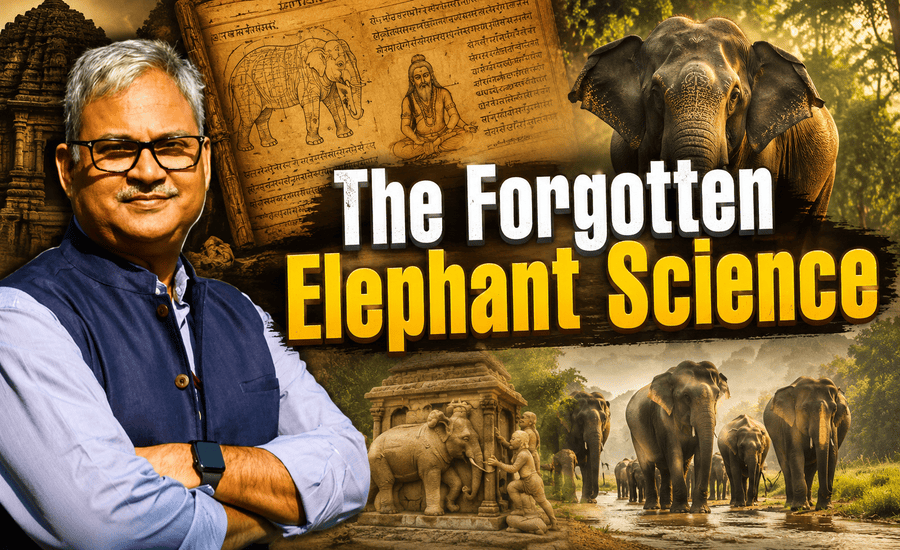
Long before wildlife biology became a recognised scientific discipline and centuries before modern conservation science developed theories on animal behaviour, welfare and ecology, Indian scholars had already produced an extraordinary body of knowledge dedicated entirely to elephants. This discipline, known as Gaja-sastra or Elephant Science, was not mythology, folklore or religious symbolism alone. It was a systematic study of elephant behaviour, ecology, veterinary medicine, psychology, capture techniques, breeding, habitat management and welfare.
Spread across nearly two thousand years, this knowledge survives in several Sanskrit treatises written by scholars, physicians, administrators and kings. Together, they reveal that ancient India did not merely admire elephants—it observed them, documented them and developed sophisticated methods to understand and manage them. Many of these observations resonate strikingly with present-day wildlife biology and conservation science.
Today, as India grapples with shrinking elephant habitats, rising human-elephant conflict and growing debates over captive elephant welfare, these forgotten texts deserve fresh attention. Not because they replace modern science, but because they demonstrate that scientific thinking has deep roots in India’s own intellectual tradition.
THE BIRTH OF ELEPHANT SCIENCE
Unlike many ancient civilisations where elephants were viewed primarily as beasts of war or royal prestige, India developed an entire branch of knowledge exclusively devoted to them. This was possible because elephants were deeply integrated into administration, warfare, forestry, transport and religious life.
Also read – A peep inside India’s boldest breeding experiment that is likely to save a species from extinction
The result was Gaja-sastra—a specialised discipline combining careful field observation, practical management and veterinary medicine. Rather than relying solely on beliefs or symbolism, these texts documented elephant anatomy, temperament, diseases, behaviour, feeding habits, capture methods and training practices.
Perhaps no other animal in the pre-modern world generated such a sustained and technically detailed body of literature over such a long period.
PALAKAPYA’S HASTYAYURVEDA: THE FOUNDATION OF ELEPHANT SCIENCE
Among the earliest and most influential works is Hastyayurveda, attributed to the sage Palakapya.
Often described as the father of Indian elephantology, Palakapya produced what can best be understood as the world’s earliest comprehensive veterinary manual devoted entirely to elephants.
The text goes far beyond treating diseases.
It classifies elephants according to their physical characteristics, regional origins and behavioural traits. It discusses feeding habits, seasonal care, housing requirements, reproduction, ageing and methods of diagnosis. Treatments include herbal medicines, surgical procedures, wound management and rehabilitation practices.
What makes Hastyayurveda particularly remarkable is its recognition that elephants are emotionally complex animals.
Palakapya repeatedly notes that elephants experience stress, grief and behavioural disturbances when removed from their natural habitats. Their physical health, he argues, cannot be separated from their mental well-being.
Modern elephant welfare science increasingly reaches similar conclusions, emphasising social bonds, freedom of movement and behavioural enrichment as essential for captive elephants. Centuries earlier, Palakapya had already recognised this intimate relationship between environment and health.
KAUTILYA’S ARTHASHASTRA: CONSERVATION AS STATE POLICY
If Hastyayurveda focused on elephant biology and medicine, Kautilya’s Arthashastra demonstrated how elephants became central to statecraft.
Written around the Mauryan period, Arthashastra reveals perhaps the earliest known example of wildlife conservation being incorporated into public administration.
Kautilya recognised elephants as strategic national assets whose survival depended on healthy forests.
Accordingly, he prescribed the creation of protected elephant forests where hunting and habitat destruction were prohibited. Officers were appointed specifically to manage elephant reserves, monitor populations and regulate capture.
Only selected elephants were permitted to be captured, while breeding populations were to remain protected.
This remarkably resembles today’s principles of sustainable wildlife management.
Rather than exploiting elephants indiscriminately, Kautilya advocated regulated extraction supported by habitat conservation—an idea central to modern conservation biology.
MATANGALILA: UNDERSTANDING ELEPHANT BEHAVIOUR
Centuries later, Nilakantha composed Matangalila, another landmark contribution to elephant science.
Unlike purely administrative texts, Matangalila explores elephant behaviour, temperament and management in extraordinary detail.
One of its most striking conservation principles concerns pregnant female elephants and mothers accompanied by calves.
The text clearly prohibits their capture, warning that doing so would bring ruin to the kingdom. It further recommends that if such elephants are accidentally captured, they should be released into forests, sacred groves or temple lands.
Although expressed through theological reasoning, the ecological wisdom behind this instruction is unmistakable.
Modern population biology recognises that elephants have one of the slowest reproductive cycles among mammals. Females carry calves for nearly two years, while the interval between births often stretches four to five years. Removing pregnant or lactating females can significantly reduce future population growth, while capturing nursing mothers often results in the death of dependent calves.
Seen through today’s scientific lens, Matangalila reflects an intuitive understanding of demographic sustainability centuries before conservation biology emerged as a formal discipline.
WHEN COMPASSION BECAME A MANAGEMENT STRATEGY
One of the most fascinating aspects of ancient Indian elephantology is that compassion was often presented not merely as an ethical ideal but as practical management.
The texts repeatedly emphasise that frightened, stressed or mistreated elephants become unpredictable, difficult to train and dangerous to handlers.
Kindness, patience and calm behaviour were therefore recommended not only because they were morally desirable but because they improved long-term performance and reliability.
This practical understanding aligns closely with contemporary animal behaviour research, which increasingly recognises that reducing stress improves welfare, health and trainability.
Ancient Indian scholars had arrived at similar conclusions entirely through observation and experience.
MANASOLLASA: WHERE SCIENCE, STATECRAFT AND ETHICS MEET
By the twelfth century, elephant science had become even more sophisticated.
King Somesvara III’s encyclopaedic work Manasollasa, also known as Abhilashitartha Chintamani, devoted an extensive section exclusively to elephants.
The treatise discusses classification based on physical features, temperament and geographical origin, enabling rulers to identify animals best suited for warfare, ceremonial functions or royal service. It also explains methods of capture, taming, feeding, housing, disease management and veterinary treatment using herbs, oils and traditional medicinal practices.
What distinguishes Manasollasa is its repeated emphasis on mental well-being.
The text advises that elephants should remain free from stress because anxiety reduces their effectiveness and makes them unstable. Calm handling, patience and respectful treatment are described as essential prerequisites for successful long-term management. Compassion, therefore, is presented not simply as virtue but as an effective management technique.
Yet Manasollasa also presents an important contradiction.
While advocating humane treatment in everyday husbandry, another section—Gajavahyali—describes methods for preparing elephants for arena sports and royal entertainment, including pharmacological techniques to induce musth before combat displays. Modern animal welfare science considers such practices highly stressful and harmful because musth is an extreme physiological condition that should not be artificially manipulated.
This duality makes Manasollasa historically significant. It reflects both the compassion and the contradictions that characterised the human-elephant relationship in ancient India.
A DISCIPLINE OF SCIENCE AND TRADITIONAL KNOWLEDGE
One of the strongest indicators that elephantology was regarded as a serious branch of knowledge in ancient India was its systematic structure. It was not merely a collection of folklore or myths but a well-organised discipline with defined classifications, terminology and practical applications. The literature reveals that scholars developed sophisticated systems to identify, understand and manage elephants based on their physical characteristics, behaviour, health and temperament.
Ancient Indian texts classified elephants into four principal breeds—Bhadra, Manda, Mrga and Sankirna. Bhadra and Manda were regarded as superior breeds, Mrga was considered comparatively inferior, while Sankirna represented mixed characteristics. This was not merely an aesthetic classification. It influenced how elephants were selected for warfare, royal duties and other specialised purposes.
The understanding went even deeper. Elephants were grouped according to their behavioural sensitivity into seven categories such as Atyarthvedi, Uttanvedi, Gambhirvedi, Mandavedi, Mriduvedi, Tikshnavedi and Chanchalvedi, reflecting varying levels of alertness, responsiveness and temperament. Modern behavioural science similarly recognises that individual elephants possess distinct personalities and behavioural traits.
Health management was equally advanced. Drawing from Ayurveda, elephant physicians interpreted diseases through the Tridosha framework of Vata, Pitta and Kapha. Balanced doshas indicated healthy elephants, while imbalances explained behavioural changes and illnesses. Although framed within Ayurvedic philosophy, the objective was practical—to understand symptoms and provide appropriate treatment.
WHEN CONSERVATION BECAME STATE POLICY
Perhaps the most remarkable aspect of ancient elephant science is that it contained principles that resonate strongly with modern wildlife conservation.
Nilkantha’s Matangalila explicitly prohibited the capture of pregnant elephants or females accompanied by calves. The text warned that doing so would bring ruin to the kingdom and recommended releasing such elephants into forests or sacred groves if captured accidentally.
Modern elephant biology fully supports this wisdom. Female elephants have one of the longest gestation periods among mammals—nearly 22 months—and usually give birth only once every four to five years. Removing pregnant or lactating females from wild populations has devastating demographic consequences because dependent calves often cannot survive without their mothers.
What ancient scholars expressed through religious or ethical language was, in reality, an early understanding of sustainable wildlife management. Conservation was embedded within everyday elephant management centuries before modern conservation biology emerged.
HASTIVIDYARNAVA: A SCIENTIFIC MANUAL WITH ILLUSTRATIONS
Among India’s great elephant treatises, the Hastividyarnava occupies a unique position because of its extensive use of illustrations. These images were not decorative embellishments. They functioned as teaching tools, helping standardise knowledge and making elephant science accessible even to people who could not read.
The manuscript combined classical knowledge from earlier works such as Gajasastra and Hastyayurveda with practical experience gathered from Assam’s unique ecological landscape. It documented forest-based elephant capture techniques, medicinal plants, anatomy, diseases, surgical instruments, harnesses and stable designs in extraordinary detail.
Equally significant was its recognition that elephant management could never follow a single universal formula. Forests differed. River systems differed. Climatic conditions differed. Consequently, methods of capture, care and rehabilitation also needed to vary according to local ecological realities. Its descriptions of marshlands, floodplains and seasonal river dynamics reflected intimate knowledge of the Brahmaputra landscape, even without explicitly naming the river.
The treatise also advocated non-violent training methods built upon trust between mahout and elephant. It cautioned against over-capturing elephants from the wild and recognised the importance of maintaining breeding populations—ideas that align remarkably well with present-day conservation ethics.
A KNOWLEDGE TRADITION UNMATCHED ANYWHERE
Taken together, Gajasastra, Hastyayurveda, Matangalila, Manasollasa and Hastividyarnava demonstrate an extraordinary level of intellectual specialisation.
Few civilisations produced such a sustained body of technical literature devoted entirely to one wild animal. Across centuries, Indian scholars documented elephant behaviour, ecology, medicine, psychology, anatomy, management, training and welfare with remarkable consistency.
According to the paper, no other animal in the pre-modern world generated such a comprehensive and technically rich knowledge tradition as elephants did in the Indian subcontinent.
NEITHER MODERN SCIENCE NOR MERE MYTH
Recognising Gaja-sastra as a scientific tradition does not imply claiming that ancient India practised science exactly as it exists today.
Like many historical knowledge systems across the world, these traditions existed alongside cosmology, astrology and customary beliefs. Elephants were deeply connected with kingdoms, religion and political authority. Yet the presence of these beliefs does not diminish the systematic observational knowledge contained within these texts.
Modern science itself evolved gradually through centuries of observation, experimentation, revision and correction. Similarly, Indian elephantology reveals careful observation, repeated verification through practice, accumulation of knowledge over generations and ethical reflection on animal welfare. These are precisely the characteristics that define scientific thinking.
WHY THIS ANCIENT SCIENCE MATTERS TODAY
The relevance of Gaja-sastra has perhaps never been greater.
Across India and other Asian elephant range countries, human-elephant conflict continues to intensify. Habitat fragmentation, climate change and expanding infrastructure are placing increasing pressure on elephant populations. Captive elephant welfare also remains an important concern.
Modern conservation increasingly emphasises behavioural understanding, stress reduction, welfare-oriented management and long-term coexistence between humans and elephants. Remarkably, these very principles find repeated expression in India’s ancient elephant literature.
The article argues that acknowledging this legacy does not require rejecting modern science or romanticising the past. Instead, it encourages integrating validated traditional ecological knowledge with contemporary scientific research.
LOOKING AHEAD
India has long been recognised globally for its wildlife conservation efforts, particularly through initiatives like Project Tiger and Project Elephant. Yet one of its greatest intellectual contributions to wildlife science remains relatively unknown.
Gaja-sastra reminds us that India once developed a remarkably sophisticated understanding of one of the world’s most intelligent mammals—not through laboratories or advanced instruments, but through centuries of careful observation, practical engagement and accumulated wisdom.
As conservation challenges become increasingly complex, these forgotten traditions offer more than historical curiosity. They provide ethical insights, behavioural understanding and ecological perspectives that can complement modern science in building better approaches to elephant conservation.
Perhaps the greatest lesson of Gaja-sastra is that conservation begins not merely with protecting animals, but with understanding them. That understanding, India realised centuries ago, is itself a science.
About the Author– (Dr. Ramesh Pandey is Additional Director General of Forests & Director, Wildlife Preservation, Ministry of Environment, Forest & Climate Change, Govt of India, New Delhi)
Also Read – The Weight We Inherit : How Gender Inequality Lives Inside Us