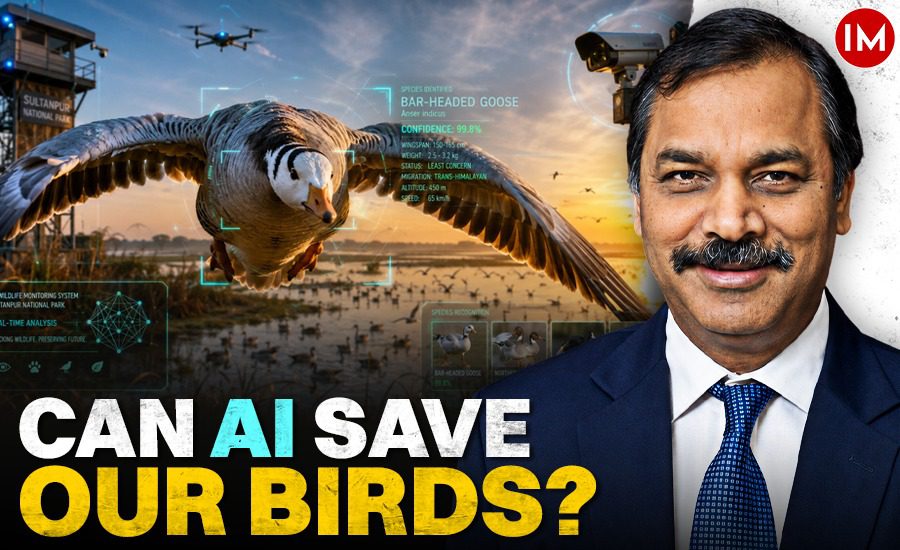
Artificial Intelligence has transformed industries ranging from healthcare to finance. Now, it is making its way into wildlife conservation. In a first-of-its-kind initiative in India, the Haryana Forest Department has begun deploying AI-enabled cameras to monitor and count birds, particularly migratory species visiting the state’s wetlands.
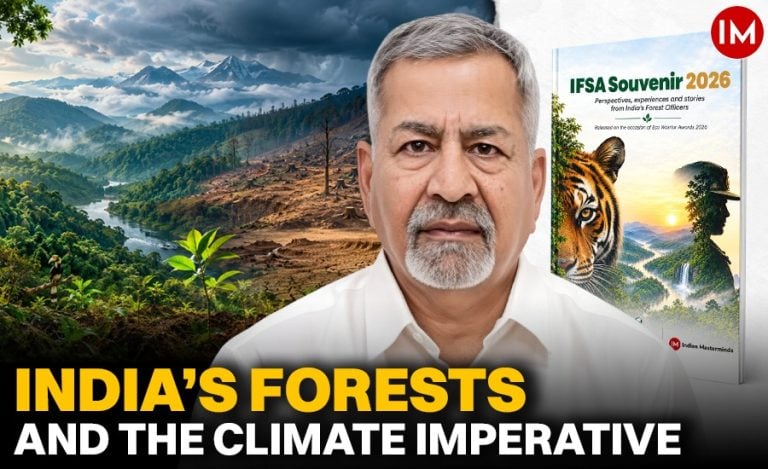
The initiative promises to revolutionise bird census methods by generating accurate, real-time data that can significantly improve conservation planning. Dr. Vivek Saxena, a 1991 batch Indian Forest Service (IFS) officer and Principal Chief Conservator of Forests and Chief Wildlife Warden, Haryana, spoke to Indian Masterminds about the project.
Please watch the full video by clicking this link…
Read Also: How A Single-Minded Devotion of Divyanshu Patel Transformed Moradabad
The project represents the natural evolution of wildlife monitoring. Just as AI-assisted camera traps have become indispensable for estimating tiger and elephant populations, similar technology can now help monitor birds that are constantly on the move, Dr Saxena said.
Unlike conventional bird censuses, where experts count birds manually at fixed locations on a designated day, the AI-based system continuously records bird activity. Strategically installed cameras capture high-resolution images, identify bird species using artificial intelligence and image-processing algorithms, and record the exact date, time and geo-location of every sighting.
According to Dr. Saxena, this continuous stream of authenticated data will prove invaluable for researchers, ornithologists and forest managers. More importantly, it will enable authorities to understand changing migration patterns and assess the ecological health of wetlands.
Haryana currently has two internationally recognised Ramsar wetlands—Sultanpur National Park and Bhindawas Wildlife Sanctuary. Every winter, thousands of migratory birds from Siberia and Central Asia arrive here to escape harsh climatic conditions. Their arrival serves as an important ecological indicator.
“The greater the diversity and number of birds, the healthier the wetland ecosystem,” Dr. Saxena explained. “If bird populations decline, it signals that habitat management requires immediate attention.”
Beyond scientific research, the initiative is expected to promote eco-tourism and public awareness. Bird enthusiasts and photographers will be able to access reliable information about the arrival of migratory species, making birdwatching more organised and rewarding. Dr. Saxena believes that this will especially encourage young people to connect with nature and develop a deeper appreciation for biodiversity.
The project also opens exciting possibilities for future research. While AI can currently identify bird species with increasing accuracy, Dr. Saxena believes advances in machine learning may eventually enable the recognition of individual birds—much like facial recognition identifies humans or stripe patterns distinguish individual tigers. Such capability could dramatically improve the understanding of migration routes, breeding behaviour and survival rates.
Although the initiative is still in its early stages, the initial results have been encouraging. AI models are successfully identifying species, while incorrect classifications are continuously being corrected through further training using larger image datasets. As the database grows, the system’s accuracy is expected to improve significantly.
Dr. Saxena estimates that nearly 250 of India’s approximately 1,000 bird species are found in Haryana. However, he cautions that bird numbers naturally fluctuate due to multiple factors, including climate change, pollution, habitat quality and weather conditions. Clean wetlands, healthy ecosystems and responsible environmental practices remain the strongest determinants of bird diversity.
He emphasised that conservation cannot be achieved by government efforts alone. Industries, businesses and citizens all have a shared responsibility to protect wetlands and prevent pollution. Migratory birds, he observed, instinctively choose habitats that are clean, safe and rich in food resources.
Dr. Saxena also expressed hope that the AI-based bird monitoring model developed in Haryana would inspire other states to adopt similar technology. Networking such systems across the country could eventually create a national database of bird movements, strengthening both conservation and scientific research.
On India’s ambitious Bonn Challenge commitments for restoring degraded landscapes, Dr. Saxena claimed that India has already made remarkable progress in ecological restoration and remains on course to achieve its international commitments well before the 2030 deadline. As artificial intelligence increasingly becomes a tool for conservation rather than merely computation, Haryana’s pioneering experiment demonstrates how technology can strengthen environmental stewardship. If replicated nationwide, AI-powered bird monitoring could become a transformative step in safeguarding India’s rich avian biodiversity for generations to come.
Read Also: Igniting National Pride Through Moradabad’s Trishul War Museum