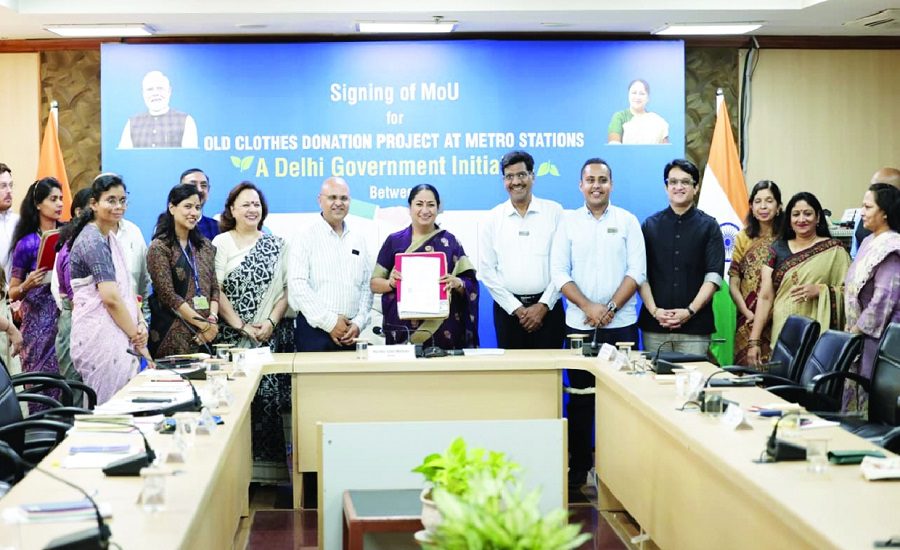
New Delhi: The Delhi Metro Rail Corporation (DMRC), in collaboration with the Delhi Government and several partner organisations, has signed a Memorandum of Understanding (MoU) to launch the Old Clothes Donation Project, a first-of-its-kind initiative aimed at promoting textile recycling, sustainable waste management, and women’s empowerment across the national capital.
The project will establish ‘Arpan’ donation centres at 10 Delhi Metro stations in its first phase, enabling commuters to donate old and unused clothes for recycling, upcycling, and responsible reuse.
MoU Signed to Promote Sustainable Textile Waste Management
The MoU was signed at the Delhi Secretariat between the Delhi Government, Delhi Livelihoods Welfare Organization (DLWO), Delhi Metro Rail Corporation (DMRC), State Urban Livelihood Mission (SULM), ReSpun, and the Clothes Box Foundation.
The agreement aims to create an organised system for collecting, sorting, recycling, and upcycling discarded clothing while reducing the amount of textile waste sent to landfills.
DMRC Managing Director Dr. Vikas Kumar and representatives from all partner organisations were present during the signing ceremony.
Read also: DMRC Launches Hydrogen-Powered Shuttle Buses at Central Vista to Promote Green Mobility in Delhi
Arpan Donation Centres to Open at 10 Metro Stations
Under the first phase, Arpan Kendras will be set up at the following 10 Delhi Metro stations:
- Shahdara
- Dr. Baba Saheb Ambedkar Hospital
- Malviya Nagar
- Hauz Khas
- Dwarka
- Mohan Estate
- Lajpat Nagar
- Mayur Vihar Phase-1
- Punjabi Bagh West
- Shalimar Bagh
The centres will operate daily from 7:00 AM to 7:00 PM, allowing commuters to conveniently donate unused clothes during their Metro journeys.
How the Old Clothes Donation Project Will Work
The donated garments will undergo a structured sorting process based on their condition.
- Wearable clothes will be upcycled into bags, garments, decorative items, and other useful products.
- Completely unusable textiles will be recycled into new yarn, fabric, and raw materials.
- Clothes used for religious rituals and sacred purposes will be respectfully reused and recycled while honouring the sentiments of donors.
The initiative aims to build a circular economy by ensuring that textiles remain in productive use instead of ending up in landfills.
Women Self-Help Groups to Drive Operations
The project is expected to generate sustainable livelihood opportunities for women.
Women from Self-Help Groups (SHGs) under the State Urban Livelihood Mission (SULM) will manage the day-to-day operations of the Arpan Kendras. They will receive specialised training in textile upcycling, enabling them to create value-added products from donated garments.
Some of the upcycled products will also be sold at Metro station kiosks, creating an income source for SHG members while promoting sustainable production practices.
Role of Partner Organisations
Each partner organisation has been assigned a specific responsibility to ensure the project’s smooth implementation.
- DLWO will coordinate among all participating organisations.
- DMRC will provide infrastructure and kiosk space at Metro stations.
- Clothes Box Foundation and ReSpun will handle the segregation, recycling, and upcycling of collected textiles.
- SULM will oversee SHG operations and provide training to women involved in the project.
This collaborative approach is expected to create an efficient and scalable textile recycling ecosystem.
Digital Donation Process for Citizens
The donation process has been designed to be completely digital and user-friendly.
Visitors to an Arpan Kendra will:
- Scan a QR code available at the kiosk.
- Enter their name, mobile number, and donation details.
- Have the donated clothes inspected and verified by SHG members.
- Receive a digital certificate immediately after donation.
- Get a shareable social media message promoting their contribution.
Each donation will be digitally mapped to the respective Metro station, allowing authorities to monitor collections in real time through a centralised dashboard.
Government Aims to Build a Cleaner and More Sustainable Delhi
The Delhi Chief Minister said the initiative would encourage citizens to actively participate in reducing textile waste while helping build a cleaner and greener city.She stated that the government is developing scientific solutions for different categories of waste and believes that systematic waste management can significantly reduce Delhi’s environmental challenges.
Why the Initiative Matters
India generates a substantial amount of textile waste every year, much of which ends up in landfills due to the lack of an organised collection and recycling system.
By placing donation centres at Delhi Metro stations, which serve millions of commuters daily, the project makes textile recycling accessible to a large urban population while promoting environmental sustainability, resource conservation, and circular economy practices.
About DMRC
The Delhi Metro Rail Corporation (DMRC) is a joint venture between the Government of India and the Government of the National Capital Territory of Delhi. Established in 1995, DMRC is responsible for planning, constructing, operating, and maintaining the Delhi Metro network. Widely recognised for its efficiency, safety, and sustainability initiatives, DMRC has played a transformative role in urban public transportation and continues to support environmentally responsible mobility solutions across India.