By Ajay Singhal, IPS, DGP, Haryana
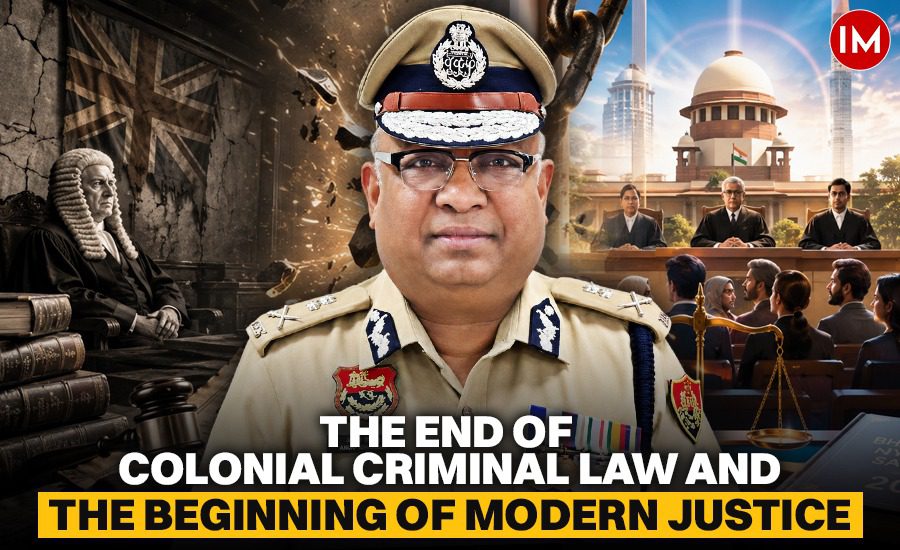
For over 160 years, India’s criminal justice system ran on colonial statutes — the Indian Penal Code of 1860, the Code of Criminal Procedure of 1898, and the Indian Evidence Act of 1872 — drafted to serve an imperial administration, not strengthen a democracy. That colonial framework has now been replaced, on 1st July 2024, by three new criminal laws — the Bharatiya Nyaya Sanhita (BNS), Bharatiya Nagarik Suraksha Sanhita (BNSS), and Bharatiya Sakshya Adhiniyam (BSA) — a decisive rewrite of criminal law since Independence.
Haryana’s journey shows what institutional will can achieve. The state has climbed from rank 12 nationally to rank 1, scoring 95.21/100, under the direction of Chief Minister Sh. Nayab Saini.
The ranking rests on four parameters: Administrative Reforms (20%), Operational Efficiency (40.21%, covering Zero FIR, 60/90-day compliance, NAFIS and e-Sakshya), ICT Applications (25%, e-Summons and Nyay Shruti), and ICJS Integration (10%). Behind it: every investigating officer retrained, mobile forensic units operational, and the I.O. Mobile Application placing the new law in every field officer’s palm.
Also Read – ‘Trinetra’ System at Mahakal Sets Benchmark for Crowd Management
Breaking Colonial Habits
I write this piece not as an administrator reciting statute numbers, but as a practitioner who has watched this transition unfold in police stations, forensic labs and courtrooms.
Colonial law maximised the state’s coercive reach; it rarely distinguished a minor lapse from a grave offence. The BNS’s introduction of community service as a sentencing option for petty offences is restorative, not retributive — keeping first-time, low-harm offenders out of an overcrowded prison system. The BNSS also removes the Victorian-era term ‘lunatic’ from procedural law, aligning it with the Mental Healthcare Act’s recognition of persons with mental illness as persons first.
Crimes the Colonial Code Never Imagined
The 1860 IPC knew no internet, no transnational crime syndicates, no trafficking networks. The BNS now names organised crime, cyber-crime, mob lynching and terrorism within the core criminal code itself, alongside trafficking and sexual assault by deceitful means — including false promises of marriage. For crimes against women and children, the law has, for the first time, consolidated them under one dedicated chapter, with penalties extending to death for the gravest offences.
Pendency: From Open-Ended Delay to a Clock
India’s pendency crisis is not abstract: 5.58 crore cases were pending as of March 2026, up roughly 30% since 2020 (India Justice Report 2025), with just 15 judges per million citizens, compared with a recommended 50. ‘Tarikh pe tarikh’ was a documentary fact, not cinema dialogue. The BNSS now imposes enforceable timelines — two-month investigations in sexual offences, 45-day judgments, 60-day framing of charges, capped adjournments — with default bail as the statutory consequence of delay. These timelines turn delay into accountability.
The Undertrial Crisis
NCRB’s Prison Statistics India 2024 shows a decade-low national occupancy of 112.7%, masking a deeper sickness: undertrials made up 73–76% of India’s 5.7-lakh prison population. In Hussainara Khatoon v. State of Bihar (1979), the Supreme Court held that a speedy trial is intrinsic to Article 21 — a right the colonial statute routinely violated. The BNSS responds by setting bounded remand through the 60/90-day chargesheet timeline, requiring mandatory release consideration under Section 479 after one-third of the sentence is served, and allowing video-conferencing for remand hearings.
From Fallible Testimony to Unimpeachable Fact
Indian prosecutions long relied on oral testimony — weak when witnesses turn hostile or forget. The BSA elevates the Rule of Best Evidence, giving structured recognition to eleven forms of evidence — oral, documentary, electronic, physical, forensic, circumstantial, hearsay, expert, judicial, extrajudicial and secondary — and making scientific, forensic and electronic evidence, including CCTV, call data and chat logs, primary rather than supplementary. The BNSS makes forensic examination mandatory for offences carrying a sentence of seven years or more; Haryana’s Mobile Forensic Units now reach the scene directly, preventing the sample degradation that once undermined DNA evidence.
From Judicial Precedent to Statutory Law
One of this reform’s quieter achievements is how much of it writes Supreme Court jurisprudence directly into statute. The arrest safeguards of D.K. Basu (1997) — memo of arrest, family intimation, right to counsel — are set out in BNSS Section 47. Likewise, Lalita Kumari v. Uttar Pradesh (2014), which made FIR registration mandatory, is now an explicit statutory rule, and Shreya Singhal v. Union of India (2015) informs the BNSS’s heightened threshold for cases involving public expression. What citizens once had to litigate for is now the law’s starting position.
Zero FIR, E-FIR and Witness Safety
Refusal of an FIR on jurisdictional grounds has long been one of policing’s most corrosive failures. Zero FIR allows a victim to register a complaint at any police station nationwide, for transfer to the jurisdictional station; in the first week of July, Haryana Police registered over 30 Zero FIRs. E-FIR extends this further, allowing certain complaints to be filed electronically — removing the excuse ‘this is not our jurisdiction’ that has long denied women and the rural poor their first point of access to justice. Alongside this, witness protection — operationalised in states like Haryana — offers secure communication channels, video-linked testimony that shields witnesses from confronting the accused, and identity protection in sensitive cases.
Hitting the Organised Criminal
Punishment stopping at the individual rarely deters the organisation. The BNS’s dedicated framework for organised crime — extortion, contract killing, cybercrime, narcotics and trafficking syndicates — instead attaches and forfeits property derived from such crimes, raising the cost of getting caught for the syndicate, not merely the foot soldier.
Technology, Paperwork and Person-Hours
The efficiency case is also measurable in rupees and litres. Haryana’s e-Challan system alone saved 6,704 reams of paper and 3.15 lakh litres of water in four months; e-Summons and video-conferencing together yielded an estimated Rs 26 crore in savings within six to seven months, with hours restored to investigation and community policing.
An Honest Reckoning
During the London riots of August 2011, those arrested were tried and convicted within a week — a functional social contract in action. India is not there yet. The lesson is clear: tools do not use themselves. Police must train for forensic-first investigation, prosecutors must build cases around the scientific record, and the judiciary must adopt the digital protocols the executive has already built.
No credible account can skip the gaps. BNSS Section 336, meant to shield public servants from routine summons, is not consistently applied. Nyay Shruti operates in only six states; in Haryana, it awaits High Court rollout. E-chargesheets and e-FIRs remain unused by most courts, and community service has been imposed in only 12 states. Even with a 22% vacancy rate across police and district judiciary, mandatory timelines remain structurally difficult to meet — a constraint no software can solve alone.
The Way Forward
Our role as police officers here is not merely administrative — it is moral. A mobile forensic unit tells the victim that their truth matters enough to be scientifically preserved; a digital chargesheet, backed by DNA and forensic reports, tells the court that the police stand for truth, not convenience. The three new laws have given us the tools; every stakeholder must now use them with the rigour justice demands.
About the Author: (Ajay Singhal is an IPS officer of the 1992 batch ( Haryana cadre). Under his leadership, Haryana has achieved the No.1 rank in India for the implementation of the three new criminal laws, as assessed by the Union Ministry of Home Affairs in June 2026 — reflected on the NCL dashboard under NCRB, MHA, GOI.)
Disclaimer– (The views and opinions expressed in this article are solely those of the author and do not necessarily reflect the views of Indian Masterminds. For feedback or queries, please write to [email protected].)
Also Read – Artificial Intelligence Needs Human Judgment, Not Blind Trust