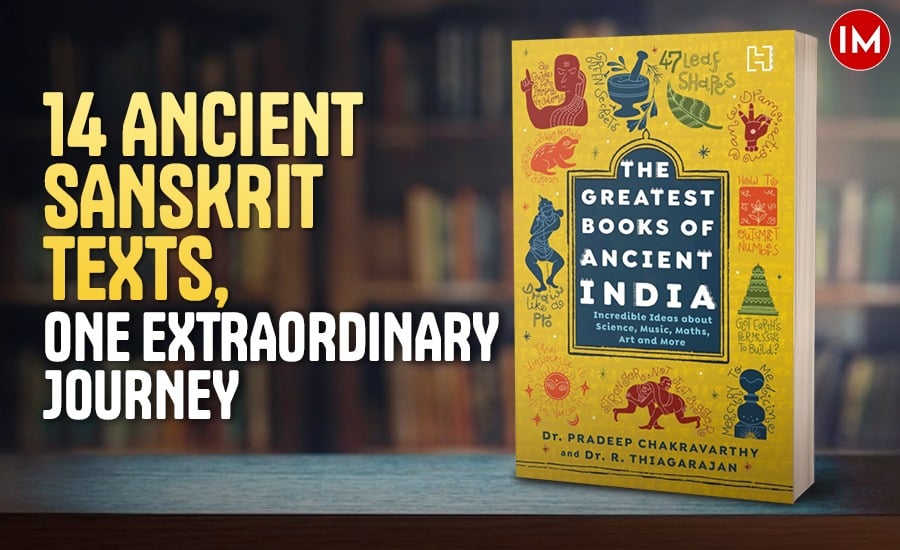
This is a fascinating book on fourteen foundational texts in Sanskrit, India’s ancient language with unique characteristics. This is a language which not only survived, but flourished in the oral tradition, and initially written in multiple scripts – Brahmi, Kharosthi, Gupta, Sharada, Gaudi, Tirhuta, Grantha, Telegu and Kannada – across the length and breadth of Bharat. When Panini and Patanjali gave the basic rules of grammar – Ashtadhayayi and Mahabhashya – respectively in the 4th and 2nd century BC, they provided the template for communication among the scholars, priests and ministers and kings of the royal courts. However Sanskrit as we know her today in the standard Devanagari format is a recent innovation. This came up in the late eighteenth century when William James established a printing press under the aegis of the Asiatic Society in Calcutta (as Kolkata was then called). When India became a Republic, it was one of fourteen languages listed in the eighth schedule. In November 2005 it received the status of a classical language. Now it is also an associate official language in two North Himalayan sates of Uttarakhand and Himachal.
Let me start with a few general comments, before we get to the review of these fourteen texts – all of which have a few things in common. They were all created in Sanskrit in different parts of India, and have covered secrets about the earth and the sky, and the entire gamut of human activity – from mathematics to astronomy, medicine, statecraft and espionage as well the social, political and natural environment.
Also Read – Operation Clawing Back: How IFS N Ravisankar Sarma Cracked a Leopard Claw Trafficking Network in Himachal
Rather than review the book on the basis of chapters as they appear, I have taken the liberty of approaching them along the historical timeline . We begin with Arthashastra (Kautilya / Chanakya), a 4th–3rd Century BCE Mauryan-era treatise on rulers and the ruled, as well as about the do’s and don’ts of a succesful ruler . In many ways, it reminded me of James Scott’s ‘Seeing like a State’, for every entry in the six thousand odd verses is a reflection on statecraft, fiscal policy, civil administration, economic regulation, trade networks, and institutional state intelligence. It was re- discovered in 1909 by Rudrapatna Shamasastry (1868-1944) when he was working on some palm leaf manuscripts at the Mysore’s Oriental Research Institute
Then we have the 3rd Century BCE Sushruta Samhita, a compendium on surgical procedures, detailing over 120 operative instruments, cataract couching, anatomical dissection, and forehead/cheek skin-flap rhinoplasty. There is an interesting box item called -The Original Indian Nose Job – which details the earliest recorded method of nose reconstruction ! Caraka Samhita came a century later . With 9,295 verses – over 300,000 words – it covers almost everything that we need to know about our bodies, starting with the Tridosa theory on the energy states of the body : the Vata ( the air element ), Kapha ( the earth element) and Pitta (the fire element ), and the need to find a balance among then.
Bharata Muni’s Natyashastra was also written around this time . It is a comprehensive manual of classical performance arts, establishing the aesthetic theory of rasa, stage design, acoustics, microtones (srutis) and body movement (mudras ) It is also called the fifth Veda ( after Rig, Sama, Yajur and Atharva). A few centuries later, in 499 of the CE, we get Aryabhata’s Aryabhatiya , a 121 verse text describing landmarks in the realm of mathematics and astronomy . It gives us an idea of the diurnal axial rotation of the Earth, scientific causes of eclipses, trigonometric sine tables, and the value of pi as 3.1416. All this came from Pataliputra, the ancient name of Patna . No wonder then that India’s first satellite was named after him.
Embedded within Vishnu Purana, a text of the 5th–7th Century CE is Chitra Sutra by Visnudharmottara Purana). Set as a conversation between king Vajra and the sage Markandeya ,this is an early Sanskrit text on painting and visual aesthetics, defining canonized body proportions ,shading, perspective, plaster preparation, and mineral pigments.
Between the 7-9th century CE, India’s super architect , Muni Maya penned 3000 aphorisms in Mayamata – a treatise on architecture (vastu sastra ) and civil engineering, outlining ground orientation via solar stylus (sanku) soil-bearing tests, and modular temple grids. The green Revolution manuals of 10th century India were called Vrksayurveda and Krsi Prasara . In the former, Surpala devotes sections to plant pathology, tree care, grafting, seed priming, and the formulation of the bio-fertilizer kunapa-jala. Prasara on the other hand , covers rainfall forecasting, water harvesting, cattle health, manure management, and seasonal rice cultivation.
King Somesvara III of the Chalukyas dynasty was a patron of liberal arts. It was during his regime that an imperial encyclopaedia Manasollasa ,‘that which makes the mind happy’ was commissioned. This 100 chapter book has entries on almost every subject under the sun – from statecraft to secular arts, culinary sciences ( paka kala) ,horticulture, cattle breeding, falconry, games, and music.
The entry on Mathematics is called Lilavati. It was written by Bhaskaracharya around 1150 CE. He was the head of the astronomical observatory in Ujjain and a top notch astronomer. This was the compilation of a father’s playful verse riddles to teach his young daughter Lilavati the nuances of arithmetic, combinations, geometry, and indeterminate equations. Addressed to a younger audience, this treatise is actually a set of four books – Lilavati, on arithmetic and geometry, Bija Ganita on algebra and Graha Ganita and Gola Adhyaya on astronomy. At a time when across the world – including many parts of India-it was not at all common for girls to be educated, here was a father who insisted that his daughter become absolutely proficient in maths .
A hundred years later, we have Sangita Ratnakar written during the reign of King Singhama of the Yadav dynasty who ruled Deva Giri ( now Daulatabad )in northern Maharashtra. It was composed by Saranga Deva, the grandson of Bhaskara who fled Kashmir to escape the invaders in the thirteenth Century CE (1210–1247. This book of seven chapters is definitive musicological bridge between ancient forms and modern Hindustani/Carnatic systems, categorizing 264 ragas and rhythmic talas .
We know of the popularity of wrestling from many of our ancient texts, including the Mahabharat . There are references to Krishna and Balarama defeating the evil king Kamsa, as well as of the duel between Bhima and Duryodhana in which the former emerges the decisive victor. All the techniques of this sport are captured in Malla Purana, a 13th Century CE Gujarati manual attributed to the Jyeshti Malla clan. It codifies wrestling styles (malla-yuddha), arena construction, physical training regimens, as well as the diets and the daily routines that budding wrestlers had to follow .
And finally, we have the 3871 verse Rasaratna-Samuccaya from the 14th Century CE. Acharya Vaga Bhata’s offering is a metallurgical compendium detailing chemical apparatus (yantras), crucibles, mercury purification (samskaras), and the pyrotechnic extraction of metallic zinc.
If all the fourteen entries were to be taken together, it would be a whopping 9,500 pages . Therefore the authors deserve our heartfelt thanks for putting this together in an easy- to- read, fun- fact filled book with multiple quizzes and challenge rounds in less than 200 pages. It is, in the language of Artha Shastra, true value for money !
Also Read – Vikas Bhi, Virasat Bhi : Narendra Modi’s Vision for a Modern and Rooted India