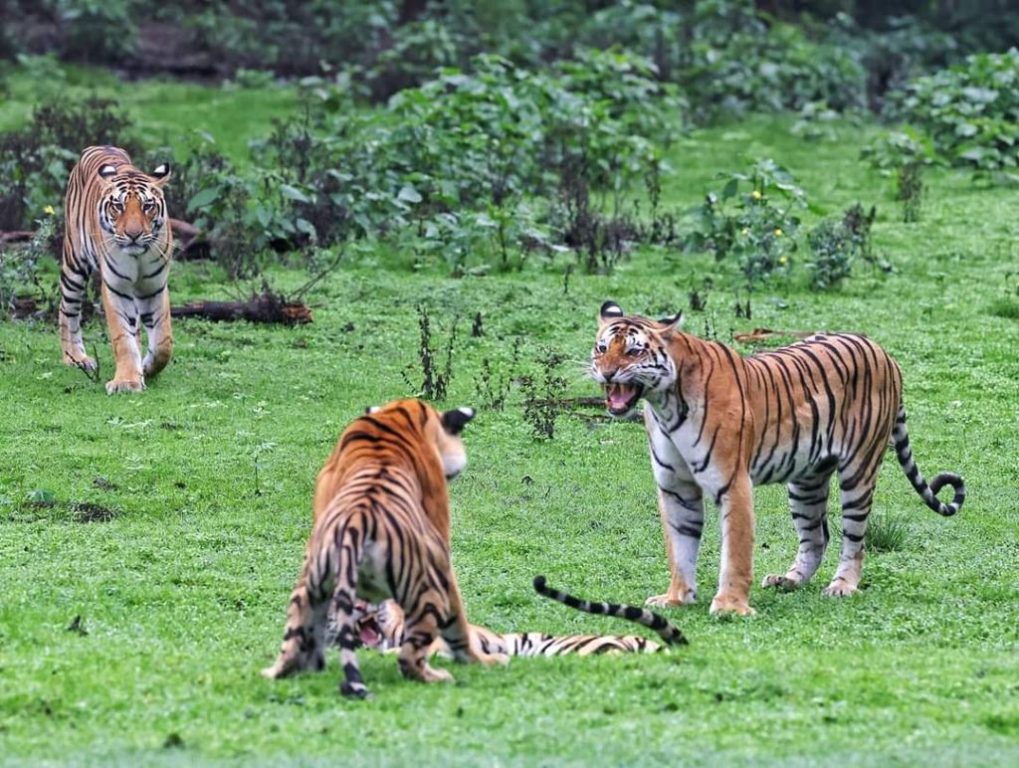
The real heroine of Vidya Balan starrer recent Bollywood blockbuster ‘Sherni’, tigress ‘Avni’ had died in a conflict with the humans in Maharashtra few years ago. Sometime later, another tigress was crushed under a tractor near Dudhwa National Park in Uttar Pradesh. Stark reality is that 490 tigers have died since 2014 in the country while 85 tigers lost their life in 2018 alone. Apart from poaching and natural reasons, man-animals conflict has also become a major cause of their deaths.
What is the major reason behind these incidents and how can they be avoided? Have tigers reached to an optimum population beyond which can’t be contained in Indian forests?
On the occasion of International Tiger’s Day, Indian Masterminds reached out to many tiger conservation experts to find out the answers.
LEGAL BACKING SINCE 2006
In the past few decades, the human population increased by many folds expanding residential and agricultural limits of tigers’ habitat. With sharp decline in dense forest cover, the tigers also started coming out into agricultural fields and human habitations. Only 1400 tigers were left on Indian soil in 2006 and after Sariska fiasco- where all tigers died or killed in Rajasthan’s Sariska Tiger Reserve, the Wildlife Conservation Act was amended to give legal backing to tiger conservation.

Now, 15 years later, the number of tigers has more than doubled. With tigers increasing in reserves, the man-animal conflicts in nearby areas are also increasing. Each tiger needs about 20 sq km area while a tigress requires at least 10 sq kms for itself. Tigers mark and guard their territory ferociously and any intrusion by another tiger results in territorial fights, injuries and often fatalities as well.
‘CONFLICTS NOT NEGATIVE INTERFACE’
The Director the National Zoological Park, Delhi Mr. Ramesh Pandey says, “Like humans, tigers also need bigger space to live. Each tiger wants their own territory, so when population increases in a certain region, the tigers start to move from their source population to sync population. Mostly, the moving ones are either a transient male who wants to have their own territory or they are the old ones who lost the territory battles with the young & strong. When they move, the conflict happens in the villages which comes in between their way”.

He also emphasizes that the conflicts are generally seen as a negative interface but it should be taken as a sign of good conservation meaning it should be treated as a signal of increasing tiger population. He feels the conflict could be minimized with professional approach.
LOT MORE TO BE DONE
“With my personal experience, I can say that by creating awareness in people about the importance of tiger reserves and changing their antagonistic approach, the conflicts could be minimized. By reducing the response during a conflict, strengthening the rescue & rehabilitation process and well-equipped team, we can not only ensure the safety of people and give safe passage to the animal as well”, said Mr. Pandey.
According to Mr. Pandey, we as a country have become leader in conserving a species with our extensive approach & protective laws. However, we have a great potential to increase the number of tigers. “Till now only Mansa tiger reserve and Pilibhit Tiger reserve is awarded with TX2 award for doubling the tigers. We have 51 tiger reserves, so many are left with the potential to increase the number of tigers by double fold. All we need to do is ensure good prey base and proper habitation”, said Mr. Pandey.
FUTURE IS OUTSIDE TIGER RESERVES

DFO, Rudraprayag Mr. Vaibhav Singh says, “The future of Tigers in India lies in forest areas outside the Tiger Reserves. In the context of Uttarakhand Forest Divisions like Lansdowne, Ramnagar, Terai have great potential for increase in Tiger population.”
Retired as Principal chief conservator Mr. ID Pandey shares a different view. He says, “When it comes to conservation of tiger one should not only focus on statistics. We should have a dynamic approach and consider all the factors including the resources & finances. If a conflict happens or a tiger deviate from its territory, the general SOP is to capture it alive and put it in a zoo or national park. In my view, we should do everything to minimize the conflict but also consider every single factor when it comes to conservation”.
Most wildlife experts however, do agree that tigers’ habitat is shrinking and there is an urgent need to expand forest cover everywhere in the country and also to convert sparse forest into dense forest so that increasing tigers population may not feel ‘thrown out of home’.