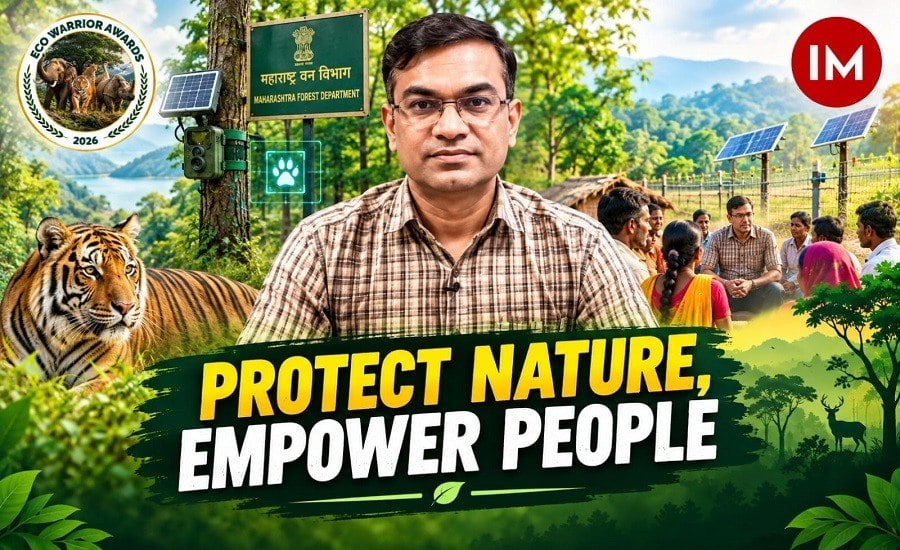
Conservation becomes truly sustainable when the protection of forests and wildlife is accompanied by opportunities for the people living around them. At the Tadoba-Andhari Tiger Reserve and in other forest landscapes where he has served, Dr. Jitendra Ramgaokar has pursued precisely this approach – using technology to prevent human-wildlife conflict, replacing dangerous farm fencing with safer solar alternatives, opening buffer areas to community-led tourism and creating livelihood opportunities for tribal youth.
His conservation journey has also extended beyond habitat management. He has led investigations into tiger poaching cases in central India, helping uncover domestic and cross-border linkages in wildlife crime networks. At Tadoba, his interventions in habitat development, fire prevention, village resettlement, conflict mitigation and tiger population management contributed to a landscape where wildlife protection and community development could advance together.
A 2006-batch Indian Forest Service (IFS) officer, Dr. Ramgaokar is currently serving as CCF (Mantralaya), Mumbai. His work has earned him the Wildlife Service Award from Sanctuary Asia in 2013 and the Gold Medal from the Government of Maharashtra for excellence in public service.
Indian Masterminds interacted with Dr. Ramgaokar to understand the thinking behind his initiatives and their impact on conservation and local communities.
How It Started: Making Communities Partners in Conservation
For Dr. Ramgaokar, conservation could not remain limited to protecting forests from outside pressures. Communities living along forest boundaries had to become stakeholders in the conservation process.
This philosophy became particularly visible through his work on nature-based tourism and livelihood generation. In areas affected by Left-Wing Extremism, including Gondia, he worked to convert degraded or underutilised natural sites into community-managed tourism destinations.
At a waterfall near Nawatola village, for instance, forest restoration was combined with tourism infrastructure and adventure activities. Through Joint Forest Management Committees (JFMCs), local youth were involved in adventure sports, mountaineering activities, guiding and handicraft-related opportunities.
The idea was simple: conservation would become more meaningful when local people could see tangible economic benefits from protecting their natural surroundings.
“If the local community gets livelihood from the forest without destroying it, the community itself becomes an important force for conservation,” Dr. Ramgaokar explained.
The approach subsequently became an important feature of his work at Tadoba as well.
Using AI to Prevent Human-Wildlife Conflict
One of the most innovative interventions associated with his tenure at Tadoba was the Human-Animal Conflict Mitigation System (HACMS), which brought artificial intelligence and computer vision into the management of wildlife movement near villages.
In collaboration with corporate partners, the reserve deployed an AI-powered video analytics platform known as Wildlife Eye. Cameras positioned along vulnerable forest edges continuously analyse live footage and identify the movement of animals such as tigers, leopards and sloth bears.
The significance of the system lies in its ability to shift conflict management from reaction to prevention.
When a potentially dangerous animal approaches a village boundary, the system can trigger local warning mechanisms, including audio alerts and hooters, while simultaneously sending notifications to quick-response forest teams.
“The objective was not simply to respond after an incident. We wanted to know about the animal’s movement early enough to warn people and give the response team time to act,” he said.
The technology-based system was subsequently highlighted by Prime Minister Narendra Modi during his Mann Ki Baat programme. It was designed to reduce the risks faced by both villagers and wildlife by creating an early-warning layer around vulnerable settlements.
Solar Fencing: Protecting Crops Without Killing Wildlife
Another major intervention focused on a less visible but potentially lethal source of conflict—the electric fencing installed around agricultural fields.
Farmers often used illegally electrified live wires to protect crops from herbivores such as wild pigs, chital and sambar. While such barriers could deter animals, they also created a serious danger to wildlife, including tigers moving through agricultural landscapes.
Dr. Ramgaokar helped shift the model from broad and hazardous community boundaries to individual, safer agricultural fencing.
Under the initiative, government-supported solar fencing kits were provided to more than 5,000 farmers living along the forest fringe.
The objective was twofold: protect standing crops while eliminating the risk posed by illegal live wires.
“We had to find a solution in which the farmer’s crop was protected without creating another danger for wildlife. Solar fencing provided that safer alternative,” Dr. Ramgaokar said.
The intervention demonstrated that human-wildlife conflict often requires solutions that address the economic concerns of communities alongside the conservation needs of animals.
Taking Tourism Beyond the Core Forest
Dr. Ramgaokar also worked to reshape the economics of ecotourism at Tadoba by expanding tourism opportunities into buffer areas.
Instead of concentrating tourism pressure and revenue within a limited part of the landscape, several safari routes were developed in buffer areas. More importantly, local communities were brought into the management and financial structure of tourism.
Village-level institutions and JFMCs were involved in activities such as gate management, vehicle operations and nature guiding. Local households were also encouraged to develop homestays.
This created a direct link between the presence of wildlife and local economic opportunity.
“Tourism should not only bring visitors into the forest. It should also create opportunities for the people living around the forest,” he explained.
The model gave villagers a greater economic stake in maintaining the landscape and supporting wildlife protection.
From Forest Protection to Tribal Employment
The livelihood dimension of his conservation philosophy was visible even before Tadoba.
In Maoist-affected areas, he used nature-based adventure tourism as an alternative livelihood strategy for tribal youth. Local young people were trained and involved in tourism-related activities, while JFMCs became platforms for community participation.
Adventure sports, nature guiding, handicrafts and tourism services generated employment while encouraging communities to view forests as productive natural assets rather than resources that had to be exploited.
The approach also carried a wider social objective: creating meaningful livelihood opportunities for young people in areas where employment options were limited.
His work in this field earned him the Arun Bongirwar Public Service Excellence Award.
Sharing Tourism Revenue With Villages
During his work involving the Melghat Tiger Reserve and Chikhaldara, Dr. Ramgaokar also supported mechanisms through which tourism revenue could flow back to local communities.
JFMCs were guided to collect a structured disturbance fee from tourist vehicles, with the revenue being channelled back to villages. The funds supported local infrastructure and employment, including opportunities for trained naturalists and certified guides.
This reflected a broader principle that runs through his conservation career: communities should not merely bear the costs of living beside protected forests; they should also participate in the benefits generated by those forests.
Gallery for a Cause: Conservation Beyond the Forest
In July 2024, the same philosophy was extended into the world of art through “Gallery for a Cause”, a digital exhibition of nature-themed artwork organised around International Tiger Day.
The initiative created an alternative fundraising avenue, with proceeds directed towards the Tadoba-Andhari Tiger Reserve Conservation Foundation for wildlife welfare and community-oriented programmes.
It represented another dimension of conservation—using public participation and creativity to generate support for wildlife protection.
A Conservation Model Built on Partnership
Dr. Ramgaokar’s career demonstrates a consistent thread: conservation is not only about protecting an animal or a forest boundary; it is also about creating conditions in which people can coexist with nature.
From AI-enabled early warnings and thermal surveillance to solar fencing, community-managed safaris, homestays, adventure tourism and village-level revenue sharing, his interventions have attempted to address conservation challenges at their source.
His work on tiger poaching investigations further adds a law-enforcement dimension to this approach, with investigations helping expose wider networks operating within India and across borders.
“Wildlife conservation cannot succeed in isolation. Technology, enforcement, habitat management and community participation have to work together,” he said.
Today, as he serves as CCF (Mantralaya), Mumbai, the central idea behind his conservation journey remains relevant across India’s forest landscapes: when communities find dignity and livelihood in protecting nature, conservation stops being only a government responsibility and becomes a shared social commitment.