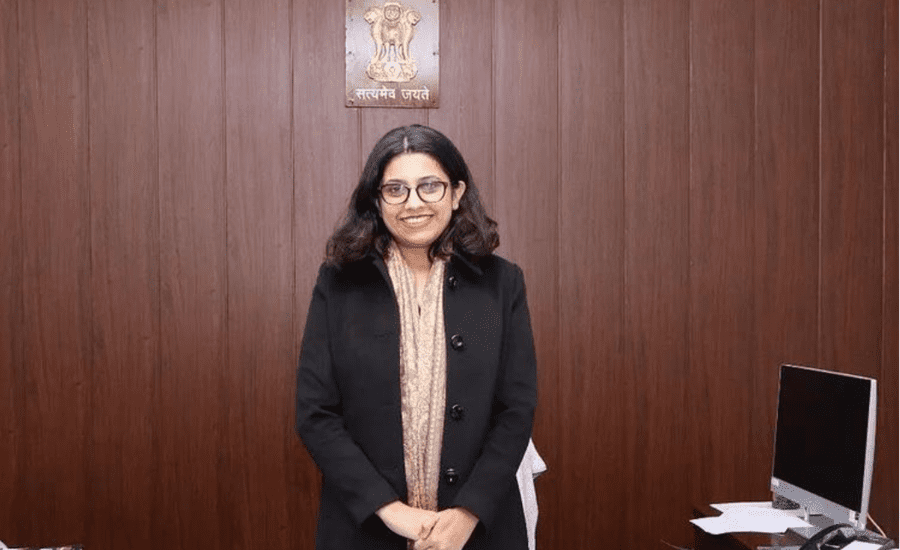
Nazuk Kumar is a 2016-batch Indian Administrative Service (IAS) officer of the AGMUT cadre whose career is an example of analytical depth, field sensitivity, and systems-driven governance. A native of Chandigarh, she secured All India Rank 58 in the UPSC Civil Services Examination (2015), along with an exceptional interview score of 209/275- among the highest that year.
An NTSE scholar and recipient of the Bal Shree Award for scientific innovation, she is a B.Tech graduate from Indian Institute of Technology Delhi with a postgraduate qualification in Public Management. Currently, she serves as Managing Director of Delhi State Industrial and Infrastructure Development Corporation Limited in New Delhi.
Early Signals of a Problem-Solver
At Carmel Convent School Chandigarh, Nazuk Kumar’s early years show distinctive inclination toward applied innovation. Rather than limiting herself to theoretical excellence, she explored real-world problem-solving through design and experimentation. Her award-winning “accident-safe car” project, featuring fatigue detection, alcohol sensing, and adaptive collision-response systems, demonstrated an advanced understanding of risk mitigation and human behaviour at a remarkably young age.
This project was not just technically impressive; it shows a systems-thinking mindset-identifying vulnerabilities, anticipating failure, and designing preventive solutions. The recognition through the Bal Shree Award, given by President of India, validated this approach, but more importantly, it foreshadowed an administrative philosophy rooted in anticipatory governance, solving problems before they escalate.
Read Also: C.V. Anand: The Cricketer Who Walked Off the Pitch to Command Telangana Police
Academic Formation: Where Engineering Meets Governance
Nazuk Kumar’s academic journey at Indian Institute of Technology Delhi extended far beyond engineering. She actively engaged in institutional life, taking on leadership roles such as publicity coordinator for Rendezvous, the institute’s flagship cultural festival. These experiences provided her with early exposure to coordination, stakeholder management, and large-scale execution, skills directly transferable to public administration.
Her engagement with public policy began through the RBI Young Scholar Program, where she studied financial inclusion in rural Haryana. Her findings highlighted a structural gap between access and usage of banking services, an insight that would later resonate with initiatives like the Pradhan Mantri Jan Dhan Yojana.
Simultaneously, her work under Sarva Shiksha Abhiyan, screening schoolchildren for vision impairments, demonstrated an early commitment to human development. These experiences collectively shaped her understanding that governance must be both data-informed and human-centric.
The UPSC Inflection Point: Clarity and Perspective
Nazuk Kumar’s success in the UPSC Civil Services Examination reflected not only academic preparation but also intellectual clarity. With Sociology as her optional subject, she approached governance through a structural and behavioural lens, recognising that policy effectiveness is deeply tied to social realities.
Her interview response, connecting Mahatma Gandhi’s principle, “an eye for an eye makes the whole world blind”, to the risks of nuclear escalation, demonstrated an ability to bridge ethical philosophy with contemporary global challenges. Her high interview score exhibits qualities that continue to define her administrative style: composure, clarity, and analytical depth.
Field Administration: From Serchhip’s Water Security to Aizawl’s Urban Governance
Nazuk Kumar’s field tenure in Mizoram stands out as a defining phase of her career. As District Commissioner of Serchhip, she addressed a complex water crisis shaped by ecological stress and changing rainfall patterns. Rather than relying solely on top-down interventions, she adopted a participatory governance model, placing community ownership at the centre of water conservation efforts.
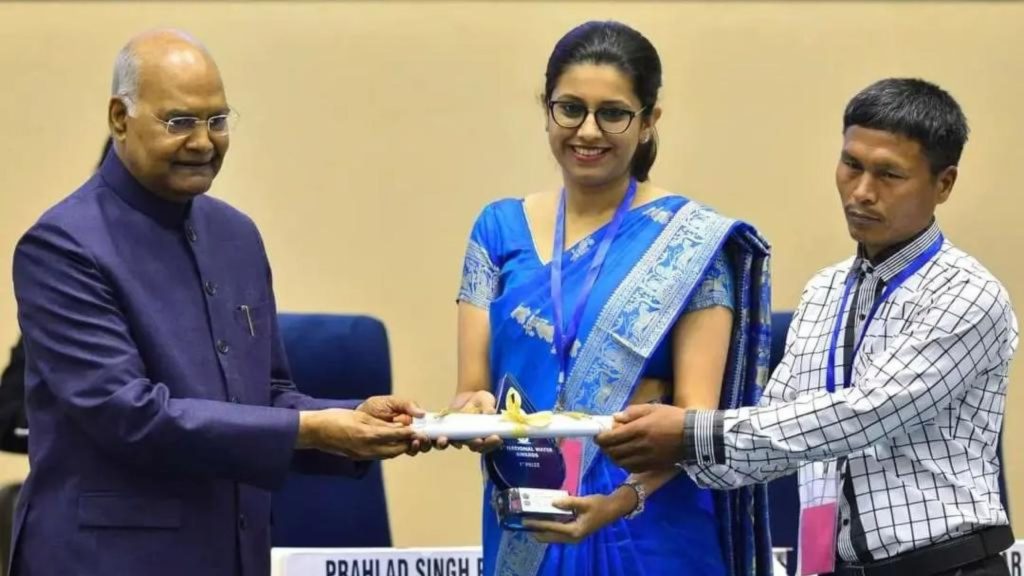
By reviving traditional systems, ensuring convergence of government schemes, and promoting behavioural change, her administration enabled sustainable water management. Villages like Leng and Sialsir receiving National Water Awards reflected not just administrative success but the effectiveness of community-driven governance.
Her subsequent role as Deputy Commissioner of Aizawl expanded her responsibilities to urban administration in a State capital, requiring a different balance of infrastructure management, service delivery, and institutional coordination. This transition highlighted her adaptability across governance contexts.
From Social Sector to Economic Governance: The DSIIDC Phase
Nazuk Kumar’s appointment as Managing Director of Delhi State Industrial and Infrastructure Development Corporation Limited marks an evolution in her administrative journey. Having assumed charge in May 2025, she now working at the intersection of industrial infrastructure, urban development, and economic policy in the national capital.
DSIIDC plays a crucial role in developing industrial estates, managing land resources, and facilitating economic activity in Delhi. Leading such an institution requires not only administrative efficiency but also strategic vision, balancing regulatory frameworks, infrastructure demands, and growth imperatives.
This transition from district-level governance and education administration to economic and infrastructure leadership underscores the breadth of her administrative capabilities. It reflects a shift from primarily social sector engagement to macro-level development planning, an evolution that positions her within the core of urban economic governance.

Leadership journey: Trust, Participation, and Institutional Depth
Nazuk Kumar’s leadership style shows a modern administrative ethos, moving beyond hierarchical authority toward collaborative governance. She emphasises consultation, encourages innovation within teams, and builds institutional trust across levels.
Her decision-making approach is deliberative, grounded in field realities and stakeholder inputs. This not only improves policy outcomes but also ensures smoother implementation. By prioritising long-term impact over short-term visibility, she aligns governance with sustainability rather than immediacy.
Across domains, whether innovation in her early years, water governance in Mizoram, education administration in Delhi, or industrial infrastructure through DSIIDC, Nazuk Kumar’s work reflects a consistent methodology: identify systemic gaps, design context-sensitive interventions, and ensure stakeholder ownership.
Reimagining Public Service
In a governance landscape increasingly shaped by speed and visibility, Nazuk Kumar’s career offers an unique example, one that prioritises depth, participation, and institutional resilience. From the classrooms of Chandigarh to the administrative landscapes of Mizoram and now the industrial framework of Delhi, her journey reflects the evolving grammar of India’s civil services.
It is a story not just of progression, but of purpose, where each role builds upon the last, and where governance is understood not merely as authority, but as the design of systems that improve lives in lasting ways.
Read Also: How DGP Ashok Tewari Is Changing Policing in Himachal-And Public Perception Too