On 24 January 1950, as India prepared to formally become a Republic, the United Provinces was renamed Uttar Pradesh. This moment marked more than an administrative transition; it symbolised the constitutional shaping of a state that would, over the decades, emerge as India’s most politically consequential and demographically significant region. With its civilisational depth, vast population, and geographic centrality, Uttar Pradesh has always occupied a unique position in India’s political, cultural, and economic imagination.
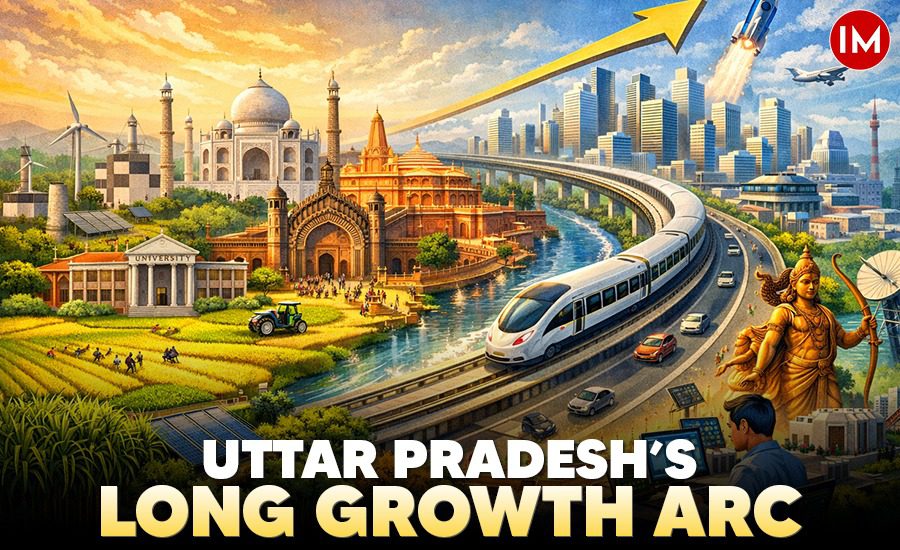
More than seven decades later, Uttar Pradesh stands at a markedly different inflection point. While the state continues to carry the weight of history and legacy challenges, its contemporary story is increasingly defined by economic scale, infrastructure-led development, improving fiscal discipline, and renewed investor confidence. Modern Uttar Pradesh is no longer viewed only through the prism of past constraints; it is steadily repositioning itself as a safer, vibrant, progressive, and increasingly prosperous growth engine of India.
HISTORICAL FOUNDATIONS: SCALE, LEADERSHIP AND COMPLEXITY
The land that constitutes present-day Uttar Pradesh has been the heartland of North Indian civilisation for millennia. Ancient settlements along the Ganga and Yamuna rivers nurtured early urban cultures, while later centuries saw the rise of powerful kingdoms, Sultanate capitals, and the Mughal Empire. Cities such as Varanasi, Prayagraj, Agra, and Lucknow became centres of religion, learning, administration, and culture.
Under British rule, the region was administered as the United Provinces of Agra and Oudh, one of the largest and most politically conscious provinces of colonial India. It produced a disproportionate number of freedom fighters, constitutional thinkers, and administrators. After Independence, Uttar Pradesh inherited both this political prominence and a formidable governance challenge: a vast agrarian population, limited industrial base, low per-capita incomes, and deeply entrenched social hierarchies.
In the decades following 1950, Uttar Pradesh shaped national politics like no other state, producing multiple Prime Ministers and influencing parliamentary arithmetic. However, development outcomes often lagged behind those of smaller, more industrialised states. Population pressure, fragmented landholdings, uneven urbanisation, and administrative overstretch slowed progress in health, education, and employment generation. The creation of Uttarakhand in 2000 reduced geographic complexity but did not fundamentally alter UP’s structural challenges.
What has changed decisively in the last decade—and accelerated in the 2020s—is the policy orientation: from welfare-heavy, consumption-led governance towards growth-led development anchored in infrastructure, industrialisation, and fiscal discipline.
MODERN UTTAR PRADESH: SCALE MEETS STRATEGY
Uttar Pradesh today ranks among India’s largest state economies. Its Gross State Domestic Product is projected at ₹30.80 lakh crore in FY26, reflecting a strong compound annual growth rate of nearly 12 per cent since FY19. This sustained momentum places the state firmly among the top three state economies in absolute size, underlining its macroeconomic heft.
Per capita income has also shown consistent improvement. Per capita GSDP reached ₹1,07,468 in FY24, growing at over 6 per cent annually since FY17. While the state still trails the national average, the trajectory reflects structural shifts away from subsistence agriculture towards services, manufacturing, logistics, and formal-sector employment. Given Uttar Pradesh’s population size, even incremental gains translate into significant national economic impact.
A defining feature of contemporary Uttar Pradesh is its improving fiscal profile. For FY26, the state is estimated to record a revenue surplus of 2.6 per cent of GSDP while maintaining its fiscal deficit at 3 per cent of GSDP, in line with FRBM norms. This balance allows the state to sustain high capital expenditure without compromising fiscal stability. Improved public finances have strengthened investor confidence and enabled long-term investments in infrastructure and social sectors.
INFRASTRUCTURE AS THE BACKBONE OF TRANSFORMATION
Perhaps the most visible symbol of modern Uttar Pradesh is its infrastructure expansion. The state now possesses the second-largest road network and the largest railway network in India. A rapidly expanding grid of access-controlled expressways has transformed inter-district connectivity, sharply reducing travel times and integrating previously remote regions into economic circuits.
This connectivity has reshaped the investment geography of the state. Industrial parks, logistics hubs, warehousing clusters, and townships are emerging along expressway corridors, allowing growth to spread beyond traditional urban centres. Tourism, agricultural supply chains, and MSME manufacturing have particularly benefited from improved transport infrastructure.
Complementing physical infrastructure is a strong push towards digital and future-ready assets. Data centres have emerged as a strategic focus area, with 644 MW of proposed capacity backed by investments exceeding ₹21,000 crore as of mid-2025. This positions Uttar Pradesh as a serious player in India’s digital economy, supporting cloud services, fintech, governance platforms, and emerging technologies.
INDUSTRY, INVESTMENT AND EXPORTS
Uttar Pradesh’s industrial strategy is increasingly corridor-based and sector-focused. The state is ranked second in Ease of Doing Business, reflecting reforms in approvals, land availability, and regulatory processes. Between April 2019 and June 2025, cumulative foreign direct investment inflows stood at over ₹17,000 crore, a significant achievement given the state’s earlier reputation as an investment laggard.
Manufacturing growth is being driven by food processing, electronics, defence production, textiles, and engineering goods, supported by a vast MSME ecosystem. Export performance has been particularly strong, with exports recording 18 per cent year-on-year growth, underlining the role of small and medium enterprises in integrating Uttar Pradesh with global markets.
AGRICULTURE: SCALE WITH VALUE ADDITION
Despite rapid industrialisation, agriculture remains central to Uttar Pradesh’s economy and social fabric. The state accounts for nearly 19 per cent of India’s total food-grain production and is a national leader in sugarcane and potato output. Policy emphasis is shifting from volume-led production to value addition through food processing, cold chains, storage infrastructure, and improved market access. This transition is critical for enhancing farm incomes and reducing vulnerability to price shocks.
TOURISM AND THE CULTURAL ECONOMY
Tourism has emerged as a significant growth driver in modern Uttar Pradesh. The state’s unparalleled cultural and spiritual heritage—spanning the Taj Mahal in Agra, the ghats of Varanasi, the confluence at Prayagraj, and the renewed urban landscape of Ayodhya—is being actively leveraged through infrastructure investment and destination development.
Improved road and rail connectivity, airport expansion, urban renewal projects, and hospitality investments are transforming tourism into a major employment generator. Religious, spiritual, heritage, and cultural tourism are increasingly linked with local livelihoods, handicrafts, services, and small businesses. The cultural economy is thus becoming an important contributor to both regional development and the state’s evolving global image.
EMPLOYMENT, SAFETY AND DEMOGRAPHIC ADVANTAGE
A safer law-and-order environment has become central to the state’s development narrative. Improvements in policing capacity, faster judicial processes, and targeted action against organised crime have contributed to better perceptions of safety—an essential precondition for investment, tourism, and urban quality of life.
Demographically, Uttar Pradesh holds one of India’s most significant advantages: around 56 per cent of its population is of working age. According to the Periodic Labour Force Survey, the unemployment rate stood at 5.7 per cent in 2018–19, with subsequent skilling initiatives aimed at aligning youth capabilities with emerging sectors such as logistics, manufacturing, construction, and digital services.
BALANCED REGIONAL DEVELOPMENT
Historically, western Uttar Pradesh has been more agriculturally productive and industrially advanced, while eastern Uttar Pradesh and Bundelkhand lagged behind. Current policy thrust emphasises spatially balanced growth, with expressways, defence corridors, industrial parks, and logistics hubs designed to integrate lagging regions into the broader growth story.
OPPORTUNITIES AND THE NEXT PHASE OF REFORM
Despite undeniable progress, Uttar Pradesh’s transformation remains a work in progress. The next phase of growth presents clear opportunities—particularly in health and education—that will determine whether economic momentum translates into sustained improvements in quality of life.
Public health infrastructure, while improving, requires continued investment in primary care, district hospitals, medical education, and preventive healthcare. Education outcomes—especially in learning levels, teacher training, and higher education capacity—need focused reform to fully harness the state’s demographic dividend. Bridging regional gaps in human development remains essential for inclusive growth.
Equally important is the need to balance rapid infrastructure expansion with environmental sustainability and efficient land use, particularly in riverine and agrarian regions.
CONCLUSION
From its constitutional birth in January 1950 to its present-day transformation, Uttar Pradesh’s journey mirrors India’s own evolution—complex, layered, and increasingly aspirational. Modern Uttar Pradesh is no longer defined solely by legacy constraints but by economic scale, improving fiscal health, expanding infrastructure, a growing tourism economy, and renewed investment momentum.
While challenges in health, education, and regional equity remain, the direction is unmistakable. If current momentum is matched with sustained focus on human capital and institutional reform, Uttar Pradesh is poised not merely to participate in India’s growth story, but to shape it decisively.