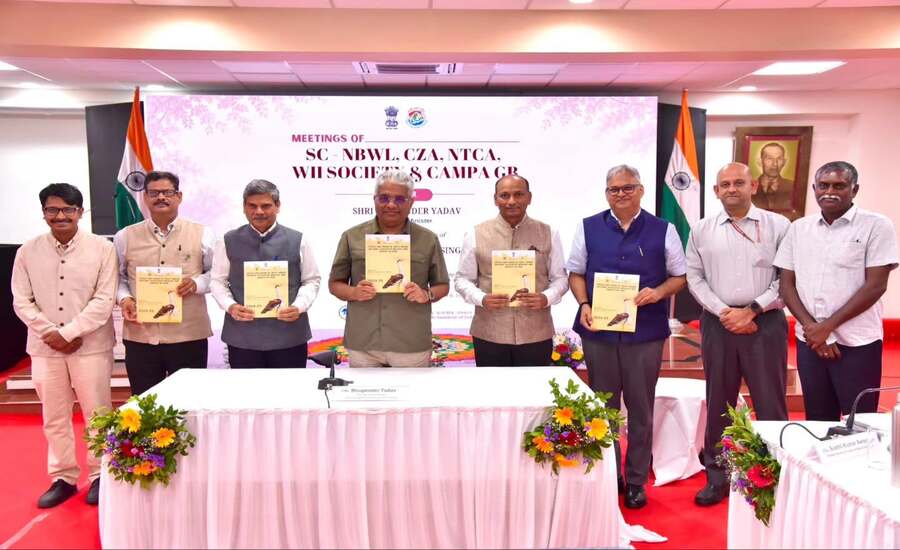
Coimbatore: Union Minister for Environment, Forest and Climate Change Bhupender Yadav chaired the 91st meeting of the Standing Committee of the National Board for Wildlife (SC-NBWL) at the Central Academy for State Forest Service in Coimbatore, where the committee reviewed 118 infrastructure, defence and development proposals from across the country while assessing the progress of key wildlife conservation initiatives.
The meeting also deliberated on long-term conservation strategies for several endangered species, reviewed active tiger population management, and released important scientific publications to strengthen India’s science-based approach to wildlife conservation.
Focus on Science-Based Wildlife Conservation
During the meeting, the Standing Committee reviewed the progress made on several directions issued in previous meetings of the National Board for Wildlife (NBWL) and its Standing Committee.
The discussions reaffirmed the Government’s commitment to:
- Science-based wildlife conservation
- Protection of critical wildlife habitats
- Strengthening ecological connectivity
- Balancing sustainable development with biodiversity conservation
The Committee also reviewed the implementation of decisions taken during the 7th meeting of the National Board for Wildlife, chaired by the Prime Minister.
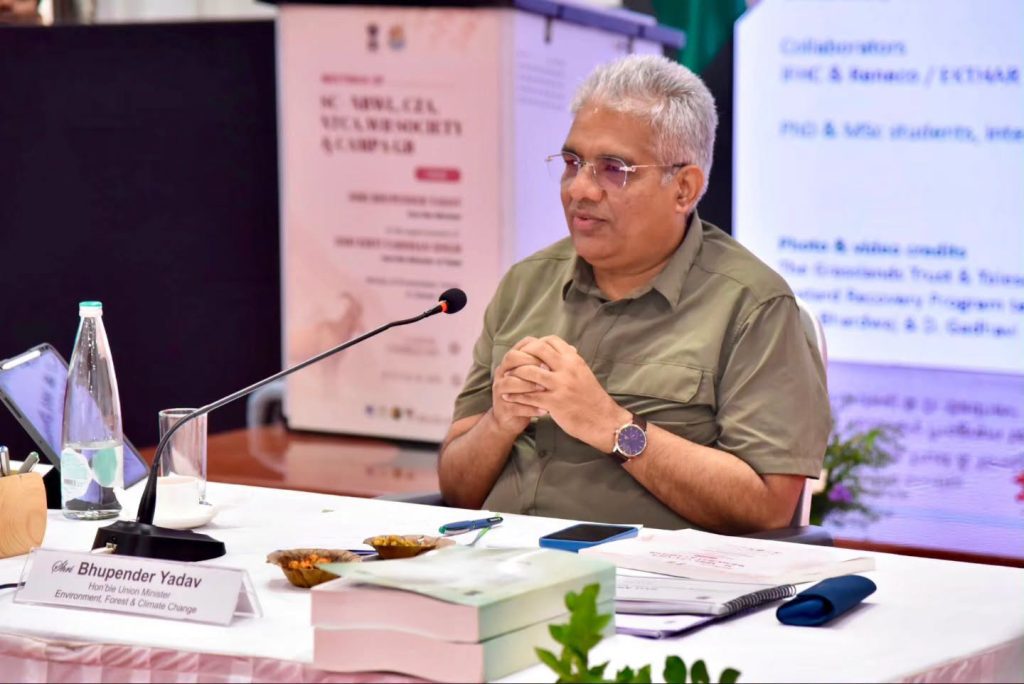
Bhupender Yadav Calls for Solution-Based Policies
Addressing the meeting, Bhupender Yadav said wildlife conservation remains at the core of India’s environmental governance.
He stressed that developmental projects in and around wildlife habitats should continue to be guided by:
- Scientific planning
- Habitat connectivity
- Effective mitigation measures
The Minister also called for solution-based policy interventions, integrating:
- Technological innovations
- Sociological studies
- Traditional ecological knowledge
to strengthen wildlife conservation efforts across the country.
Key Species Conservation Initiatives Reviewed
The committee discussed several important conservation programmes, including:
- Long-term conservation strategy for the Greater One-Horned Rhinoceros using the Rhino DNA Indexing System (RhoDIS).
- Future conservation roadmap for the Great Indian Bustard.
- Proposal to include the Pygmy Hog under the Species Recovery Programme.
- Review of conservation programmes for other threatened wildlife species.
- Progress in active tiger population management.
Scientific Publications Released
To strengthen evidence-based conservation, the committee released several technical publications covering:
- Great Indian Bustard
- Sloth Bear
- Small Cats
- Rhinoceros conservation
These publications are expected to support policymakers, forest managers and wildlife researchers in developing effective conservation strategies.
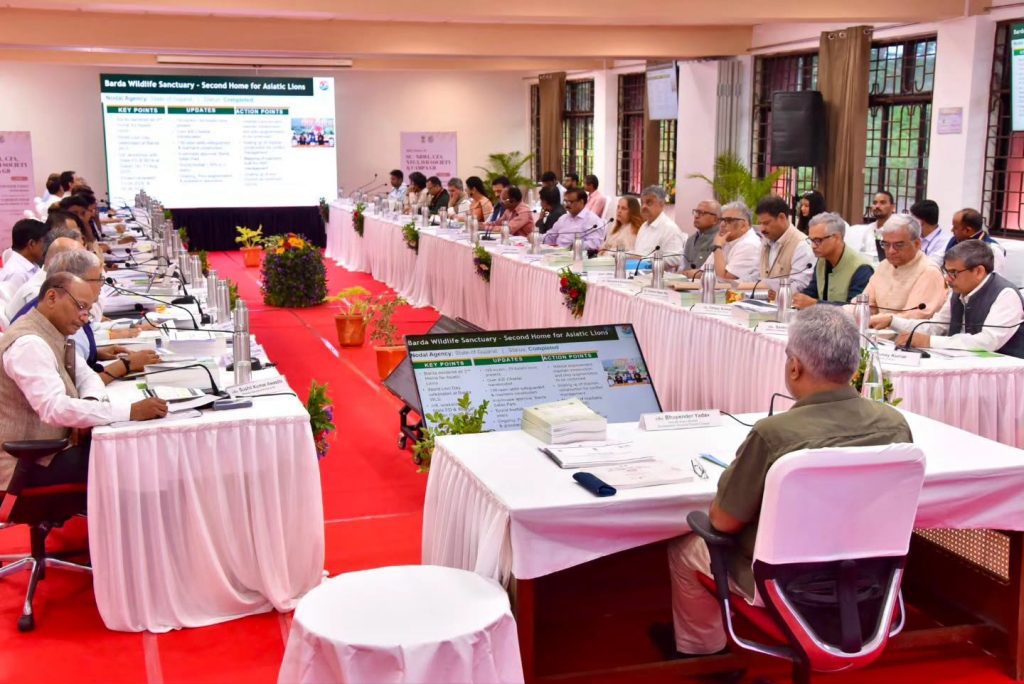
118 Development Projects Reviewed
The Standing Committee examined 118 proposals seeking wildlife clearance under the Wild Life (Protection) Act, 1972.
The proposals covered a wide range of sectors, including:
- Roads and bridges
- Defence infrastructure
- Drinking water supply projects
- Communication towers
- Power transmission lines
- Optical fibre networks
- Pipelines
- Mining projects
- Renewable energy projects
- Educational institutions
- Public infrastructure
- Other essential development works
Each proposal was evaluated based on:
- Ecological impact
- Public welfare
- National development priorities
- Adequacy of mitigation measures for wildlife protection
Balancing Conservation with Development
The committee reiterated that while developmental projects of national importance must continue, they should be implemented with appropriate environmental safeguards to minimise impacts on wildlife and their habitats.
It emphasized that all clearances would continue to be governed by the provisions of the Wild Life (Protection) Act, 1972, along with other applicable environmental regulations.
The meeting underscored the Government’s continued emphasis on integrating infrastructure development with biodiversity conservation through scientific planning and effective mitigation strategies.