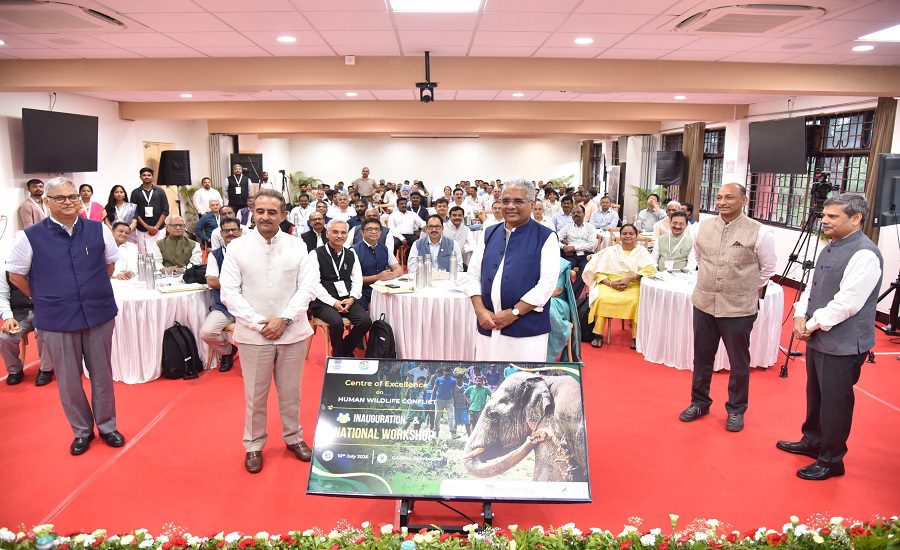
Coimbatore, Tamil Nadu: Union Minister for Environment, Forest and Climate Change Bhupender Yadav inaugurated the Centre of Excellence (CoE) on Human–Wildlife Conflict at WII-SACON, Coimbatore, marking a major step towards developing science-based solutions for managing rising human-wildlife interactions in India.
The inauguration was followed by a National Workshop on Human–Wildlife Conflict, which brought together policymakers, forest officials, scientists, researchers, technology experts and conservation practitioners from across the country to discuss challenges, innovations and collaborative approaches for conflict management.
The event was also attended by Union Minister of State for Environment, Forest and Climate Change Kirti Vardhan Singh.
Coexistence and Harmony Must Be the Goal for Ecological Sustainability: Bhupender Yadav
Addressing the gathering, Union Minister Bhupender Yadav said human-wildlife conflict has become one of India’s major conservation and development challenges due to factors such as:
- Habitat fragmentation
- Changing land-use patterns
- Expansion of human activities
- Increasing interaction between communities and wildlife
The Minister emphasised that the focus should be on finding solutions rather than only identifying problems.
He said modern technologies and scientific approaches must be used to develop effective strategies for managing conflicts.
“Coexistence and harmony, instead of conflict, should be the mantra of ecological sustainability,” the Minister said.
Centre of Excellence to Become National Hub for Conflict Management
The newly established Centre of Excellence has been developed following the announcement made by Prime Minister Narendra Modi during the 7th Meeting of the National Board for Wildlife.
The Centre will work as a national platform for:
- Research and innovation
- Policy support
- Capacity building
- Knowledge sharing
- Development of best practices
- Scientific management of human-wildlife conflict
The initiative aims to strengthen evidence-based approaches for reducing conflicts while ensuring protection of both wildlife and human communities.
Focus on Tigers, Leopards and Elephant Conflict Management
Bhupender Yadav highlighted the need for developing specialised strategies to address conflicts involving:
- Tigers outside tiger reserves
- Leopards in human-dominated landscapes
- Elephants and local communities
He stressed the importance of creating awareness programmes in both urban and rural areas to educate people about safe responses during wildlife encounters.
The Minister said conflict management should involve both area-specific and species-specific solutions to reduce fear and panic among communities.
Forest Departments Asked to Adopt Preventive Measures
The Environment Minister urged forest departments across the country to take proactive steps to prevent damage caused by wildlife conflicts.
He called for coordinated action involving:
- Local communities
- Government agencies
- Conservation organisations
- Technology experts
- Other stakeholders
He also encouraged the adoption of innovative practices and advanced technologies for wildlife conservation and conflict reduction.
National Human-Wildlife Conflict Portal Launched
During the event, Bhupender Yadav launched the National Human–Wildlife Conflict Portal, a digital platform designed to improve conflict management across India.
The portal will support:
- Data collection and management
- Knowledge sharing
- Decision-making support
- Better coordination among stakeholders
The platform is expected to help authorities analyse conflict patterns and develop more effective mitigation strategies.
Report on Human-Wildlife Conflict Status in India Released
The Minister also released the first edition of a publication titled:
“Current Status of Human–Wildlife Conflict in India: An Overview”
The report provides insights into:
- Current trends in human-wildlife conflicts
- Emerging challenges
- Conservation-related concerns
- Management requirements across regions
The publication will help policymakers and conservation experts understand the changing dynamics of wildlife interactions in India.
National Workshop Discusses Technology and Conservation Solutions
The technical sessions during the workshop focused on key areas including:
Human-Elephant Conflict
Experts discussed strategies to reduce elephant-related conflicts and improve community safety.
Human-Big Cat Conflict
Deliberations focused on managing interactions involving tigers and leopards.
Technology and Innovation
Experts highlighted the role of modern tools in monitoring wildlife movement, improving data collection and developing early warning systems.
The discussions are expected to generate actionable recommendations for strengthening national strategies on human-wildlife conflict management.
Balancing Wildlife Conservation with Human Livelihoods
Union Minister Kirti Vardhan Singh said successful conservation efforts have increased interactions between humans and wildlife, creating both ecological and socio-economic challenges.
He emphasised the need for long-term solutions that balance:
- Wildlife protection
- Human safety
- Livelihood security
- Sustainable development
He expressed confidence that the Centre of Excellence would play a key role in capacity building, technology adoption and promoting peaceful coexistence between people and wildlife.
Government’s Commitment Towards Science-Based Conservation
The establishment of the Centre of Excellence reflects the Government of India’s continued focus on protecting biodiversity while safeguarding human lives and livelihoods.
Through scientific research, digital tools, community participation and technological innovation, the initiative aims to create a sustainable framework where humans and wildlife can coexist peacefully.
The event was attended by senior officials from the Ministry of Environment, Forest and Climate Change, State Forest Departments, academic institutions and partner organisations.
Read also: Bhupender Yadav Chairs 91st NBWL Meeting; 118 Wildlife, Infrastructure and Defence Projects Reviewed