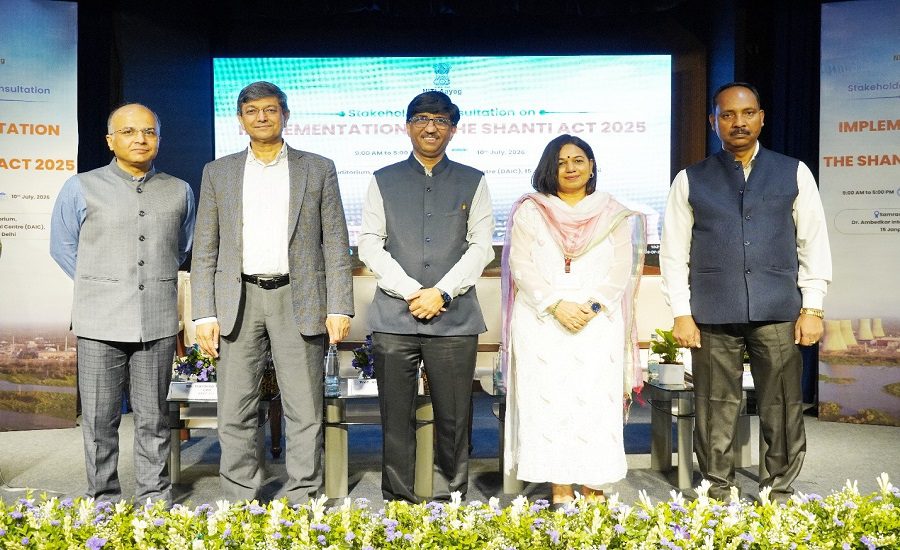
New Delh: NITI Aayog convened a high-level Stakeholder Consultation on the implementation of the SHANTI Act 2025 on July 10, 2026, bringing together senior government officials, policymakers, industry leaders and technical experts to discuss the operational framework of the landmark legislation.
The consultation was held at the Samrasta Auditorium, Dr. Ambedkar International Centre, New Delhi, with the objective of developing a robust implementation strategy for the SHANTI Act, which aims to strengthen India’s nuclear energy ecosystem through policy reforms, investment and institutional capacity building.
Consultation Chaired by NITI Aayog Member Prof. Abhay Karandikar
The stakeholder consultation was chaired by Prof. Abhay Karandikar, Member, NITI Aayog.
Several senior government and industry leaders participated in the discussions, including:
- Pankaj Agrawal, Secretary, Ministry of Power
- Ghanshyam Prasad, Chairperson, Central Electricity Authority (CEA)
- Gurdeep Singh, Chairman and Managing Director, NTPC Ltd.
- Dr. Anshu Bharadwaj, Programme Director, NITI Aayog
- Rajnath Ram, Adviser, NITI Aayog
- Dr. Garima Sharma, Head, Sustainable Energy Systems Division, Department of Atomic Energy
- Hari Kumar, Distinguished Scientist and Director, Atomic Energy Regulatory Board (AERB)
The gathering brought together experts from government departments, research organisations and the energy industry.
Read also: NITI Aayog Releases Strategic Roadmap to Make Ayurveda Global Under Viksit Bharat@2047 Vision
Focus on Legislative and Regulatory Framework
One of the key sessions focused on developing the legislative and regulatory ecosystem required for the effective implementation of the SHANTI Act 2025.
Discussions covered:
- Draft rules under the SHANTI Act
- Regulatory provisions
- Statutory compliance mechanisms
- Foreign Direct Investment (FDI) policy framework
Participants explored ways to attract global investment while ensuring that India’s strategic and domestic interests remain protected.
Finance, Insurance and Public Awareness Discussed
Another major area of discussion focused on the financial and risk-management aspects of implementing the Act.
Stakeholders deliberated on:
- Financing mechanisms for nuclear energy projects
- Long-term insurance frameworks
- Risk mitigation strategies
- Public communication and awareness initiatives
- Community engagement to improve acceptance of nuclear energy projects
The session highlighted the importance of building public confidence alongside financial sustainability.
Manufacturing and Capacity Building Take Centre Stage
The third technical session focused on strengthening India’s industrial and operational readiness for implementing the SHANTI Act.
Key issues discussed included:
- Expanding domestic manufacturing capabilities
- Strengthening supply chain resilience
- Ensuring operational preparedness
- Developing skilled manpower
- Designing dedicated training and capacity-building programmes
Experts stressed that a strong domestic manufacturing ecosystem and a highly skilled workforce would be essential for supporting the long-term growth of India’s nuclear energy sector.
Stakeholder Inputs to Strengthen Implementation Framework
Participants shared diverse perspectives and recommendations across all three focus areas.
According to NITI Aayog, the suggestions received during the consultation will help refine the implementation framework of the SHANTI Act 2025 and support the development of an efficient, transparent and future-ready ecosystem.
The consultation also reinforced the importance of collaboration between government agencies, industry, research institutions and regulatory bodies in ensuring the successful execution of the Act.
Towards a Stronger Nuclear Energy Ecosystem
The SHANTI Act 2025 is expected to play a significant role in strengthening India’s nuclear energy sector by creating a supportive policy environment for investment, innovation and capacity development.
Through stakeholder consultations and collaborative policy planning, the government aims to ensure the Act is implemented effectively while promoting technological advancement, industrial growth and energy security for the country.