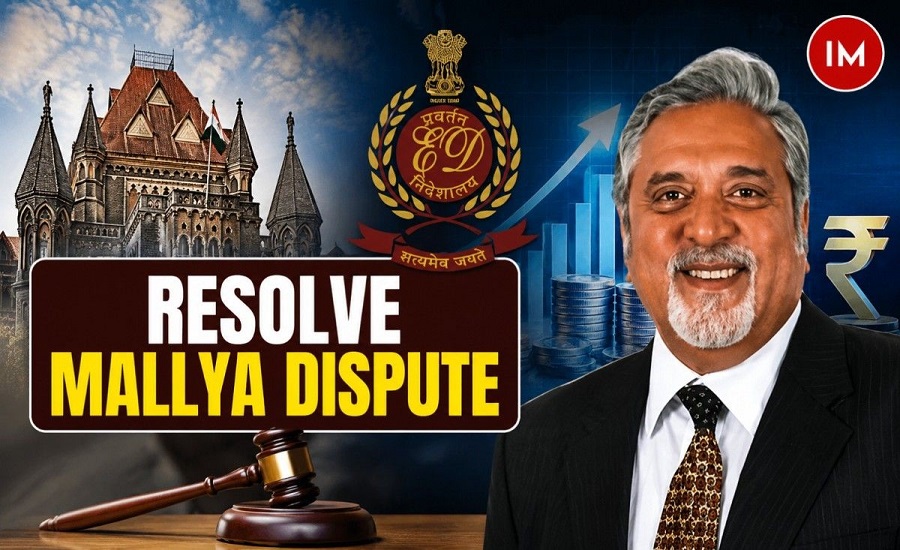
Mumbai: The Bombay High Court has urged fugitive businessman Vijay Mallya and the consortium of banks led by the State Bank of India (SBI) to find a practical resolution to their long-running commercial dispute, observing that allowing the matter to remain unresolved could have an adverse impact on the country’s economy.
The High Court has also sought details from the Enforcement Directorate (ED) regarding the present status of its investigation and the assets attached in connection with the case.
The observations came while hearing a petition filed by Mallya challenging an order concerning the handing over of his attached assets to the consortium of banks.
A single-judge bench headed by Justice Milind Jadhav emphasised that the dispute, which has continued for nearly a decade, should now reach a logical conclusion.
Court Calls for Practical Resolution
During the proceedings, the High Court indicated that continuing the dispute indefinitely would serve little purpose and encouraged the parties to explore a practical solution.
The bench observed that commercial disputes often contain the means for their own resolution and suggested that the parties should move beyond prolonged litigation.
The Court also expressed concern over the wider implications of allowing such a major financial dispute to continue without resolution, noting that failure to settle the matter could have a direct and negative impact on the country’s economy.
The Court has accordingly sought further information before considering the matter, including details concerning the status of the ED proceedings and the assets that have been attached.
Read also: Bombay HC Orders Maharashtra DGP to Audit CCTV Cameras Across All Police Stations
Mallya Challenges Asset Handover to Banks
Mallya had approached the Bombay High Court challenging an order passed by the special Prevention of Money Laundering Act (PMLA) court.
The PMLA court had permitted a consortium of banks led by SBI to utilise assets attached by the ED for recovery of the dues arising from loans extended to Kingfisher Airlines (KFA).
Mallya challenged the order in 2020, arguing that the handing over of his assets to the banks was unjust.
The dispute relates to allegations that Mallya defaulted on loans of around ₹9,000 crore obtained from a consortium of banks for the now-defunct Kingfisher Airlines.
The banking consortium has been pursuing recovery of the outstanding dues for several years, while various legal proceedings concerning Mallya’s assets have continued before different courts and authorities.
Vijay Mallya Left India in 2016
The case has its roots in the collapse of Kingfisher Airlines and the subsequent loan recovery proceedings.
Mallya left India in March 2016 and has remained in the United Kingdom.
In 2019, he was declared a fugitive economic offender under the Fugitive Economic Offenders Act (FEOA).
The declaration opened the way for authorities to pursue confiscation of his assets under the law.
The Government of India has also been pursuing his extradition from the UK in connection with the criminal proceedings against him.
Bombay HC Earlier Refused Relief Without His Return
The latest proceedings follow another round of litigation before the Bombay High Court earlier this year.
In February 2026, a bench comprising then Chief Justice Shri Chandrashekar and Justice Gautam Ankhad heard petitions filed by Mallya challenging his declaration as a fugitive economic offender under the FEOA.
During the hearing on February 12, the Court indicated that it would not entertain Mallya’s challenge unless he returned to India and submitted himself to the jurisdiction of the Indian courts.
At a subsequent hearing on February 18, Mallya’s side submitted that he was unable to specify when he could return because of restrictions imposed by courts in England.
Mallya’s Lawyer Cites Supreme Court Judgments
Senior Advocate Amit Desai, appearing for Mallya, subsequently relied upon judgments of the Supreme Court to argue that constitutional courts have the power to adjudicate writ petitions even when the petitioner is not physically present in the country.
On that basis, Mallya’s counsel urged the High Court to consider the two petitions independently rather than linking their hearing to his physical return to India.
The issue forms part of the broader legal battle surrounding Mallya’s status as a fugitive economic offender and the recovery of assets linked to the Kingfisher Airlines loan default.
What Is the ED’s Role in the Case?
The ED has been involved in proceedings concerning the attachment of Mallya’s assets under the Prevention of Money Laundering Act.
The Bombay High Court has now sought details from the agency regarding the current status of the investigation and the assets attached in the matter.
These details are expected to assist the Court in assessing the present position of the proceedings and the assets involved in the dispute between Mallya and the bank consortium.
The asset recovery process has been a crucial part of the lenders’ efforts to recover the money owed in connection with Kingfisher Airlines.
What Is the Fugitive Economic Offenders Act?
The Fugitive Economic Offenders Act, 2018 was enacted to deal with individuals accused of specified serious economic offences who leave India to avoid criminal prosecution or refuse to return to face the law.
The law provides a mechanism for declaring an individual a fugitive economic offender and for confiscating properties connected with such cases, subject to the statutory process.
The legislation was introduced against the backdrop of high-profile financial fraud cases involving accused persons who left India and remained abroad while facing criminal proceedings.
Mallya became one of the prominent cases in which the legislation was invoked.
Vijay Mallya Case: Key Timeline
- March 2016: Vijay Mallya left India and subsequently remained in the UK.
- 2019: He was declared a fugitive economic offender under the FEOA.
- 2020: Mallya challenged the PMLA court’s order allowing the SBI-led bank consortium to utilise assets attached by the ED.
- February 2026: The Bombay High Court heard Mallya’s challenge to his fugitive economic offender status and indicated that he would need to return to India and submit to the court’s jurisdiction for relief.
- August 2026: The High Court, while hearing the asset-related dispute, urged the parties to find a resolution and sought an update from the ED on the attached assets and the status of the investigation.
A Decade-Long Financial Dispute
The Bombay High Court’s latest observations underscore the long-running nature of the litigation surrounding Mallya, Kingfisher Airlines, the bank consortium and the attached assets.
While the recovery proceedings and various criminal and constitutional challenges have continued across forums, the High Court has now indicated that the commercial dispute should move towards a practical conclusion.
The Court’s request for updated information from the ED is likely to provide clarity on the status of the attached assets and the proceedings surrounding them.
For the banks, the central objective remains recovery of the outstanding dues, while Mallya continues to challenge aspects of the asset recovery and fugitive economic offender proceedings.
The matter therefore remains closely watched as the High Court considers the ED’s response and the next steps in the long-running dispute.
Read also: Justice Yashwant Varma Cash Case: All 3 Charges Proved by Probe Panel – Know Everything