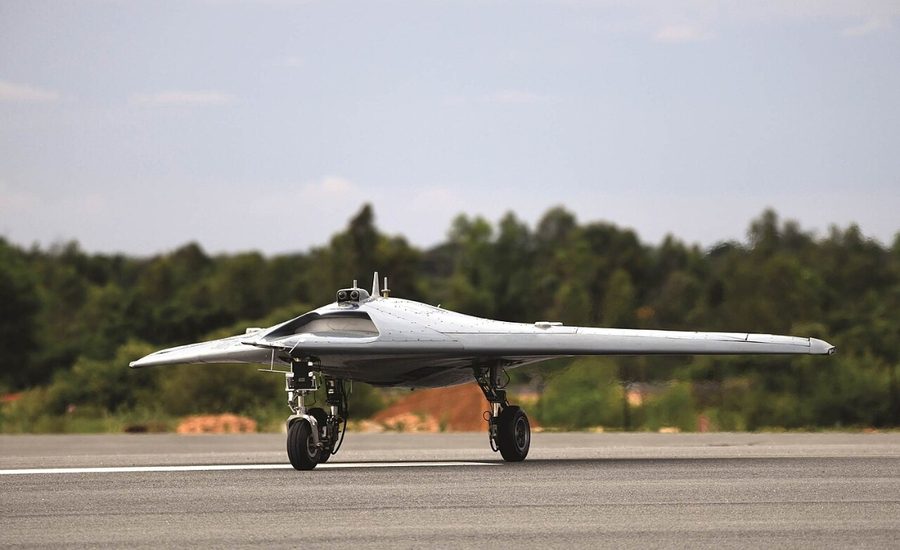
New Delhi: India’s Ghatak UCAV program is emerging as a game-changer in military aviation, marking a major step toward self-reliance in advanced defence technology.
The Ghatak UCAV is being developed as a fully autonomous stealth strike platform capable of penetrating heavily defended enemy airspace. With fighter jet–like dimensions similar to the Tejas Mk1, this indigenous system is expected to redefine India’s deep-strike capabilities while strengthening its position among leading global military powers.
Details of Ghatak UCAV
The Ghatak UCAV program, led by the Defence Research and Development Organisation (DRDO), has reached a critical stage with official confirmation of its core specifications.
Read also: Why DRDO’s Ghatak Stealth Drone Could Become Nearly Invisible: The 90% Carbon Composite Advantage
The project has now been integrated into the Remotely Piloted Strike Aircraft (RPSA) initiative, which has received a significant push after the Defence Procurement Board approved approximately ₹39,000 crore for acquiring more than 60 units for the Indian Air Force.
This approval highlights the government’s strong focus on indigenous defence systems and long-term strategic autonomy.
What are the Features of Ghatak UCAV
One of the most striking features of the Ghatak UCAV is its size and weight.
- Classified as a 13-tonne class platform
- Comparable in dimensions to the Tejas fighter jet
- Estimated length: 14 metres
- Wingspan: 18 metres
This scale places Ghatak in a unique category of heavy stealth combat drones, offering greater payload capacity and mission flexibility compared to smaller UAVs.
Indigenous Engine: Kaveri Derivative Power
The UCAV will be powered by a derivative of India’s indigenous Kaveri engine.
What are the Features of Kaveri Engine
- Thrust Output: ~49 kN
- Type: Non-afterburning (“dry”) engine
- Optimized for: Subsonic stealth missions
Unlike supersonic fighter engines, this design prioritizes:
- Fuel efficiency
- Longer endurance
- Reduced heat signature
Operating without an afterburner significantly lowers infrared emissions, helping the aircraft evade heat-seeking missiles.
Advanced Stealth Design and Survivability
Stealth is the core philosophy behind the Ghatak UCAV.
What are the Stealth Features of Ghatak UCAV
- Flying wing (tailless) configuration for low radar visibility
- Serpentine air intakes to hide engine blades
- 2D rectangular exhaust nozzles to reduce infrared signature
- Minimal external protrusions
These features collectively reduce the aircraft’s radar cross-section (RCS), making it extremely difficult to detect and track.
Internal Weapons Bay for Silent Strikes
Unlike conventional drones, Ghatak avoids external weapon mounts.
Weapon System:
- Two internal weapon bays
- Total payload capacity: ~1.5 tonnes
This allows it to carry precision weapons like:
- Smart Anti-Airfield Weapon (SAAW)
- Advanced glide bombs
Internal storage ensures that stealth is not compromised, enabling covert deep-strike missions.
High Endurance and Deep Strike Capability
Because it is unmanned, Ghatak eliminates the need for:
- Cockpit
- Pilot life-support systems
This allows for:
- Higher internal fuel capacity
- Longer mission duration
- Deep penetration into enemy territory
The UCAV can perform:
- Suppression of enemy air defences (SEAD)
- Destruction of high-value targets
- Pre-emptive strikes before manned aircraft deployment
Built on Proven Technology: SWiFT Demonstrator
The Ghatak program builds on the success of the Stealth Wing Flying Testbed (SWiFT), which has already demonstrated autonomous flight capabilities.
This phased development approach ensures:
- Reduced technical risks
- Faster operational readiness
- Proven stealth and flight control systems
What is the Importance of Ghatak UCAV
The Ghatak UCAV represents a major leap in India’s defence ecosystem.
Strategic Benefits:
- Strengthens Atmanirbhar Bharat (self-reliance) in defence
- Reduces dependency on foreign UAV technology
- Enhances deep strike and stealth warfare capability
- Acts as a force multiplier alongside manned fighter jets
Globally, it places India among a select group of nations developing advanced stealth combat drones.