New Delhi: The Indian Army-Navy MoA on inter-service cooperation marks a major step toward stronger military coordination and operational unity between the two defence forces.
The agreement was signed to improve jointness, enhance operational cohesion, and build deeper professional cooperation between formations, institutions, regiments, and naval establishments. The move reflects India’s growing focus on integrated defence preparedness and modern military coordination.
Details of Indian Army-Navy MoA
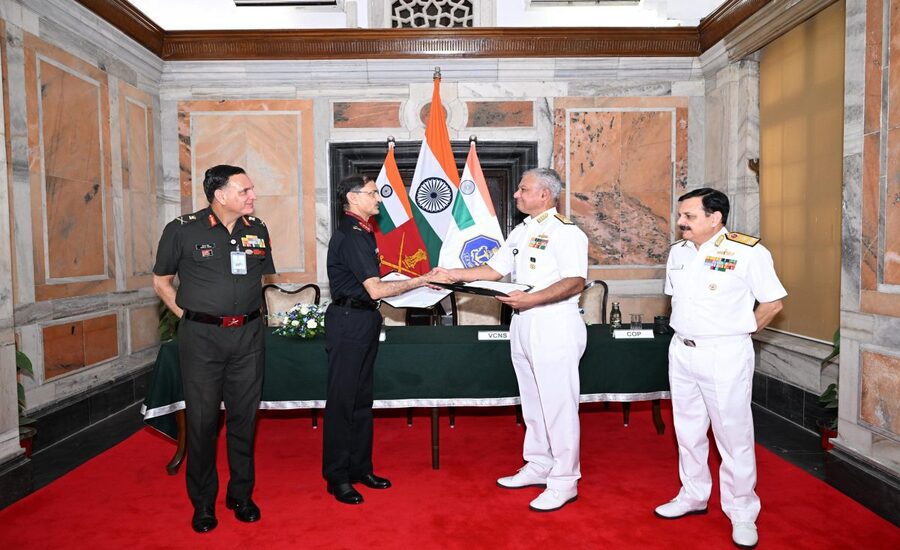
The Memorandum of Association (MoA) was officially signed by:
- Lt Gen VPS Kaushik, Adjutant General, representing the Indian Army
- Vice Admiral Gurcharan Singh, Chief of Personnel, representing the Indian Navy
The agreement was signed in the presence of senior officers from both services.
Read also: Indian Army Plans Smart Combat Tanks With AI, Anti-Drone Systems Under Project Ranjeet
According to the Ministry of Defence, the MoA aims to institutionalise long-term cooperation between the Army and Navy.
What Is the Main Objective of the Indian Army-Navy MoA ?
The newly signed agreement focuses on:
- Strengthening inter-service coordination
- Improving operational synergy
- Encouraging joint training and interaction
- Building professional camaraderie
- Enhancing integrated military functioning
The Defence Ministry said the affiliation framework will help create stronger cooperation between military formations, establishments, and naval ships. It will also serve as a guideline for future affiliations between the Indian Army and the Indian Navy.
Why Indian Army-Navy MoA Is Important
India has been steadily working toward greater military integration in recent years. Modern warfare increasingly requires seamless coordination between the Army, Navy, and Air Force.
Defence experts believe such agreements can improve:
- Faster joint response during emergencies
- Better communication between services
- Combined operational planning
- Efficient use of military resources
The affiliation pact comes at a time when India is strengthening its defence preparedness and focusing on integrated warfighting capabilities.
Push for Greater Jointness in Indian Armed Forces
The Indian government and Ministry of Defence have repeatedly emphasized the need for “jointness” among the armed forces.
Recent reforms in India’s defence structure, including theatre command discussions and integrated operations, highlight this larger vision. The Army-Navy MoA is being viewed as another practical step toward achieving that goal.
Connection With India’s Strategic Defence Goals
India faces evolving security challenges in the Indian Ocean Region and along its borders. Improved coordination between the Army and Navy can help India maintain stronger defence readiness.
The agreement also supports India’s broader strategy of creating a technologically advanced and combat-ready force capable of multi-domain operations.
Read also: Drone Threat Rising: Indian Army Plans Smart ADGS System to Replace Legacy Guns