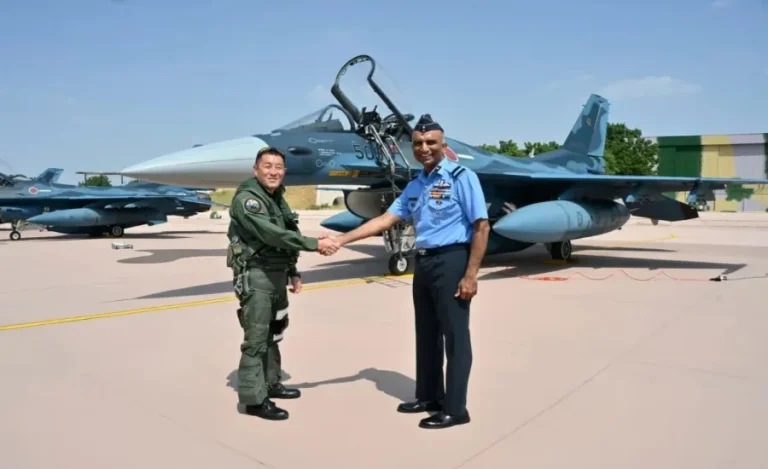
Jodhpur: Japan F-2 Fighter In India has become a major defence headline after the Japan Air Self-Defense Force (JASDF) deployed its advanced F-2 fighter aircraft to Jodhpur for Exercise Veer Guardian 2026.
The bilateral air exercise is being held at Air Force Station Jodhpur from September 9 to September 22, 2026. The deployment highlights the growing strategic and defence partnership between India and Japan.
According to official statements from the Indian Air Force (IAF) and Japan’s Ministry of Defense, the exercise aims to improve interoperability, operational coordination, and joint combat readiness between the two air forces.
What Is Exercise Veer Guardian 2026
Exercise Veer Guardian is a bilateral air exercise conducted by the Indian Air Force and the Japan Air Self-Defense Force. The exercise focuses on advanced aerial operations, mission planning, tactical cooperation, and knowledge sharing between pilots and defence personnel from both countries.
Read also: Garuda 25: A Milestone in India–France Defence Partnership and Air Force Interoperability
The 14-day exercise includes complex operational missions, engineering interactions, aerospace safety discussions, and subject-matter expert exchanges.
Aircraft Participating In The Veer Guardian 2026
The Indian Air Force has deployed some of its most capable fighter aircraft for the exercise. These include:
- Tejas Light Combat Aircraft
- Su-30MKI Multirole Fighters
- Rafale Fighter Jets
Japan has deployed its F-2 multirole fighter aircraft, one of the most advanced platforms in its air combat fleet.
Why The Arrival Of Japan’s F-2 Fighter Matters
The arrival of the F-2 fighter in India marks another important step in the rapidly expanding defence cooperation between New Delhi and Tokyo. The deployment allows pilots from both countries to train together in realistic combat scenarios and learn from each other’s operational experiences.
Japanese Defence Minister officials have stated that such deployments help improve tactical capabilities and strengthen the foundation for future defence cooperation.
Growing India-Japan Strategic Partnership
India and Japan have significantly expanded their defence relationship over the past decade. Both countries share common interests in maintaining peace, stability, and a rules-based order in the Indo-Pacific region. Regular military exercises, technology cooperation, and security dialogues have become key pillars of this partnership.
What Is Japan’s F-2 Fighter Aircraft
The F-2 is a multirole fighter aircraft jointly developed by Japan and the United States. Although its design is based on the American F-16 Fighting Falcon, the F-2 is significantly modified to meet Japan’s operational requirements. Because of its larger size and advanced systems, the aircraft is often described as an enlarged and upgraded version of the F-16.
Key Features Of The F-2 Fighter
Japan introduced several major improvements to the aircraft. These include:
- Larger wing design for improved maneuverability
- Advanced composite materials to reduce weight
- More powerful engine performance
- Enhanced radar systems
- Improved electronic warfare capabilities
- Advanced mission systems designed for maritime and air superiority missions
These upgrades make the aircraft highly effective in Japan’s unique operational environment.
Performance And Capabilities Of The F-2
The F-2 is powered by a General Electric F110-GE-129 afterburning turbofan engine. The aircraft can reach speeds of approximately Mach 2 and has an operational range of nearly 2,900 kilometers. Its advanced radar and weapons systems enable it to perform air-to-air and air-to-surface missions with high effectiveness.
Role In Japan’s Defence Strategy
The F-2 remains an important part of Japan’s fighter fleet. Over the years, Japan has continuously upgraded the aircraft with improved networking capabilities, anti-ship weapons integration, and enhanced mission systems. The aircraft plays a critical role in protecting Japanese airspace and maritime interests.
How Exercise Veer Guardian 2026 Benefits India And Japan
The exercise provides valuable opportunities for both air forces to improve operational coordination. Pilots gain experience in joint mission planning, aerial combat tactics, and interoperability with modern fighter platforms. The exercise also helps strengthen military-to-military ties and increases mutual understanding between the two strategic partners.
Exercise Veer Guardian 2026: Focus On Indo-Pacific Security
India and Japan are increasingly working together to address emerging security challenges in the Indo-Pacific. Joint exercises such as Veer Guardian contribute to regional stability and improve preparedness for future contingencies. They also demonstrate the commitment of both nations to deeper security cooperation.
Future Of India-Japan Defence Cooperation
Defence ties between India and Japan are expected to continue expanding in the coming years. Areas such as military technology, maritime security, cyber defence, and advanced military exercises are likely to see greater collaboration.
The participation of the F-2 fighter in Veer Guardian 2026 reflects the growing trust and strategic alignment between the two countries.
Read also: What Makes Indian Air Force Sarang Team The World’s Most Unique Helicopter Display Unit?
FAQs
Japan has deployed F-2 fighters to participate in Exercise Veer Guardian 2026, a bilateral air exercise aimed at improving interoperability, combat readiness, and defence cooperation with the Indian Air Force.
The F-2 is a multirole fighter aircraft jointly developed by Japan and the United States. It is based on the F-16 design but includes larger wings, advanced radar systems, and several Japan-specific upgrades.
The exercise includes India’s Tejas, Su-30MKI, and Rafale fighter aircraft, along with Japan’s F-2 multirole fighter jets.