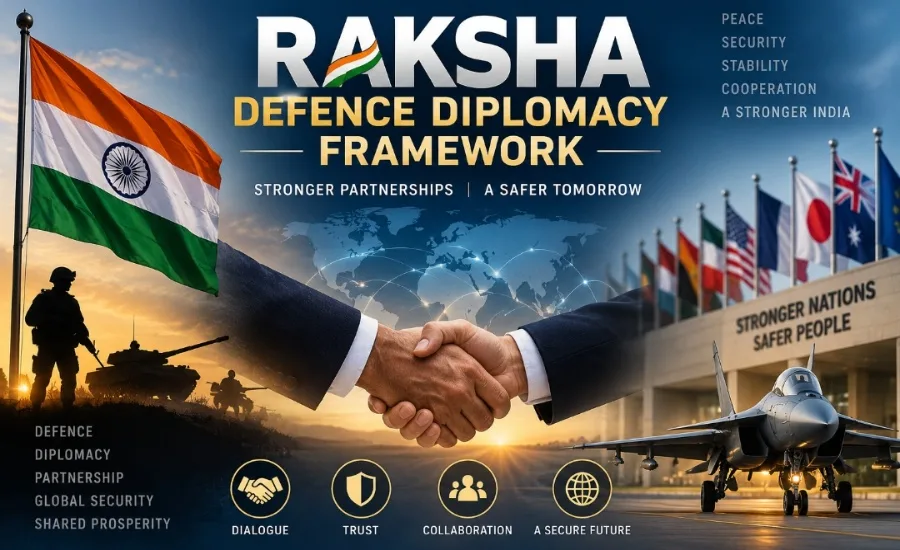
New Delhi: RAKSHA defence diplomacy Blueprint is India’s new 10-year strategic framework aimed at strengthening global defence partnerships, boosting defence exports, enhancing military cooperation, and aligning defence diplomacy with national security and foreign policy goals.
Released by Defence Minister Rajnath Singh, the roadmap marks a major shift from traditional military engagement towards long-term, outcome-oriented partnerships that support India’s strategic interests and global influence.
The initiative comes as India seeks to deepen defence ties across the Indo-Pacific, Europe, West Asia, Africa, and other regions while promoting indigenous defence products under the Atmanirbhar Bharat vision.
What is RAKSHA Defence Diplomacy Blueprint
RAKSHA is a comprehensive defence diplomacy document that outlines India’s strategic vision for global defence engagement over the next decade.
Read also: No Defence Technology For Pakistan: Belgium Makes Key Assurance To India During Defence Talks
The framework aims to integrate defence diplomacy more closely with India’s foreign policy, economic priorities, and national security objectives. It seeks to make India a more influential and dependable security partner in an increasingly complex geopolitical environment.
According to the Ministry of Defence, the document provides a clear and actionable roadmap to strengthen India’s defence partnerships while promoting peace, stability, and a rules-based international order.
Why India Launched The RAKSHA Defence Diplomacy Blueprint
The global security environment is changing rapidly due to regional conflicts, technological advancements, and growing strategic competition.
India believes defence diplomacy can no longer remain limited to ceremonial military exchanges, high-level visits, and joint exercises. Instead, it should contribute directly to national security, defence capability development, industrial growth, and foreign policy goals.
The RAKSHA framework is designed to address these challenges through structured and long-term engagement with partner nations.
What are the Pillars Of RAKSHA Defence Diplomacy Blueprint
One of the most important pillars focuses on expanding bilateral and multilateral defence cooperation.
India plans to strengthen defence engagement with friendly countries by identifying areas of mutual strategic interest and increasing security collaboration. The goal is to create long-term partnerships that deliver measurable outcomes rather than symbolic engagements.
Recent defence cooperation initiatives, including missile exports and security agreements with partner nations, reflect this broader approach.
Capacity Building
The second pillar focuses on enhancing military cooperation through training, education, and joint exercises.
India intends to expand training programs for foreign military personnel, professional military education initiatives, and institutional partnerships between armed forces. These efforts are expected to improve interoperability and strengthen long-term defence relationships.
Indigenous Defence Exports
A major focus of RAKSHA is promoting India’s defence manufacturing sector globally. The framework supports co-development, co-production, technology transfer, and supply-chain integration under the Atmanirbhar Bharat initiative. India aims to establish itself as a reliable defence manufacturing hub and trusted supplier of military equipment.
India’s defence exports reached a record ₹38,424 crore in FY 2025-26, highlighting growing international demand for Indian defence products and technologies.
Maritime Security
The fourth pillar emphasizes India’s role in maintaining stability across the Indian Ocean Region and the Indo-Pacific. The framework supports naval cooperation, maritime domain awareness, humanitarian assistance, disaster relief operations, and regional security initiatives. India aims to strengthen its position as a net security provider and first responder in the region.
How RAKSHA Defence Diplomacy Blueprint Supports India’s Defence Industry
The blueprint strongly supports defence industrial cooperation with international partners. India is increasingly pursuing partnerships focused on co-development and co-production rather than simple imports. Such collaborations help improve domestic manufacturing capabilities, encourage technology transfer, and reduce dependence on foreign suppliers.
Recent agreements involving defence manufacturing partnerships demonstrate how India is combining defence diplomacy with industrial growth and self-reliance objectives.
RAKSHA And India’s Growing Defence Exports
India has transformed from being one of the world’s largest arms importers into an emerging defence exporter. Indian companies are now supplying missiles, artillery systems, radars, electronic warfare systems, patrol vessels, ammunition, and other defence equipment to friendly countries. The government sees defence diplomacy as an important tool for expanding export opportunities and strengthening strategic relationships.
The RAKSHA framework is expected to accelerate this trend by creating stronger government-to-government engagement and improving international confidence in Indian defence products.
Strategic Importance For India
The launch of RAKSHA reflects India’s ambition to become a leading security partner in the Indo-Pacific and beyond. By combining defence diplomacy, military cooperation, industrial growth, and maritime security under a single long-term framework, India aims to expand its strategic influence while supporting national security objectives.
The blueprint also provides a structured approach for navigating future geopolitical challenges and strengthening partnerships with countries that share common security interests.
Read also: S-400 Missile System Deal: Russia Proposes 5 More Missile Defence Systems For India
FAQs
The RAKSHA framework was released by Defence Minister Rajnath Singh in New Delhi on September 3, 2026.
RAKSHA is India’s 10-year defence diplomacy blueprint that aims to strengthen global defence partnerships, boost defence exports, and align defence engagement with foreign policy and national security goals.
The four key pillars are Strategic Partnerships, Capacity Building, Indigenous Defence Exports, and Maritime Security.