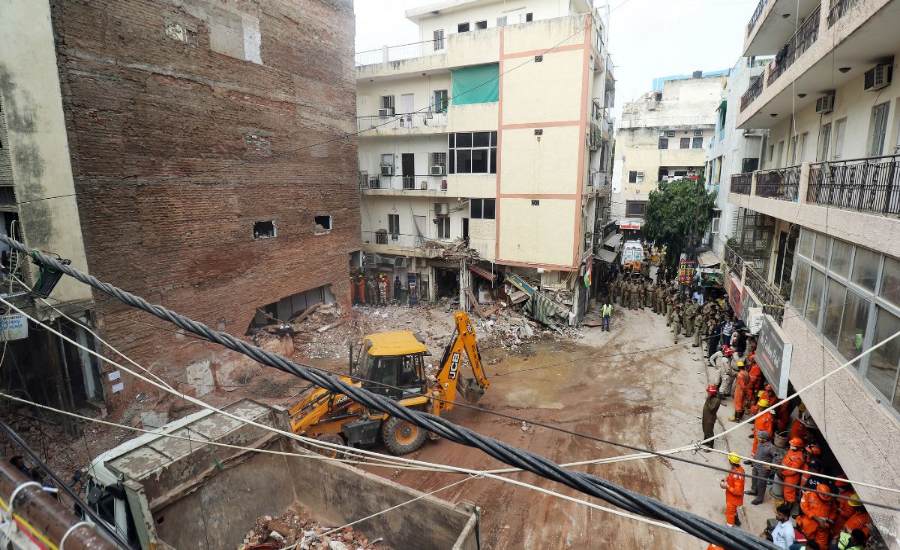
New Delhi: Delhi’s proposed new Master Plan could make it easier for owners to redevelop ageing buildings by providing additional Floor Area Ratio (FAR), creating greater construction potential to offset demolition and rebuilding costs.
The proposal gains significance after the recent Satya Niketan building collapse, which killed seven people and renewed concerns over the safety of ageing structures in the capital.
Additional FAR to Support Redevelopment
D Thara, Secretary, Department of Capital Development, Ministry of Housing and Urban Affairs, said the proposed Master Plan provides significant scope for regeneration and redevelopment of old properties.
According to Thara, many older buildings currently have a FAR of around 1.5. Under the proposed framework, redevelopment could provide 50% more FAR, giving property owners additional construction potential.
The idea is to make redevelopment financially viable. Additional development rights could help owners recover part of the cost of demolishing unsafe structures and constructing new buildings.
The proposal comes as Delhi faces the challenge of replacing ageing buildings while simultaneously creating more housing and urban infrastructure.
Read Also: Delhi Uses Tech-Based Randomisation to Post Sub-Registrars Across All 39 Sub-Divisions
Up to 40 Lakh New Homes Planned
The proposed Master Plan also envisages a major expansion in Delhi’s housing capacity.
According to Thara, the city could potentially see up to 40 lakh new homes over the next 20 years.
Around 20,000 hectares along Metro corridors have been identified for high-density development. The government wants more residential and commercial activity around public transport networks so that people can access jobs and services without depending heavily on private vehicles.
Thara said a survey cited by her indicated that around 70% of jobs are located around Metro corridors, making these areas suitable for greater housing density.
The approach would also make better use of Delhi’s existing transport infrastructure and extensive road network.
‘Sponge Cities’ Approach to Rainwater
The proposed urban development framework also places emphasis on managing rainfall and reducing waterlogging.
Thara advocated the concept of “sponge cities”, where urban areas absorb and retain rainwater instead of quickly sending it into drainage systems.
She also raised concerns about excessive concrete surfaces in homes and other properties, which prevent rainwater from entering the soil.
The approach could encourage developers and property owners to consider more permeable surfaces and better rainwater management while planning construction.
Land Pooling Needs Greater Participation
Land pooling was another issue discussed by Thara. She said the first land pooling scheme has already received approval, but its progress will depend on building confidence among landowners.
The process requires landowners to come together through associations and participate in planned land aggregation.
The Delhi Development Authority (DDA) is expected to play a stronger role in bringing landowners together. A platform is also being developed to facilitate communication between individual landowners and the authority.
Why the Higher FAR Proposal Matters
The proposed FAR relaxation comes at a time when Delhi needs to address two challenges simultaneously—unsafe ageing structures and growing demand for housing.
If implemented effectively, additional FAR could give property owners a stronger financial incentive to replace old buildings rather than continue occupying structures that may require major repairs.
At the same time, concentrating new development around Metro corridors could support more compact growth, reduce dependence on cars and make better use of existing urban infrastructure.
The combination of redevelopment incentives, transit-oriented housing, improved rainwater management and land pooling could shape how Delhi accommodates its growing population while dealing with its ageing built environment.
Read Also: Delhi Plans Higher FAR, Hostel Redevelopment as Student Housing Demand Surges