The history of forest management in India can be traced through several lenses — from the traditional tribal knowledge of forest-dwelling communities, to the spiritual and game reserves maintained by various dynasties, to the scientific principles introduced in the British era, and finally to the modern forest management practices that have evolved since independence. Over time, the priorities of forest management have shifted as well — from production, protection and conservation, to meeting primary livelihood needs, and now to supporting the spiritual and cultural wellbeing of a mentally and emotionally healthy society. Today, forest management is a delicate balancing act: protection, conservation and law enforcement on one side, and public participation, accountability, and efficient, transparent service delivery on the other. In this era of e-governance and digitisation, with growing demands for transparency, efficiency and sustainable outcomes, forest management must adopt innovative practices that harness the latest available technology.
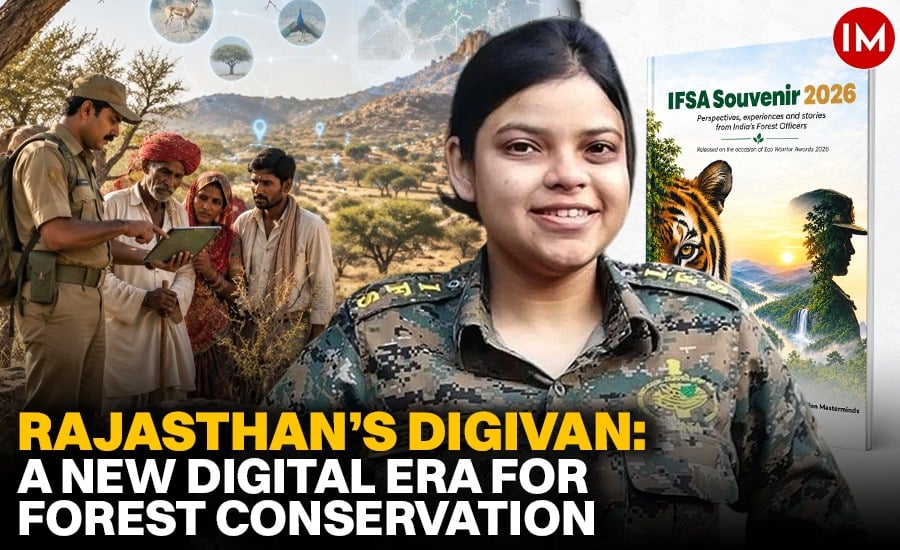
The Rajasthan Forest Department, in collaboration with the Japan International Cooperation Agency’s (JICA) DXLab and the Boston Consulting Group (BCG), developed DigiVan — India’s first Digital Forest Stack — to build a data-based decision support system and impact-monitoring tool for the department. It also aims to be a transparent public-access system for the department’s activities, opening up its data stack to spur innovation in the forestry sector. DigiVan represents a transformative step towards digital-first, data-driven forestry management.
In mid-2024, Sirohi division was chosen as the pilot division to develop a Proof of Concept (POC). Being posted as the Deputy Conservator of Forests, Sirohi, I had the opportunity to be part of this project from its pilot stage. Since it was an entirely new and innovative approach, we had considerable room to use our imagination and creativity while working to solve the fundamental challenges faced by the forest department.
Also Read – No Forest Warrior Should Be Forgotten: How the IFS Welfare Trust Is Supporting Frontline Personnel
The first Proof of Concept focused on forest health monitoring. The aim was to develop measurable parameters that could indicate whether forests had improved — qualitatively and quantitatively — over time. Parameters that change over time, such as canopy density, groundwater levels and land-use patterns, were selected as Key Performance Indicators (KPIs), with data from the Rajasthan Forest Department’s FMDSS used as the baseline. A web application was then built, layering freely available data sources such as satellite imagery from NASA, groundwater levels from the Water Resources Department, canopy density data from the Forest Survey of India (FSI), and revenue and forest boundaries from the Revenue Department. The system draws on multiple Application Programming Interfaces (APIs) from different organisations, bringing together all publicly available information relevant to the forest department at a single location, in a form field staff can easily understand. The interface was kept simple and intuitive, with users able to toggle layers on and off — making the system accessible even to range officers.
This POC supported several analytical and decision-making activities, including:
- Understanding the impact of protection and plantation efforts over time — comparing canopy density, groundwater levels and other parameters helps demonstrate the impact of protection and plantation work in specific areas, offering visible proof of the often-unseen work done by field staff.
- Monitoring encroachment and other illegal activities — tracking land-use change over time helps identify possible threats to forest land, such as the sudden appearance of habitations or an unexplained loss of canopy cover.
- Providing baseline data for future planning, policy-making and problem-solving — by consolidating a holistic, multi-parameter analysis into a single portal, the system supports decisions on the causes of forest degradation, the feasibility and comparison of areas proposed for diversion (for both user agencies and the department), the design of plantation models to improve forest quality, and the identification and mitigation of threats to forests.
Following the Forest Health POC, a Planning POC was developed, designed to be user-friendly enough for department staff at every level — from range officers to senior officials — to use in planning development activities, such as identifying viable areas for plantations based on soil and rock type, slope, water availability, existing canopy density and fire vulnerability.
At its core, the idea behind DigiVan is simple: bring together all the data layers relevant to forest management onto a single platform, making the technology accessible even to ground-level staff and enabling data-backed, scientifically informed decision-making.
DigiVan also functions as a Forest Stack — a digital ecosystem that combines data, technology and governance to enhance forest cover, biodiversity conservation and community involvement, while motivating further innovation among startups, academia and conservationists. It is designed to offer a holistic view across multiple forest-related verticals and to enable rapid digital interventions in the forestry space. DigiVan has now been scaled up across the entire state of Rajasthan and made a public stack, increasing open accessibility and, with it, public accountability, transparency and citizen participation in forest management.
Being part of the team that developed DigiVan was a valuable opportunity to think through the fundamental, ground-level challenges faced by forest departments. Defining these challenges was essential — from the significant digital gap at the field level, to making the portal simple enough for field staff to use. Extensive field surveys were carried out to ensure the highest possible accuracy in training the AI model. For instance, areas cleared of weeds such as Lantana camara or Prosopis juliflora were initially flagged as a loss of forest cover, an error that had to be corrected; similarly, grasslands were classified as a distinct category, since they have lower canopy cover but very high ecological value. This process made clear that while technology stacks are powerful decision-support tools that can strengthen scientific forest management, they cannot replace the quiet, dedicated work of field staff in protection, plantation, wildlife conservation and more.
Innovations like DigiVan are set to become an integral part of citizen-centric public service and efficient, scientific, data-driven forest management in the years ahead. As the first digital stack of its kind in the country, DigiVan’s continued use — along with the feedback and experience it generates — will not only benefit current users but also inspire further innovation in forestry for generations to come.
Also Read – Why India’s Forest Conservation Legacy Begins on the Ground, Not Behind a Screen