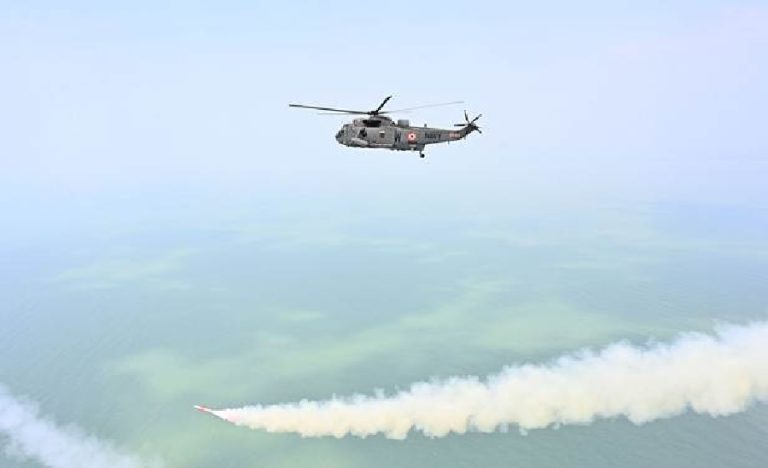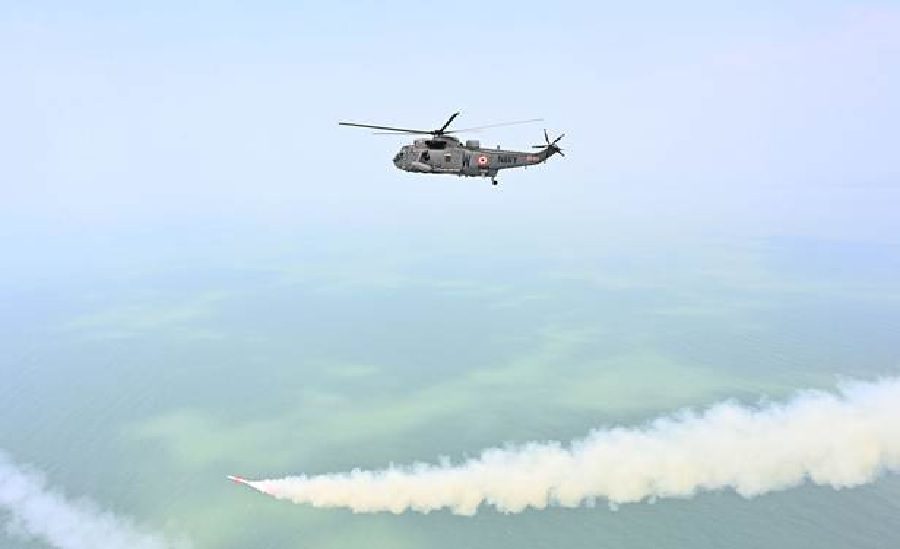
New Delhi: In a significant boost to India’s maritime strike capabilities, the Defence Research & Development Organisation(DRDO), in collaboration with the Indian Navy, successfully carried out the maiden salvo launch of the Naval Anti-ship Missile-Short Range (NASM-SR). The test was conducted from a naval helicopter platform off the coast of the Bay of Bengal in Odisha.
The trial marked a major technological milestone, as two missiles were launched in quick succession from the same helicopter. This achievement makes it the first-ever salvo launch of an advanced air-launched anti-ship missile system in India.
All Test Objectives Successfully Achieved
According to official sources, all mission objectives were successfully met during the trial. The performance of the missiles was comprehensively tracked and validated using a range of sophisticated instruments deployed at the Integrated Test Range (ITR), Chandipur.
Key tracking systems included radar, electro-optical sensors, and telemetry systems, which captured detailed flight data. Notably, the missiles demonstrated precise “waterline hit capability,” indicating their effectiveness in targeting enemy ships at critical points to ensure maximum damage.
The test launches were witnessed by senior scientists from DRDO, representatives from the Indian Navy and the Indian Air Force, as well as Development-cum-Production Partners (DcPP).
Read also: DRDO Unveils Advanced Tracked and Wheeled Armoured Platforms with Crewless 30 mm Turret
Advanced Indigenous Technologies Power NASM-SR
The NASM-SR missile is equipped with advanced indigenous technologies, showcasing India’s growing self-reliance in defence systems. It uses a solid propulsion booster coupled with a long-burn sustainer for enhanced performance.
Several critical subsystems have been indigenously developed, including:
- A state-of-the-art seeker
- Integrated avionics module
- Advanced navigation and guidance systems based on fibre-optic gyroscope-based Inertial Navigation System
- Radio-altimeter for precision targeting
- Advanced control and guidance algorithms
- High-bandwidth two-way data link
- Jet-vane control mechanism
These systems collectively ensure high accuracy, reliability, and operational flexibility in complex maritime environments.
Multi-Lab Collaboration Drives Development
The missile system has been developed by the Research Center Imarat, Hyderabad, in collaboration with several other DRDO laboratories. These include the Defence Research & Development Laboratory, Hyderabad; High Energy Materials Research Laboratory, Pune; Terminal Ballistics Research Laboratory, Chandigarh; and ITR Chandipur.
Production of the missiles is currently underway through Development-cum-Production Partners (DcPP), with active participation from Indian industries and emerging start-ups, further strengthening the country’s defence manufacturing ecosystem.
Leadership Applauds Successful Trial
Defence Minister Rajnath Singh congratulated DRDO, the Indian Navy, the Indian Air Force, and industry partners, including DcPP, for the successful maiden salvo launch. He noted that the development of the NASM-SR missile would significantly enhance the operational capabilities of India’s defence forces.
Dr Samir V Kamat, Secretary of the Department of Defence R&D and Chairman of DRDO, also lauded the teams involved in achieving this milestone, highlighting their dedication and technical excellence.
Strategic Boost to India’s Maritime Defence
The successful testing of the NASM-SR missile represents a critical advancement in India’s naval warfare capabilities. With its ability to be launched from helicopters and execute precise strikes on enemy vessels, the system adds a potent dimension to India’s maritime strike arsenal.
This achievement underscores India’s continued progress towards defence self-reliance and strengthens its preparedness in safeguarding maritime interests.