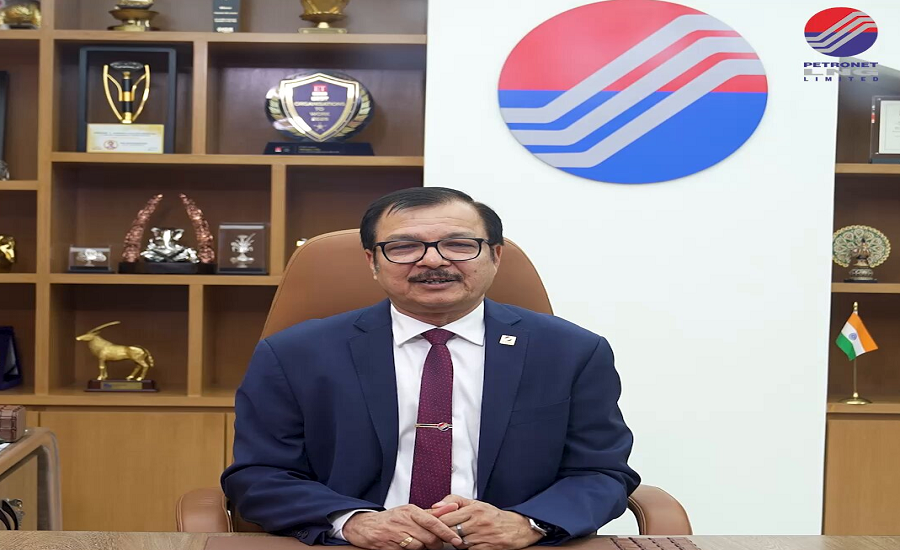
New Delhi: The Union Cabinet’s approval of the GOBARdhan (National Circular Bioenergy Scheme) has been welcomed as a major step towards India’s clean energy transition, with Petronet LNG Limited (PLL) MD & CEO A.K. Singh describing the initiative as a “gamechanger” that could transform waste into wealth while driving rural economic growth.
Singh said the scheme can create a new economic ecosystem around agricultural residue, cattle dung, municipal organic waste and other biomass resources, converting them into clean energy and high-value organic manure.
According to him, the initiative has the potential to create a virtuous cycle of rural prosperity, additional income for farmers, large-scale employment generation and greater domestic energy security.
GOBARdhan to Turn Rural Waste into Income
At the heart of the scheme is the idea of converting India’s large biomass and organic waste resources into commercially valuable products.
Singh emphasised that for farmers and rural communities, the most important benefit would be the transformation of otherwise discarded rural waste into a source of secure and additional income.
Agricultural residue, cattle dung and other biomass that traditionally have limited economic value can instead become feedstock for the production of Compressed Biogas (CBG) and organic manure.
This waste-to-wealth approach could provide rural households with an additional revenue stream while simultaneously addressing waste management and clean energy requirements.
Read also: Cabinet Approves ₹23,731 Crore GOBARdhan Scheme to Scale Up India’s Compressed Biogas Revolution
₹23,731 Crore Scheme to Strengthen CBG Ecosystem
The GOBARdhan scheme has a total financial outlay of ₹23,731 crore and is scheduled to be implemented from FY 2026-27 to FY 2035-36.
The scheme seeks to establish a stronger and more predictable ecosystem for compressed biogas production by providing policy support and commercial incentives to the sector.
One of the key features highlighted by Singh is the government’s assured offtake price of ₹2,110 per MMBtu, which he described as a lucrative incentive for CBG producers and project developers.
The assured pricing mechanism is intended to provide greater visibility to investors and producers while encouraging the development of new CBG capacity.
Nearly 10-Fold Growth in Domestic CBG Production
Singh highlighted the potential of the scheme to significantly increase India’s domestic CBG production.
According to his assessment, the initiative could drive nearly 10-fold growth in domestic CBG production, creating a larger indigenous source of gaseous fuel.
A significant increase in CBG availability could, in turn, reduce the country’s dependence on imported natural gas and contribute to a reduction in LNG imports.
The move assumes significance as India continues to look for ways to strengthen domestic energy security and reduce exposure to fluctuations in international energy markets.
From Farm Waste to Clean Energy
The scheme is designed around a broad range of biomass resources rather than a single feedstock.
These include:
- Agricultural residue
- Cattle dung
- Municipal organic waste
- Other biomass resources
By converting these materials into clean energy, the initiative can simultaneously address multiple challenges, including waste management, rural income generation, clean fuel production and greenhouse gas emissions associated with unmanaged organic waste.
The resulting CBG can serve as a cleaner gaseous fuel, while the process can also generate organic manure that can be utilised in agriculture.
Rural India Could Become Clean Energy Hub
Singh also emphasised the wider socio-economic potential of the initiative.
The GOBARdhan framework could position villages as energy-generation centres, allowing rural India to play a larger role in meeting the country’s domestic clean energy requirements.
Instead of treating organic waste as a disposal problem, the policy seeks to create an economic model in which waste is collected, aggregated, processed and converted into commercially useful energy and agricultural products.
This could create a chain of economic activity within rural areas and help generate employment opportunities close to the source of the biomass.
Large-Scale Employment Opportunities
The development of a nationwide CBG ecosystem could create both direct and indirect employment.
Job opportunities can emerge across the value chain, including waste collection, biomass aggregation, transportation, processing, plant operations and distribution.
Such activity could provide new livelihood opportunities in rural areas while creating demand for local services and supporting businesses associated with the bioenergy sector.
Singh said this process could generate a virtuous cycle of holistic socio-economic development and contribute to rural prosperity.
Integrated National Framework to Bring Policy Predictability
Singh also welcomed the Integrated National Framework being introduced alongside the scheme.
According to him, greater policy predictability will be crucial for attracting investment into the CBG ecosystem.
The framework is expected to strengthen the sector through measures including assured offtake, stable pricing, capital assistance, pipeline connectivity and improved access to finance.
Long-term visibility on these parameters could help developers plan CBG projects with greater confidence and encourage investment in new production capacity.
CBG Could Help Reduce LNG Import Dependence
The push for domestic CBG production comes against the backdrop of India’s substantial dependence on imported natural gas.
A stronger domestic CBG ecosystem could provide an indigenous alternative to a portion of imported gaseous fuels and thereby improve energy security.
Singh’s assessment is that the projected increase in domestic CBG production under GOBARdhan could contribute to a substantial reduction in LNG imports.
The initiative could therefore have implications beyond the renewable energy sector, extending to India’s broader strategy for energy security, import substitution and rural economic development.
GOBARdhan Blending Target
The scheme also provides a defined trajectory for CBG blending.
The target blending trajectory is set at 3% in 2026-27, 4% in 2027-28 and 5% from 2028-29 onwards.
The phased approach is intended to create a growing market for domestically produced CBG and provide greater certainty to producers as capacity expands.
A predictable demand environment, combined with assured offtake and other financial and infrastructure support, could help accelerate investment in CBG projects.
Protecting India from Global Energy Shocks
The GOBARdhan initiative also carries strategic significance for India’s energy security.
By developing domestic alternatives to imported natural gas, India can reduce its exposure to disruptions in international energy supply chains and fluctuations in global LNG prices.
The development of indigenous bioenergy resources could therefore act as an additional layer of protection against geopolitical tensions and disruptions affecting global energy routes.
Petronet LNG Reaffirms Commitment
Welcoming the Cabinet approval, A.K. Singh reiterated Petronet LNG’s commitment to supporting the implementation of the initiative and helping make GOBARdhan a success.
The company views the scheme as an important opportunity to strengthen India’s clean energy ecosystem while creating economic value from agricultural and organic waste.
The broader vision is to establish a circular model in which waste generated in rural and urban areas becomes a resource for clean energy production, employment generation and sustainable agricultural practices.
Key Numbers at a Glance
- Total Financial Outlay: ₹23,731 crore
- Implementation Period: FY 2026–27 to FY 2035–36
- Administered Price: ₹2,110 per MMBtu
- CBG Blending Target (2026–27): 3%
- CBG Blending Target (2027–28): 4%
- CBG Blending Target (from 2028–29): 5%
- Projected Domestic CBG Growth: Nearly 10-fold
Key Feedstocks: Agricultural residue, cattle dung, municipal organic waste and other biomass.
A Waste-to-Wealth Model for India’s Energy Future
The GOBARdhan scheme seeks to bring together India’s energy, agriculture, waste management and rural development priorities under one circular bioenergy framework.
For farmers, the initiative can create additional income from agricultural and animal waste. For rural communities, it can generate employment and economic activity. For the energy sector, it can expand domestic CBG availability and reduce dependence on imported fuels.
For India as a whole, the combination of waste-to-wealth, clean fuel production, rural employment and import substitution could make GOBARdhan an important component of the country’s long-term clean energy transition.
As A.K. Singh put it, the initiative has the potential to create a virtuous cycle in which waste becomes a source of energy, income, employment and wider socio-economic development.
About Petronet LNG
Petronet LNG Limited is a leading public sector undertaking (PSU) in India’s energy sector, focused on import, regasification, and distribution of liquefied natural gas (LNG). The company is committed to sustainable energy practices, innovation, and operational excellence, making it a key player in India’s energy transition.
Read also: Petronet LNG Receives CRISIL AAA/Stable Rating for ₹12,000 Crore Term Loan Facility