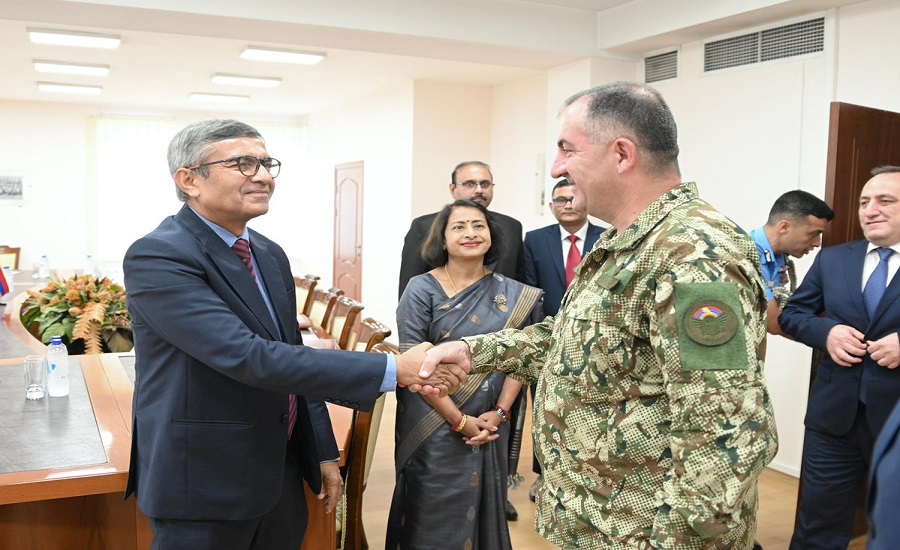
New Delhi: Defence Secretary Rajesh Kumar Singh, an IAS officer of 1989 batch from the Kerala cadre, arrived in Armenia on August 16 for a two-day visit aimed at strengthening defence and strategic cooperation between India and Armenia.
Singh was received in Yerevan by India’s Ambassador to Armenia and senior officials from the Armenian Defence Ministry. During the visit, he held talks with Armenian Defence Minister Suren Papikyan on ways to further expand bilateral defence cooperation.
According to India’s Defence Ministry, the two sides explored new avenues for strengthening defence ties and reaffirmed their commitment to deepening the strategic partnership.
Singh’s visit comes amid a rapid expansion of military cooperation between New Delhi and Yerevan, with Armenia emerging as one of the key overseas customers for Indian-made defence systems.
India-Armenia Defence Partnership Expands
India and Armenia have significantly expanded defence cooperation since 2020, with bilateral military engagement moving beyond traditional diplomatic ties towards equipment procurement, training, capability development and military modernisation.
Armenia has signed several major contracts for Indian defence equipment, including Swathi weapon-locating radars, Akash air-defence systems and Pinaka multi-barrel rocket launchers.
The partnership has also expanded into counter-drone capabilities and artillery systems, giving Armenia access to a broader range of Indian-origin military technologies.
For Armenia, closer defence ties with India provide an opportunity to diversify its military procurement sources amid changing regional security dynamics.
For India, the relationship provides an important overseas market for its indigenous defence industry while strengthening New Delhi’s strategic engagement in the South Caucasus.
Pinaka and Akash at the Centre of Defence Partnership
Among the most prominent Indian systems acquired by Armenia are the Pinaka multi-barrel rocket launcher and the Akash air-defence system.
Armenia became the first foreign customer for India’s indigenously developed Akash air-defence system after signing a deal in 2022.
The reported order, estimated at around $720 million for 15 systems, marked a major milestone for India’s defence-export ambitions.
Manufactured by Bharat Dynamics Limited (BDL), the Akash system is designed to engage aerial threats, including aircraft, guided missiles and unmanned aerial vehicles.
The system has added another layer to Armenia’s air-defence capabilities as the country seeks to modernise its armed forces and reduce its dependence on Russian-origin military equipment.
Armenia Procures Pinaka Rocket Systems
Armenia has also emerged as an important international customer for India’s Pinaka multi-barrel rocket launcher system.
Yerevan signed a contract in 2022 for four Pinaka batteries in a deal estimated at around ₹2,000 crore.
The contract covers launchers, command-and-control vehicles, logistics equipment and ammunition, including guided rockets.
The first batch of guided Pinaka rockets for Armenia was flagged off by Defence Minister Rajnath Singh from Nagpur in January 2026. Earlier deliveries of the system had begun in 2023.
Pinaka provides Armenia with a mobile rocket-artillery capability capable of delivering concentrated fire against targets at extended ranges. Guided variants further enhance the system’s precision and long-range strike capability.
Swathi Weapon-Locating Radars Marked Early Breakthrough
India’s defence exports to Armenia gained significant momentum in 2020, when Yerevan signed a contract for four Swathi weapon-locating radars.
The deal was estimated at around $40 million.
Developed by the Defence Research and Development Organisation (DRDO) and manufactured by Bharat Electronics Limited (BEL), Swathi is designed to detect and track incoming artillery, mortar and rocket fire.
The system can also determine the location from which hostile fire has originated, providing commanders with critical information for counter-battery operations.
The acquisition gave Armenia an important capability for detecting enemy artillery positions and responding to incoming fire.
Counter-Drone Systems Add New Dimension
India has also supplied counter-drone technology to Armenia as Yerevan seeks to strengthen its defences against unmanned aerial systems.
Drones have become increasingly important in modern conflicts, playing roles in surveillance, target acquisition and direct attacks.
Indian counter-drone systems are designed to detect, track and neutralise hostile unmanned aerial vehicles and protect military positions and other critical infrastructure.
For Armenia, the acquisition forms part of a broader effort to develop a more diversified and layered defence architecture based on the lessons of recent conflicts.
Indian Artillery Systems Also Expand Armenia’s Arsenal
Armenia’s interest in Indian defence equipment extends beyond missiles, radars and rocket artillery.
Indian artillery platforms, including the 155mm Trajan towed gun and MArG 155 self-propelled artillery system, have also been showcased alongside Armenian military equipment.
The MArG 155 is mounted on a 4×4 platform, giving it high mobility, while the Trajan is designed for rapid deployment and repositioning.
Together with Swathi weapon-locating radars and Pinaka, these systems provide Armenia with capabilities spanning target detection, surveillance, counter-battery operations and long-range artillery fire.
India-Armenia Defence Deals Near $2 Billion
Since 2020, India and Armenia have signed defence contracts reportedly worth nearly $2 billion, covering a broad range of military systems.
The deals represent one of India’s most significant defence-export relationships and have transformed Armenia into a major overseas user of Indian-origin military equipment.
The growing portfolio includes weapon-locating radars, air-defence missiles, rocket artillery, artillery systems and counter-drone technology.
The relationship is also gradually expanding beyond equipment sales towards military training, capability development and modernisation.
Why Armenia Is Turning to India
The expansion of India-Armenia defence cooperation has been closely linked to changes in Yerevan’s security calculations following the 2020 Armenia-Azerbaijan war and subsequent developments in the region.
The conflict exposed vulnerabilities in Armenia’s air-defence, surveillance and artillery capabilities and prompted the country to reassess its military procurement strategy.
Armenia has since sought to diversify its defence suppliers rather than relying heavily on traditional sources.
India has emerged as an important partner because of its ability to offer indigenous military systems across several capability areas.
India’s own experience of operating and upgrading Soviet- and Russian-origin military equipment has also provided a degree of familiarity relevant to Armenia’s existing defence architecture.
Defence Cooperation Moving Beyond Arms Sales
The India-Armenia relationship is increasingly moving beyond individual defence contracts.
Military cooperation now includes discussions on training, capability development and modernisation, with both sides looking at ways to create stronger institutional links between their armed forces.
Mr Singh’s visit follows high-level military engagement between the two countries, including the visit of Armenia’s Chief of General Staff Lt Gen Edvard Asryan to New Delhi, where he held discussions with Singh and other Indian officials.
Those talks covered areas including military cooperation, training, capability development and modernisation.
The latest visit by India’s Defence Secretary is expected to build on those discussions.
Strategic Significance for India
For New Delhi, Armenia has emerged as an important showcase for India’s growing defence-export capabilities.
Armenia is now operating or procuring multiple Indian-origin systems across different capability categories. This provides Indian manufacturers with an overseas user base and demonstrates the performance of indigenous defence technologies in an operational environment.
The partnership also has a wider geopolitical dimension.
Armenia is seeking to diversify its external security partnerships, while India’s defence engagement with the country gives New Delhi a stronger strategic presence in the South Caucasus.
The relationship also takes place against the backdrop of Pakistan’s deepening defence cooperation with Azerbaijan and Türkiye, adding another strategic dimension to India’s growing engagement with Yerevan.
From Defence Exports to Strategic Partnership
India’s relationship with Armenia is increasingly evolving from a buyer-seller relationship into a broader strategic partnership.
While defence equipment remains at the heart of cooperation, both countries are now looking at training, technology, capability development and institutional military engagement.
IAS Singh’s latest visit to Yerevan is therefore significant not merely because of Armenia’s continuing interest in Indian weapons, but because it reflects the broader effort by New Delhi and Yerevan to deepen their strategic and defence relationship.
As Armenia continues to diversify its military partnerships and India seeks to expand its indigenous defence exports, the two countries are finding increasing convergence in their strategic interests.
Read also: India Strengthens Global Defence Footprint With New Armenia Partnership