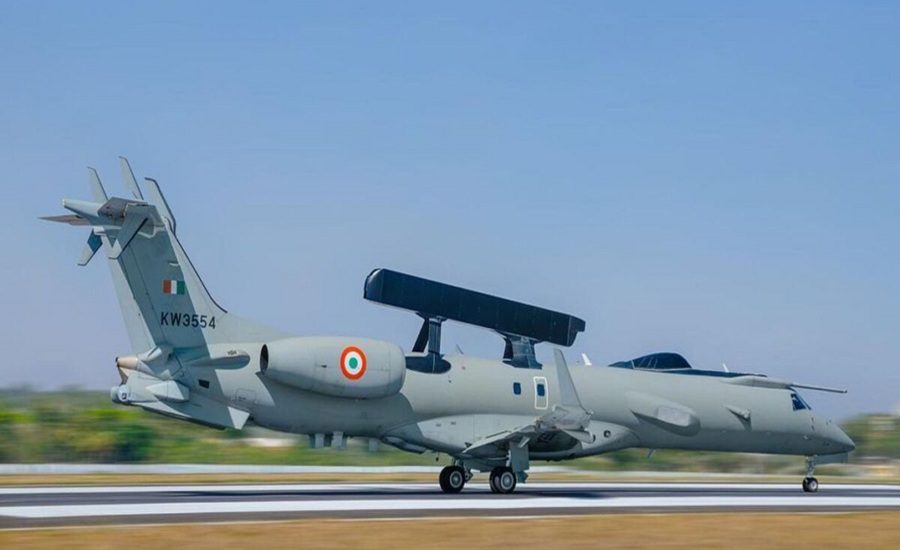
New Delhi: India has taken a major stride forward in its defence modernisation journey. The Defence Research and Development Organisation (DRDO), in partnership with the Indian Air Force (IAF) and aerospace industry partners, has secured approval for the next-generation airborne early warning and control (AEW&C) system known as NETRA Mk-2.
The key details: six aircraft, an expenditure of around ₹20,000 crore, and a switch to the larger Airbus A321 platform, all designed to deliver extended duration, greater range and superior sensor capabilities.
Background & Need of NETRA Mk-2
The impetus behind this initiative lies in the evolving security environment for India. With heightened tensions in regions such as the India-China border and cross-border dynamics with Pakistan, India’s airborne surveillance and command architecture required— and still requires — an upgrade. The small AEW&C platforms of the past have served well, but limitations in endurance, sensor range and network integration have become increasingly apparent.
Read also: India’s Su-30MKI Get RCS reduction upgrade: Radar-Absorbent Paint Entering Fleet Trials
Earlier, the NETRA series (Mk-1 and onwards) gave India a credible “eye-in-the-sky.” However, the demand for far-greater coverage, deeper reach and extended loiter time made the case for the Mk-2 clear.
What’s Changing with NETRA Mk-2
Here are the headline enhancements and changes:
Platform Upgrade: The move to a converted Airbus A321 airliner offers significantly larger internal volume, greater fuel capacity and longer sortie durations compared with the Embraer platforms used for earlier versions.
Sensor and Radar Suite: The Mk-2 will feature indigenous AESA (Active Electronically Scanned Array) radars, dorsal-mounted for near 360° coverage, improved detection range (500 km+ is cited in open sources) and integrated ELINT/SIGINT/EO/IR sensors.
Mission Systems & Integration: Enhanced mission avionics, command-and-control systems and seamless integration into the IAF’s network-centric architecture are central features. These efforts tie into the broader Integrated Air Command and Control System (IACCS).
All-Weather / Extended Operations Capability: The upgraded system is being tailored to operate in adverse weather, at higher altitudes and over extended maritime zones — critical for India’s Indian Ocean Region focus.
Strategic Impact of NETRA Mk-2
The NETRA Mk-2 project is not simply about one platform. Its implications include:
Force Multiplier: By increasing airborne surveillance hours, breadth of sensor coverage and faster data-fusion, it provides the IAF with a significant operational edge in detecting threats — whether aircraft, cruise missiles, low-RCS drones or maritime vessels.
Indigenous Capability Strengthening: The project furthers India’s “Make in India” defence motto — moving from simply buying platforms to designing, integrating and producing complex systems. This elevates domestic industry and lowers dependence on foreign systems.
Broader Defence Ecosystem Boost: Large-scale defence programmes like this stimulate local supply-chains — electronics, radar manufacturing, mission systems, structural conversions.
Geostrategic Signalling: With this upgrade, India signals to regional actors that its surveillance and command architecture is strengthening, which may act as a deterrent and stabiliser in contested airspaces.
Timeline, Costs & Execution of NETRA Mk-2
The Cabinet Committee on Security has reportedly approved the ₹20,000 crore cost estimate, underlining the seriousness of the undertaking.
The projection is that the programme will roll out over the next few years — sources suggest first flights and initial deliveries may begin by 2026-27, with full operational capability by the end of the decade.
Aircraft conversion (from civilian to military configuration), radar integration, mission control system installation and certification are all significant work streams.
Challenges & Considerations
While the path forward is promising, some key challenges merit attention:
Conversion Complexity: Retrofitting a commercial airliner (A321) into a military AEW&C platform involves structural strengthening, power/air-conditioning upgrades, acoustic modifications, certification hurdles.
Integration of Complex Systems: Bringing together radar, sensors, communications, data-links and mission consoles is a major systems-engineering effort — timelines need to be carefully managed.
Technology Transfer & Supply-Chain Readiness: True indigenous capability requires robust domestic supply chains for high-end electronics, radars and mission systems — any bottleneck could affect production.
Operational Readiness & Training: Equipping the IAF not only with hardware but also trained operators, maintenance infrastructure and networked integration is essential to realise full benefit.
Importance of NETRA Mk-2 for India
For the Indian defence ecosystem, the NETRA Mk-2 programme marks a turning point. It aligns with several long-term priorities:
Air Domain Awareness: With borders spanning land and maritime zones, India’s ability to monitor wide swathes of air-space and surface threats will be significantly improved.
Strategic Autonomy in Surveillance: By investing in indigenous AEW&C, India reduces reliance on foreign-supplied systems and retains more sovereign control over design, upgrades and export potential.
Export Potential: Once matured, such platforms could attract export interest — a boost to “Indian defence-exports” ambitions.
Integration with Network-Centric Warfare: The Mk-2 is a node in a larger air-and-sea surveillance architecture, feeding real-time data to decision-makers, fighter units and ground nodes.
Way Ahead
The approval of the NETRA Mk-2 programme is more than a headline-number. It reflects India’s commitment to reinforce its air-surveillance frontier, modernise its airborne command capability and build indigenous defence strength.
Read also: From Factories to Ships: India’s 200 MW Nuclear Reactors Set to Change the Game
If executed well, this step will amplify India’s deterrence posture and bolster its readiness in a contested and dynamic regional air-environment.
For defence-industry watchers, the next few years will be critical as prototype trials start, system-integration matures and India’s “eyes in the sky” begin to patrol with new vigour.