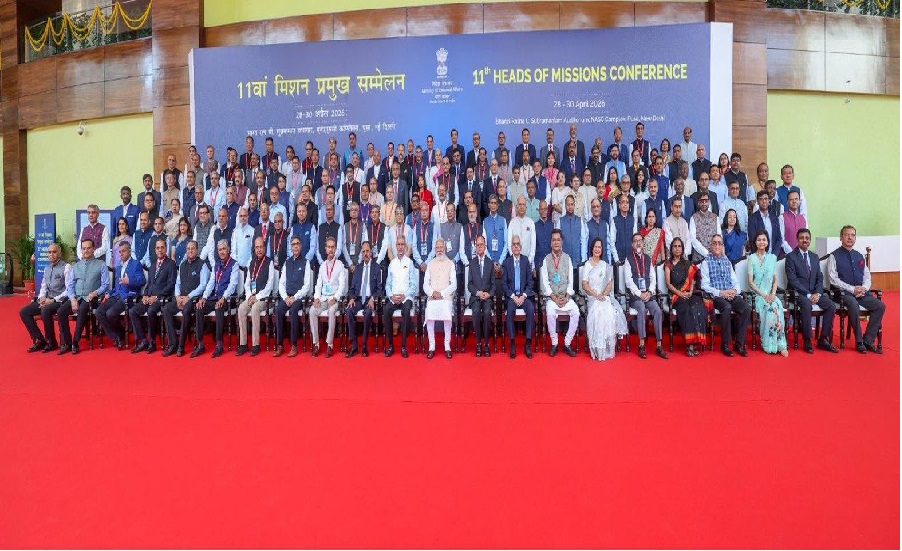
New Delhi: At a time of mounting geopolitical tensions and shifting global alignments, India convened its 11th Heads of Mission (HoM) Conference from April 28 to 30, 2026, bringing together its top diplomats to reassess foreign policy priorities and chart a strategic roadmap for the future.
Organised by the Ministry of External Affairs, the three-day conference saw participation from Indian ambassadors and high commissioners posted across the world. The high-level gathering focused on strengthening India’s global engagement and aligning diplomatic efforts with long-term national objectives.
Top Leadership Sets Strategic Direction
The conference was addressed by Prime Minister Narendra Modi, External Affairs Minister S. Jaishankar, National Security Advisor Ajit Doval, and Chief of Defence Staff Anil Chauhan.
Prime Minister Modi emphasised the need for stronger global partnerships and a proactive diplomatic approach aligned with India’s vision of becoming a developed nation by 2047. He urged diplomats to play a key role in enhancing India’s global standing through strategic engagement.
External Affairs Minister Jaishankar highlighted the rapid expansion of India’s diplomatic footprint in recent years and called for agility and adaptability in navigating an increasingly complex international environment.
Read also: I&B Ministry Proposes 40 IIS Posts in Foreign Missions to Boost India’s Global Media Outreach
Theme: Reforming Indian Diplomacy for 2047
The central theme of this year’s conference—“Reforming Indian Diplomacy for 2047”—reflected India’s long-term strategic vision. Discussions centred on aligning foreign policy with economic growth, technological advancement, and national security priorities.
Diplomats deliberated on how India can position itself as a global leader while safeguarding its interests in a rapidly evolving geopolitical landscape.
Focus on Key Geopolitical Challenges
The timing of the conference was particularly significant given the array of global challenges confronting India. Key issues discussed included:
- Ongoing tensions in West Asia impacting energy security
- Evolving strategic ties with the United States
- China’s expanding geopolitical influence
- Changing dynamics involving Pakistan and BRICS nations
Detailed sessions were held on India’s neighbourhood policy, developments in West Asia, and the broader global order, reflecting the need for a nuanced and multi-dimensional diplomatic approach.
‘3Ts’ Strategy: Trade, Technology and Tourism
A major highlight of the conference was the emphasis on expanding India’s global footprint through the “3Ts” strategy:
- Trade: Enhancing economic partnerships and boosting exports
- Technology: Strengthening collaborations in emerging and critical technologies
- Tourism: Promoting India as a global tourism destination
This integrated approach is aimed at driving economic growth while reinforcing India’s soft power globally.
Security and Strategic Preparedness
The conference also featured in-depth discussions on security challenges and military preparedness. National Security Advisor Ajit Doval and CDS General Anil Chauhan provided strategic inputs on evolving threats and defence readiness.
These sessions underscored the importance of synchronising diplomatic and security strategies to address both traditional and emerging challenges.
Toward a More Coordinated Diplomatic Approach
A key takeaway from the conference was the emphasis on making India’s diplomacy more coordinated, outcome-driven, and future-ready. The discussions highlighted the need for:
- Stronger inter-agency coordination
- Data-driven decision-making
- Greater responsiveness to global developments
As India navigates a complex global environment, the HoM Conference reinforced the importance of a unified and strategic diplomatic framework.
Conclusion
The 11th Heads of Mission Conference marks a crucial moment in India’s foreign policy journey. With a clear focus on reform, resilience, and global engagement, the country is positioning itself to effectively respond to emerging challenges while advancing its long-term vision of becoming a developed nation by 2047.