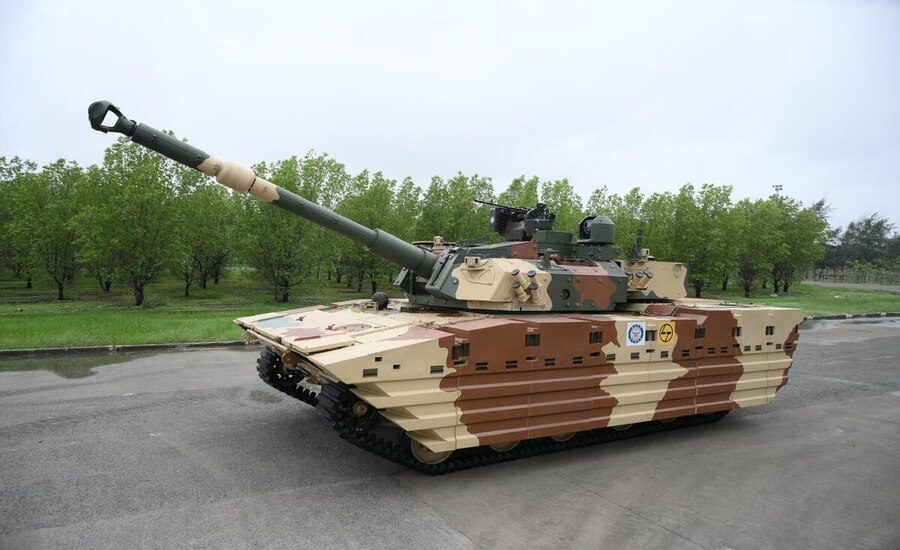
New Delhi: India is at a crucial juncture in its defence vehicle modernization. The requirement for an agile, lightweight tank—capable of operating in mountainous terrain and being air-transportable—was driven by the 2020 standoff in eastern Ladakh, where heavier main battle tanks found limitations.
Major Highlights of Zorawar lightweight Tank
The programme under the umbrella of the Defence Research & Development Organisation (DRDO) and the Indian Army aims for a 25-tonne class “light tank” that can manoeuvre at high altitude, be air-lifted by transport aircraft like C-17/C-130J, and deploy rapidly in difficult terrain.
Until now, the first phase has focused on the vehicle being developed by Larsen & Toubro (L&T) in cooperation with DRDO’s CVRDE lab, under the name “Zorawar”.
Now, the competition has broadened and private players such as TATA Advanced Systems and Mahindra Defence Systems have been given prototype funding under the ‘Make-I’ category—hinting at a dual-source strategy.
Light Tank Race Accelerates After Zorawar Lightweight Tank Successful Launch
According to the reports, India’s light tank programme has entered a decisive phase – the Zorawar prototype is undergoing advanced user trials, while Tata and Mahindra are rapidly building competing prototypes.
Key points to note:
- Zorawar, developed by L&T and DRDO’s CVRDE, is now in endurance and mobility trials in simulated high-altitude terrain (e.g., Ladakh conditions above 16,000 ft).
- The second prototype of Zorawar features refined suspension geometry, improved amphibious sealing systems, and weight optimisations.
- Tata Advanced Systems is working on a lighter modular chassis built for Himalayan and amphibious operational roles, with digital battle-management and drone-link integration.
- Mahindra Defence’s variant emphasises active protection systems (APS), sensor-fusion and survivability enhancements, intended for hybrid/terrain-versatile operations.
- The Ministry of Defence (MoD) appears to be moving toward a “competitive trial” or dual-induction model—where more than one design may enter limited production before full-scale induction—to encourage innovation and multiple supply sources.
- The initial procurement order size is 59 tanks for Phase-I, but plans indicate the number could rise significantly—multiple regiments potentially, signalling orders in the hundreds.
Why this matters: Strategic & Industrial Implications
Strategic advantages
- The lighter tank class addresses terrain-specific challenges along the Indo-China border (Himalayan, Ladakh, Arunachal sectors) where heavier tanks face mobility, transport and deployment constraints.
- Enhanced mobility, rapid deployment and air transportability give the Indian Army options for faster response and flexible operations.
- Indigenous development reduces reliance on foreign imports—critical in an era of supply-chain constraints and complex geopolitical alignments.
Industrial & policy significance
- This marks a push toward the government’s “Atmanirbhar Bharat” (self-reliant India) mission in defence manufacturing—encouraging both public-sector and private-sector players in armoured vehicle production.
- Entry of Tata and Mahindra signals the opening up of a major defence procurement opportunity to private industry, boosting competition, innovation and domestic value-addition.
- Supply-chain maturation is evident: e.g., turbine blade casting, machining, indigenous power-pack development are now part of the ecosystem.
- A dual-source strategy hedges risks and fosters market competition, rather than reliance on a single vendor—a significant shift in procurement philosophy.
Timeline & Next Steps
Design & Prototype Phase: Completed for Zorawar’s first iterations; now undergoing advanced trials.
Prototype Funding & Competition: Tata and Mahindra have been approved to build their Make-I prototypes.
User Trials & Selection: The Indian Army will evaluate prototypes in various conditions (desert, high altitude, amphibious). Dual induction possible.
Initial Production & Scale-Up: The first batch of 59 tanks is earmarked, but scale-up to multiple regiments is likely.
Target Induction: The programme aims for induction by the late 2020s; some earlier sources quoted 2027 for Zorawar.
Challenges & Considerations
Development Risk: Despite rapid progress, the complexity of high-altitude operations, amphibious capability and indigenous power-packs means delays remain possible.
Cost vs Performance: The balance between weight, protection, firepower, mobility and cost will be crucial. Light tanks carry trade-offs in armour and survivability.
Competition & Vendor Capability: Private firms must scale manufacturing, ensure supply-chain maturity, and meet Army’s reliability standards.
Export & Future Growth: While domestic needs drive the programme, export potential could enhance economics—but geopolitical sensitivities may arise.
Way Forward
- Watch for official announcements from the Ministry of Defence on prototype selection, contract awards, trial results and induction timelines.
- Monitor the competitive landscape – How Tata’s and Mahindra’s entries compare with L&T-DRDO’s Zorawar in terms of performance, cost and readiness.
- Keep an eye on sub-systems – Indigenous power-packs, active protection systems (APS), drone-integration and modular chassis – all key differentiators.
- Assess implications for border strategy – Lighter, mobile armour could alter the deployment dynamics in mountain sectors.