https://indianmasterminds.com

ADVERTISEMENT
ADVERTISEMENT

Samudrayaan Mission Explained: How This 500-Metre Dive Strengthens India’s Deep-Ocean Capabilities

India’s Samudrayaan mission is gearing up for a 500-metre test dive of the Matsya-6000 submersible in May 2026.
Samudrayaan mission
Indian Masterminds Stories

New Delhi: India’s Samudrayaan mission is fast gaining momentum as the nation prepares for the Matsya-6000 submersible’s maiden 500-metre dive in May 2026, a major milestone toward deep-sea exploration goals.

This first full-depth test marks a significant step in India’s effort to become a leader in crewed underwater missions and reinforces its presence in global ocean science and resource exploration.

What Is the Samudrayaan Mission?

Samudrayaan is India’s ambitious deep-sea exploration program under the Ministry of Earth Sciences and is part of the wider Deep Ocean Mission (DOM). Designed to explore the deep ocean floor and ocean resources, it aims to gather scientific data, study marine biodiversity, and potentially discover valuable minerals such as polymetallic nodules.

Read also: Black Shark Torpedo Deal: How India’s ₹1,896 Crore Agreement With Italy Will Transform Indian Navy’s Underwater Combat Power

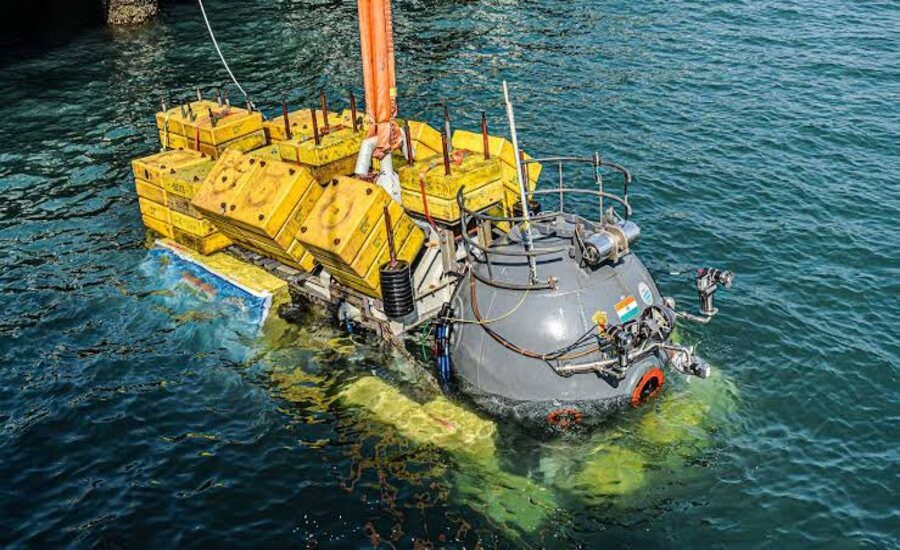
The centerpiece of the mission is the Matsya-6000, an indigenously engineered submersible capable of carrying three aquanauts and operating at depths up to 6,000 metres — the sort of capability only a few nations currently possess.

Fast-Tracking the 500-Metre Maiden Dive

Officials at the National Institute of Ocean Technology (NIOT) in Chennai are actively integrating and testing the Matsya-6000 for its first dive to 500 metres in May 2026.

This shallow-to-mid-depth dive is critical: it allows engineers to assess systems like pressure hull strength, life support units, navigation sensors, buoyancy control and communication systems under real ocean conditions.

Instead of conducting multiple shallow trials first, NIOT plans to move directly to this 500-metre testing phase, reflecting confidence in the vehicle’s indigenous engineering.

Why the 500-Metre Dive Matters

The May 2026 dive is not the final goal — that remains the full target of a 6,000-metre crewed voyage. However, this intermediate test will:

  • Validate safety and operational systems before deeper missions.
  • Build confidence for future deep-sea crewed missions, the first of their kind in India.
  • Position India alongside nations such as the United States, Russia, China, France, and Japan, which have achieved similar underwater exploration milestones.

Science, Strategy, and Global Context

Deep-sea missions like Samudrayaan serve multiple purposes:

Scientific Discovery

Exploration at several hundred to thousands of metres can help scientists understand marine ecosystems, geology, deep-sea life, and ocean circulation, enriching knowledge that could aid climate science and oceanography.

Resource Potential

The Indian Ocean’s seabed is believed to contain polymetallic nodules, rich in metals like manganese, nickel, cobalt, and copper — resources critical for electronics, batteries and clean technologies.

Russia, China, the United States, Japan, and France currently lead in crewed ocean exploration. India is gradually catching up and could join this elite group upon the success of Samudrayaan’s deep-sea milestones.

Preparing for the Full 6,000-Metre Objective

The 500-metre test dive is a precursor to the ultimate objective of a 6,000-metre crewed descent by late 2026 or 2027. Once complete, that mission will push India into a very select global club of countries with deep-sea crewed submersible capability.

Officials believe the lessons learned in May will guide enhancements to support life support systems, structural integrity and emergency protocols for deeper operations.

Beyond Exploration — The Future of Indian Marine Technology

The Samudrayaan project also aligns with India’s Blue Economy initiative, which seeks sustainable economic growth from ocean resources. Investment in deep-sea technology, marine research, and human skills development could lead to breakthroughs in science, climate understanding, industry and even ocean-based tourism.
Read also: India Becomes 6th Nation Ever: Matsya-6000 Submersible Ready for Epic 6000m Ocean Dive, A Boost to Samudrayaan Mission


Indian Masterminds Stories
Join our WhatsApp Channel
ADVERTISEMENT
ADVERTISEMENT
Related Stories
ADVERTISEMENT
ADVERTISEMENT
NEWS
J&K to Roll Out 20 AI Governance Use Cases; MeitY Centre of Excellence at IIT Jammu by August 2026 Atal Dullo
J&K to Roll Out 20 AI Governance Use Cases; MeitY Centre of Excellence at IIT Jammu by August 2026
NIELIT, SCL Mohali Launch Indigenous 1
NIELIT, SCL Mohali Launch Indigenous 1.2 µm Process Design Kit on eChipHub to Boost India's Semiconductor Ecosystem
Atanu Chakraborty
Who Is IAS Atanu Chakraborty? Ex-Finance Secretary to Head West Bengal’s 7th State Pay Commission
Manoj Kumar Agarwal IAS
Who Is IAS Manoj Kumar Agarwal? IIT Kanpur Graduate Gets 6-Month Extension as West Bengal Chief Secretary
ChatGPTImageJul232026at11_54_45P
Who is IAS Naresh Pal Gangwar? IIT Graduate Appointed New Education Secretary Amid NEET Row Protests; Vineet Joshi Shifted
SFAC MD
ACC Approves Major Reshuffle with 17 Top-Level Changes; 13 IAS Officers Get Secretary-Level Appointments, Sushil Kumar Lohani Named Animal Husbandry OSD
DRDO Develops India's First Indigenous 350 kg Thrust Turbo Jet Engine, Marking Major Defence Milestone
DRDO Successfully Tests Kusha Missile, Boosting India's Indigenous Air Defence Capability
ADVERTISEMENT
ADVERTISEMENT
Videos
Piyusha Jagtap
How IFS Piyusha Jagtap Is Changing Conservation Through Stories, Communities and Compassion | Video Interview
Pulkit Khare
How Uttar Pradesh Is Preparing Its Youth for the AI Revolution
Haryana Leads India's First AI-Powered Bird Census
ADVERTISEMENT
UPSC Stories
nitesh upsc
CSE 2025 AIR 562 Nitesh Chose India Over an American Dream and Reached Civil Services After Six Attempts
UPSC CSE 2025 AIR 562 Nitesh's inspiring journey from a small village in Madhya Pradesh to IIT Bombay,...
WhatsApp Image 2026-07-19 at 9.46
Why So Many UPSC Aspirants Fail Despite Studying So Hard
Many UPSC aspirants mistake attending lectures for preparation, but the examination rewards independent...
Sanjay Bagali and Deekshith N UPSC IFS 2025
How Trust, Teamwork and Persistence Helped Two Friends Crack UPSC IFS 2025
Read the inspiring UPSC IFS 2025 success story of Deekshith N (AIR 14) and Sanjay Bagali, whose friendship,...
CSR NEWS
NCL CSR
NCL Signs ₹11.71 Crore CSR MoU to Build 8-Km Road in Singrauli, Boost Rural Connectivity
Northern Coalfields Limited partners with MPRRDA to construct Obri-Kasaiya via Kanhaiya Dah road, improving...
MCL CSR
MCL to Build 5 Km BT Roads in Odisha’s Angul with ₹5.35 Crore CSR Support for Better Connectivity
Mahanadi Coalfields Limited signs MoU for road development in Athmallik NAC to improve all-weather transport...
WCL
WCL Partners with Narayana Institute Nagpur to Provide Free JEE Coaching Under Project TARASH
WCL signs MoU with Narayana Institute for the 4th batch of Project TARASH, offering expert JEE coaching...
ADVERTISEMENT
ADVERTISEMENT
ADVERTISEMENT
Latest
Sanjay Gehlot
Politics Without Politicians? How Retired IRS Officer Sanjay Gahlot Wants to Reimagine Democracy
J&K to Roll Out 20 AI Governance Use Cases; MeitY Centre of Excellence at IIT Jammu by August 2026 Atal Dullo
J&K to Roll Out 20 AI Governance Use Cases; MeitY Centre of Excellence at IIT Jammu by August 2026
ADVERTISEMENT
ADVERTISEMENT
ADVERTISEMENT
ADVERTISEMENT
ADVERTISEMENT
ADVERTISEMENT
ADVERTISEMENT
Videos
Piyusha Jagtap
Pulkit Khare
Haryana Leads India's First AI-Powered Bird Census
ADVERTISEMENT
ADVERTISEMENT