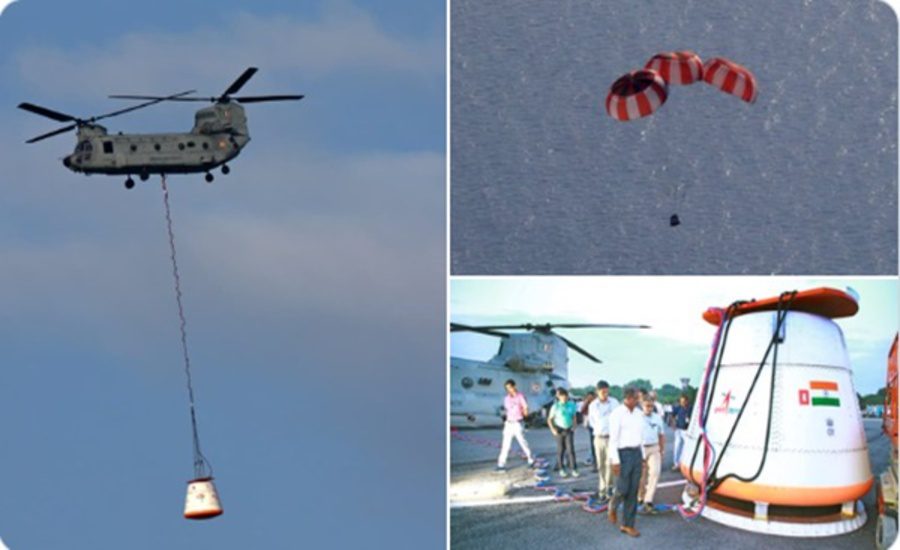
Jhansi: In a decisive stride towards human space-flight, the Indian Space Research Organisation (ISRO) has announced the successful completion of a critical test of the main parachutes for its Gaganyaan Crew Module.
The validation took place on 3 November 2025 at the Babina Field Firing Range (BFFR) in Jhansi, Uttar Pradesh.
This achievement adds a vital layer of assurance to India’s ambition to launch its first crewed mission and safely bring back astronauts from orbit.
Background of Gaganyaan Parachute Test
The Gaganyaan mission represents India’s first attempt at an independent human space-flight programme. The capsule will carry a three-member crew on a short orbital mission and ensure safe re-entry and landing.
A key element of this endeavour is the parachute-based deceleration and recovery system for the crew module.
Read Also: ISRO Mangalyaan 2: India’s Bold Mars Landing Mission Set to Redefine Space History by 2030
In previous tests such as the Integrated Air Drop Test (IADT-01) in August 2025, ISRO had validated portions of the system. The latest test is part of the ongoing Integrated Main Parachute Airdrop Tests (IMAT) aimed at qualifying the full parachute sequence under extreme conditions.
About the Gaganyaan Parachute Test & Technical Details
- The test conducted on 3 November 2025 at BFFR, Jhansi, simulated a drop of a test vehicle equivalent to the mass of the crew module from an altitude of about 2.5 km using an IAF IL-76 aircraft.
- The parachute system consists of 10 parachutes of four distinct types, arranged in a strict sequence:
- Two apex-cover separation parachutes to remove the protective cover of the parachute compartment.
- Two drogue parachutes to stabilize and slow the module.
- Three pilot parachutes that extract three main parachutes.
- Three main parachutes that decelerate the module to a safe landing speed.
- The system is built with redundancy; even if one of the three main parachutes doesn’t fully deploy, the module can still land safely with two.
During the recent test, ISRO specifically simulated an extreme scenario of delayed disreefing (delayed full opening) between two main parachutes to evaluate structural integrity under asymmetric load conditions. The test validated the module’s safe descent and landing.
The collaboration involved ISRO’s Vikram Sarabhai Space Centre (VSSC), Defence Research and Development Organisation (DRDO), Indian Air Force, and Indian Army.
Importance of the Gaganyaan Parachute Test
This successful test is highly significant for several reasons:
- Human-safety validation: The parachute recovery system is critical for ensuring astronaut safety during the re-entry and touchdown phase of Gaganyaan. Without proven reliable parachutes, the crewed mission cannot proceed.
- Mission readiness for crewed flight: With this test done, ISRO moves closer to its planned uncrewed demonstration flights and eventual crewed launch, currently envisaged in the first quarter of 2027.
- Technological maturity: Designing a human-rated spacecraft entails rigorous qualification. Achieving this milestone signals India’s growing capability in human spaceflight systems, positioning the nation among those capable of independent crewed missions.
- National prestige and defence-space linkage: The test strengthens India’s space and defence ecosystem, underpinning strategic capabilities and showcasing collaboration between ISRO, DRDO and defence services.
- Public confidence: Such transparent milestones increase public and stakeholder confidence in the mission schedule and technical robustness.
Challenges & Implications
Despite the success, several challenges remain:
- Final operational integration: Full qualification demands further tests under varied conditions (e.g., higher altitudes, ocean splashdown, varied weather) to cover all contingencies.
- Crew module systems readiness: Beyond parachutes, life-support, escape systems, orbital manoeuvre systems, and ground infrastructure must all align seamlessly.
- Mission schedule pressure: With crewed flight planned for early 2027, delays in any subsystem can cascade. Mission readiness demands strict timeline adherence.
- Recovery logistics: Safe landing involves sea-surface recovery, uprighting of the module if it flips, and range-safety management — all complex operations.
- Human-rating certification: Transitioning from unmanned tests to crewed launch requires certification of hardware, software and operational procedures to human-flight standards.
Implications of successful completion
- India edges closer to becoming the fourth country (after USSR/Russia, USA, China) with independent human space-flight capability.
- Boost to domestic aerospace industry, higher-education, defence-industry linkage and spin-off technologies.
- Potential inspiration for future missions (space station, lunar missions) and international partnerships.
Way Forward
Looking ahead, this is how ISRO and partners should proceed:
- Complete remaining parachute-qualification tests: Introduce range of altitudes, fail-safe conditions, splashdown scenarios.
- Execute uncrewed demonstration missions: Prior to sending astronauts, full system tests in orbit (G-1, G-2 etc) must confirm reliability.
- Integrate astronaut safety systems: Finalise crew-escape, life-support, guidance & control, thermal protection systems.
- Strengthen recovery & ground operations: Ensure sea-surface recovery, module retrieval, uprighting system (if necessary), and contingency response are fully rehearsed.
- Maintain schedule discipline: Keep to mission timelines, while preserving safety margins; avoid rushing human-flight elements.
- Public engagement & transparency: Regular updates build national commitment and inspire the next generation of aerospace talent.
- Leverage international collaboration & commercial spin-offs: Use the momentum to engage globally and extract technology spill-overs into defence, civil aerospace and startup ecosystems.