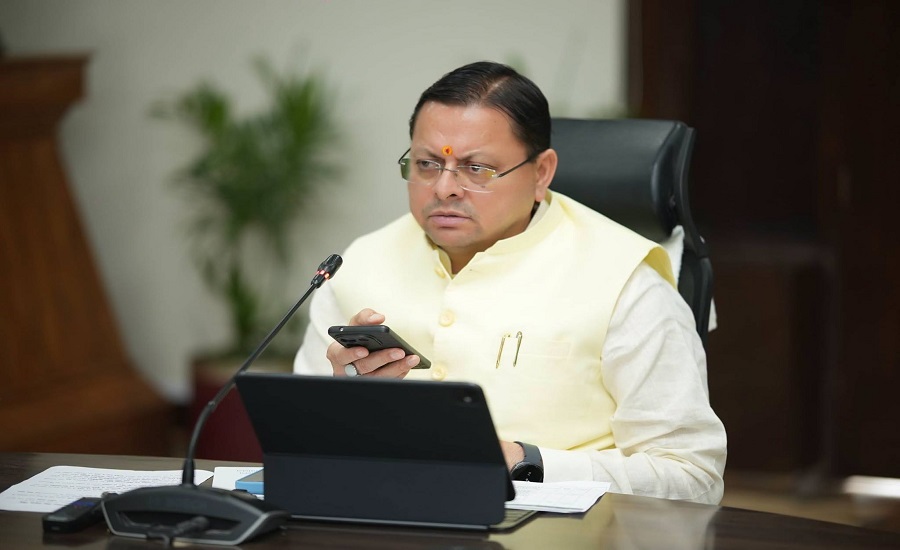
Dehradun: Uttarakhand Chief Minister Pushkar Singh Dhami has said the Gross Environmental Product (GEP) can help scientifically and economically assess the contribution of the state’s natural and environmental wealth. The approach, he said, will help policymakers better understand the value of natural resources and incorporate their contribution into development plans and policies.
Dhami made the remarks during a meeting with experts at his official residence in Dehradun on Saturday evening, held on the occasion of the release of the technical report on GEP.
Uttarakhand Needs a Model Suited to Its Geography
Dhami said Uttarakhand has unique geographical and environmental conditions, making it important to develop a GEP model suited to the state’s local conditions, requirements and natural resources.
He sought technical suggestions and support from experts and scientific institutions to further develop the framework.
The broader objective is to make environmental considerations a more measurable part of development planning rather than treating them separately from economic and infrastructure decisions. Uttarakhand has previously been recognised for conceptualising GEP alongside conventional economic measures such as GDP.
Read Also: Uttarakhand Plans Master and Zonal Framework for 8,000-Hectare Tehri Lake Area
Balancing Development With Environmental Protection
The Chief Minister stressed that development and environmental protection must move together.
He identified the Himalayas, forests, water sources, rivers, biodiversity and other natural resources as major strengths of Uttarakhand. Protecting these resources, he said, is important not only for ecological balance but also for the local economy, livelihoods and long-term sustainable development.
Dhami said future development plans should take into account the capacity of natural resources, environmental sensitivity and local conditions of different areas.
Linking Scientific Data With Policy
The meeting also focused on strengthening the scientific foundation of GEP.
Experts discussed the collection and analysis of environmental data and ways to connect scientific studies and technical information directly with policy formulation. The role of local communities in this process was also discussed.
The Chief Minister particularly emphasised the need to make water harvesting simple and affordable for the general public, so that environmental conservation measures can be adopted more widely.
Experts and Scientists Join GEP Discussion
The meeting brought together experts and representatives from scientific and academic institutions.
Those present included Professor Ajay Sood, Principal Scientific Adviser to the Prime Minister’s Office; Padma Bhushan Dr Anil Prakash Joshi, founder of HESCO; Professor Shiv Kumar, Chief Executive Officer of the Anusandhan National Research Foundation; Dr Parminder Main, senior scientist; Professor K.K. Pant, Director of IIT Roorkee; Professor Durgesh Pant, Director General of Uttarakhand State Council for Science and Technology (UCOST); educationist Dr Reema Pant; Surendra Singh Manral; and Dr Vipin Sati.
Why GEP Matters for Uttarakhand
For a Himalayan state whose economy and livelihoods are closely connected with forests, rivers, water resources, biodiversity and other natural assets, putting an economic value on environmental resources could provide policymakers with another tool for assessing the impact of development decisions.
The GEP framework is therefore aimed at connecting environmental data, scientific assessment and development planning. The focus on locally suitable models and community participation also indicates an effort to make the framework relevant to Uttarakhand’s specific ecological and social conditions.
The discussions around affordable water harvesting further underline the practical side of the approach, with conservation expected to be linked to everyday needs and local livelihoods.
Read Also: Uttarakhand Approves Over ₹306 Crore for Roads, Flood Protection and Development Works