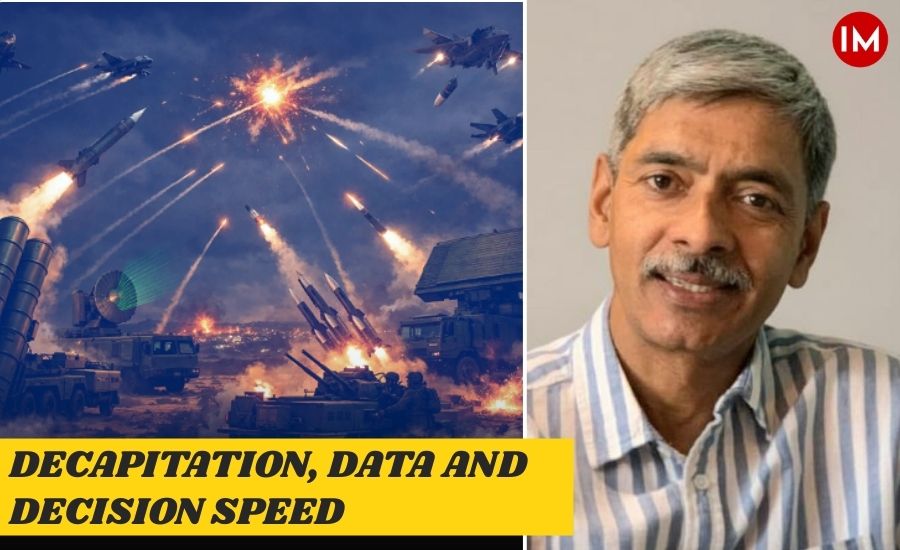
War has always been the crucible where change reveals itself first. What used to be a clash between masses and materiel now unfolds as a duel of intellect, networks, and timing. The recent US–Israel and Iran conflicthas shown, in stark terms, that the future of warfare is not a repeat of the past but a dramatic evolution of how power is projected, contested, and controlled. The operations that have shaped this period from what global media now reports as Operation Epic Fury and Operation Lion’s Roar highlights that warfare today favours precision, joint action, AI-driven decision cycles, and doctrinal adaptability far more than traditional firepower alone.
When headlines flash that a coalition has executed nearly 900 coordinated strikes in hours targeting leadership figures and critical infrastructure, it is now clear that a new logic of war is at play. Among the most striking features of what unfolded is the decapitation strategy — removing leadership, collapsing command-and-control, and shaping political outcomes without prolonged mass engagements. This is not an academic observation; this is real, observable in the Middle East theatre right now.
The commentary we have developed in the Indian Masterminds series over the last few months argument about precision as the new currency of power, the demand for doctrinal agility, the growing centrality of AI to decision superiority, and the imperative of integrated warfighting are not theoretical anymore. They are operational realities today. They are being enacted in real time on battlefields that reverberate far beyond their geographic bounds. Let me unpack these themes again in the context of what we see now and then consider what it means for strategic thought in India.
Precision as the New Currency of Power
The axiom that “he who strikes first, strikes with precision” has moved from doctrine into practice. In the current conflict, Israel and the United States coordinated strikes deep inside Iranian territory using a combination of long-range standoff weapons, drones, F-22 Raptors, EA-18G Growler aircrafts and guided munitions designed to minimise collateral impact while maximising strategic effect. Targets included missile launchers, air defence nodes, and command centres located in densely populated areas.
This is the same logic we analysed in Why the Next War Will Not Look Like the Last One—precision is not just about killing the enemy; it is about shaping the political centre of gravity. Cutting off an adversary’s decision spine can produce effects on morale and cohesion far beyond what conventional attrition strategies ever could.
In the words of Sun Tzu’s – “The skillful leader subdues the enemy’s army without battle.” Precision today is that skill.
For India, the lesson is that investments in high-fidelity intelligence, satellite navigation resilience, precision-guided munitions, and secure targeting networks are not optional. If the next conflict in South Asia begins as a short, sharp shock as the Middle East situation suggests it might, then precision readiness will determine outcomes faster than mobilising massive combat formations.
Doctrinal Readiness and the Need to Adapt Faster than the Adversary
In the days before these joint strikes, global intelligence communities were tracking movement patterns, communications, and leadership routines for months. The result was a sudden strike three hits in under 60 seconds that eliminated key regime figures simultaneously.
This is what doctrinal agility looks like, one that anticipates ambiguity, exploits surprise, and adapts quickly to the reality of compressed timelines. That kind of readiness depends on pre-coordination between political leadership and military planners; it demands escalation ladders that are well understood, rehearsed, and communicated across national security institutions.
Indian doctrine has taken steps toward greater flexibility – creation of integrated theatre commands and a unified defence staff are meaningful moves. But the Middle East conflict shows that future engagements may unfold in hours, not days. The decision-making window compresses when AI-enhanced surveillance and real-time analytics dominate the battlespace.
The famous military adage states “The more you sweat in peace, the less you bleed in war.” We must sweat now in planning, joint staff exercises, and inter-agency scenario rehearsals because the next battleground will penalise procrastination.
Artificial Intelligence and Decision Superiority
In modern operations, raw weapons systems matter far less than the speed of insight who sees first, who understands faster, who decides quicker.
The Middle East engagements made extensive use of real-time shared intelligence, satellite feeds, AI-assisted target recognition, and predictive analytics that turned vast data streams into actionable choices. That fusion of information enabled decision superiority a decisive edge in compressing the kill chain.
Reportedly combative AI has been first used during operation Epic Fury as claimed by USA Hence the speed of decision making alters deterrence calculus completely.
Delegating lethality entirely to machines can be dangerous. Decision superiority must still be accompanied by human judgement especially where escalation and geopolitical fallout matter. The doctrinal review must include how much autonomy is acceptable in lethal engagements and which safeguards must govern these systems.
For India, building an AI-capable defence ecosystem means investing in secure data fusion systems, indigenous machine learning platforms and decision support architectures that prioritise both speed and oversight.
Jointness and Integrated Warfighting as a Strategic Necessity
One of the most telling lessons from the current conflict is how deeply joint the operations have become. Air and naval assets, cyber units, intelligence agencies, and special operations elements worked in synchrony. Each domain reinforced the other precisely the fusion we argued was essential for future wars.
Today work in isolation will only invite failure. Modern warfighting demands cross-domain synergy with a single operating picture, unified command and control, and interoperable systems.
India’s progress in jointness with theatre commands, unified procurement, multi-service exercises must accelerate into a real-time integrated operational mindset.
Decapitation and Political Signalling
The removal of leadership figures in a conflict has long strategic reverberations. The Middle East case shows that such actions are not random acts of violence but high-stakes strategic signalling. They are intended to break an opponent’s will as much as their capability.
This tactic blurs the lines between conventional war and strategic coercion. The use of precision strikes not only reshapes the battlefield but reshapes global perceptions and alliances. As operations unfold, regional actors and other nations may reconsider alignments. Afterall eliminating a duly elected Head of State by an act of precision strikes has wider ramifications being against established international principles of war
For India’s corridors of power, this is a wake-up call.The future geopolitical landscape will not tolerate hackneyed strategies. Strategic partnerships will be tested and India must pursue strategic autonomy anchored in capability depth, not reactive alignments.
Strategic Takeaways for India
The Middle East conflict and the lessons vividly demonstrates that the future of war will be defined by precision, integrated battle networks, AI-augmented decision superiority, and doctrinal nimbleness. India must shape its force posture, procurement, command structures, and strategic partnerships around these realities.
We must invest in precision ecosystems, secure AI-driven decision platforms, and robust joint warfighting capabilities. We must also cultivate strategic thought that is nimble enough to integrate military power with diplomatic foresight.
Clausewitz said that “War is the continuation of politics by other means.” Today, that “other means” is technology, networks, and cognitive dominance. India must not only recognise this change in character it must master it soon.