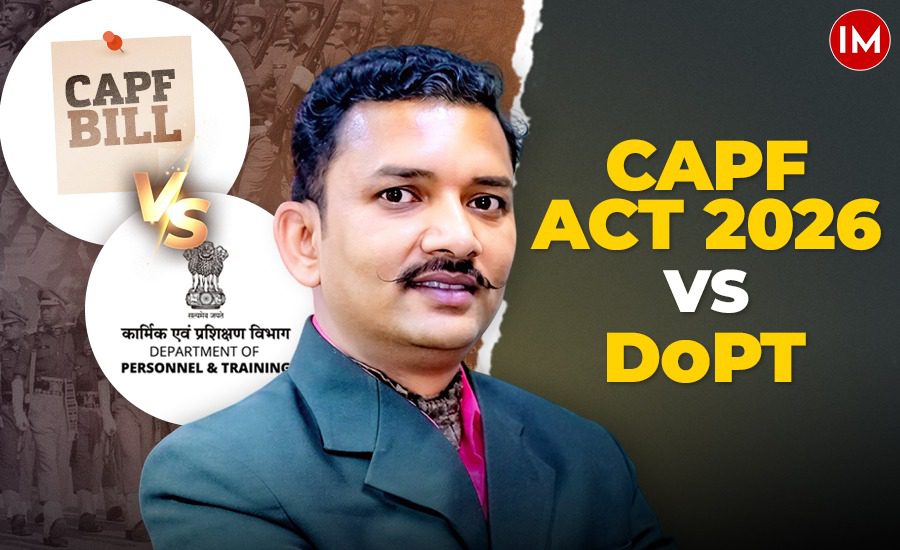
The governance of India’s Central Armed Police Forces (CAPF) is currently caught in a profound structural conflict, sitting at the intersection of constitutional mandates, administrative rules, and legislative power. At the core of this friction is a fundamental contradiction between the established role of the Department of Personnel and Training (DoPT) and the provisions of the newly enacted Central Armed Police Forces (General Administration) Act, 2026. Understanding this divide requires examining the constitutional framework of the civil services and evaluating whether this new legislative reality can withstand judicial scrutiny.
Context: The Constitutional and Administrative Mandate of the DoPT
The administrative architecture of the Government of India derives its legitimacy directly from the Constitution. Under Article 77(3), the President is empowered to make rules for the more convenient transaction of the business of the Government. This constitutional provision birthed the Government of India (Allocation of Business) Rules, 1961.
Within these rules, the DoPT is explicitly designated as the central personnel agency of the Union Government. Its binding mandate is to formulate overarching policies regarding the classification of services, recruitment, career progression, and service conditions for all Central Civil Services, specifically Group A posts. When officers are inducted into the CAPF as Assistant Commandants through the Union Public Service Commission (UPSC), they are inducted as Central Civil Service Group A officers.
The DoPT’s guiding philosophy for an Organised Group A Service (OGAS) is one of parity and natural progression. The established framework dictates that cadre officers must have an unhindered promotional pathway from entry-level to the apex administrative grades, ensuring they eventually command the organizations they serve. The DoPT’s rules are designed to prevent arbitrary stagnation and ensure that all Group A services are treated equitably across different ministries.
Findings: The Contradictory Clauses of the 2026 CAPF Act
The Central Armed Police Forces (General Administration) Act, 2026, driven by the Ministry of Home Affairs (MHA), fundamentally fractures this uniform framework. Rather than harmonizing the CAPF structure with the DoPT’s constitutional and administrative mandate, the Act statutorily codifies a parallel personnel system that contradicts core DoPT principles.
The most glaring contradiction lies in the statutory capping of career progression for CAPF cadre officers. While DoPT norms for an OGAS dictate upward mobility based on seniority and merit within the cadre, the 2026 Act explicitly reserves the highest command echelons for Indian Police Service (IPS) officers on deputation. By mandating that 50% of Inspector General (IG) posts, 67% of Additional Director General (ADG) posts, and 100% of Special Director General (SDG) and Director General (DG) posts be filled by an external cadre, the Act creates a permanent, legally enforced glass ceiling.
This creates a severe administrative anomaly: CAPF officers are Group A officers under DoPT classification, yet they are governed by an MHA-piloted law that denies them the fundamental attributes of a Group A service. The Act effectively isolates the CAPF from the protective umbrella of the DoPT’s parity-driven policies.
Implications: The Avenues for Legal Challenge
The pressing question is whether an Act of Parliament that institutionalizes such an administrative contradiction can be challenged in a court of law. The answer is unequivocally yes, though the grounds for challenge are complex.
While it is a settled legal principle that an Act of Parliament supersedes subordinate executive instructions like the Allocation of Business Rules, the CAPF Act of 2026 remains highly vulnerable to judicial review on strict constitutional grounds.
First, the Act can be challenged for violating Article 14 (Right to Equality) and Article 16 (Equality of Opportunity in matters of public employment) of the Constitution. The legal argument rests on the premise that the Act creates an arbitrary and discriminatory classification. By denying CAPF Group A officers the same career progression opportunities afforded to every other Organised Group A Service governed by the DoPT, the Act structurally discriminates against a specific cadre without a sufficiently rational nexus to the objective of operational efficiency. Subjecting one specific set of UPSC-recruited officers to permanent subordination under an external cadre violates the core tenets of equality in public service.
Second, the legislation is vulnerable under the doctrine of “legislative overruling.” Prior to the 2026 Act, the Supreme Court of India firmly recognized CAPF officers as an Organised Group A Service and directed the government to progressively reduce IPS deputation to cure the stagnation within the forces. While Parliament has the power to pass legislation that overrides a court judgment, constitutional law dictates that it cannot do so simply by declaring the judgment invalid. The legislature must remove or “cure the defect” that formed the basis of the court’s decision.
By passing an Act that statutorily enforces the exact deputation quotas the judiciary sought to reduce, it can be strongly argued that Parliament has merely bypassed a judicial writ without curing the underlying defect of cadre stagnation and lack of parity. Courts take a very strict view of legislation that appears to usurp judicial power or arbitrarily nullify a judicial directive regarding fundamental service rights.
Ultimately, while the 2026 Act provides statutory backing to the MHA’s preferred command structure, it stands on legally fragile ground. By contradicting the foundational principles of the DoPT and enforcing disparate treatment for Group A officers, the legislation sets the stage for a profound constitutional challenge regarding the rights, dignity, and equality of the forces securing the nation’s borders.
The Administrative Paradox in the Courts: Observations by Justice B.V. Nagarathna
Justice B.V. Nagarathna of the Supreme Court of India recently highlighted this exact administrative dysfunction, pointing out the severe toll it takes on the judicial system.
Speaking at the Supreme Court Bar Association’s National Conference in March 2026, she made the following critical observations regarding government litigation:
- The Government as the Biggest Litigant: She pointed out that while the State publicly expresses concern over the massive backlog of court cases, it is simultaneously the single largest generator of litigation in the country. She aptly summarized this paradox by stating the government is “both the complainant and the cause” of judicial pendency.
- Mechanical Appeals and Bureaucratic Inertia: Justice Nagarathna noted that rather than correcting flawed administrative orders or acting as a “model litigant” by settling disputes, government departments relentlessly pursue appeals, dragging cases up to the highest courts.
- Passing the Buck: She highlighted that this happens largely because government officials often prefer to “play it safe.” An official who files a routine appeal—even to defend an incorrect or trivial order—is viewed as diligent, whereas an official who accepts a lower court’s ruling or resolves an administrative anomaly internally might face audit or vigilance scrutiny.
This environment of bureaucratic caution directly mirrors the issues seen with the CAPF administration, where structural flaws and unequal service conditions are left to languish in the courts rather than being decisively resolved by the departments responsible for them.
About the Author– (Tarun Kumar Banjaree is a retired gazetted officer from the UPSC CPF 2004 batch, having served 27 years across the ITBP and Indian Navy. The Best Blogger of the Senior Command Course at the Army War College, his extensive field experience includes anti-Naxal operations, border guarding in Ladakh and Himachal Pradesh, and nationwide election duties. He led the Clean Ganga Expedition, which was recognized in the Golden Book of World Records. He was the lead petitioner among 72 CAPF officers in the OGAS implementation case, securing a favorable Supreme Court judgment in May 2025, and currently works as a writer, educator, and career counselor. He can be contacted at [email protected])