On the 13th of September 1949, sixteen members of the Constituent Assembly including Dr BR Ambedkar, G Durgabai, TT Krishnamachari, Dr P Subbaya and Dakshayani Velayudhan and Laxmi Kant Maitra (among others) moved a resolution for making Sanskrit the official language of India after the transition period for English. Interestingly none of these members were from core Hindi-speaking states, yet they all felt that this would bridge the gap between the North and the South. However, this was not to be. Per Article 343, Hindi in the Devanagari script was adopted as the official language of the Union. Perhaps as a compromise of sorts, Sanskrit was included as one of the fourteen languages of the eighth schedule.
Fifty five years later, in 2005, the Ministry of Culture accorded Sanskrit the status of a Classical language because its literary tradition spanned over two thousand years. Incidentally, Tamil had been accorded this status a year earlier in 2004. In 2010, the Government of Uttarakhand granted Sanskrit the status of ‘second official language’. All gazette notifications and signages at airports and prominent highways now reflect this new status. Ten years later, Himachal Pradesh followed suit. As of today, Sanskrit is the second official language in both these Himalayan states. Therefore, it would not be wrong to say that the political resurgence of Sanskrit is on the anvil.
The Language of Immortals
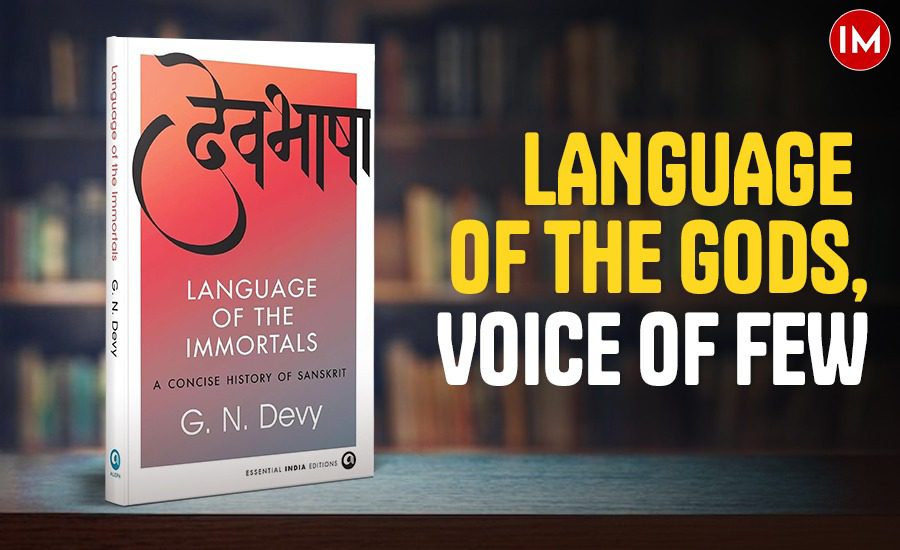
However, as Devy points out in ‘Dev Bhasha: Language of the Immortals: A Concise History of Sanskrit’, while this language exercised unparalleled salience and heft in the scriptural, religious, political, philosophical and literary texts of the country, it was never an ‘official language’ of any dynasty of India, nor used in the daily communication of the masses. The Mauryan empire used Magadhi (a Prakrit variant), the Ashokan inscriptions were written in the Brahmi or the Kharosthi script, the Chalukyas used Kannada, and the Satvahanas also used a variety of Prakrit in their court.
Also Read : IRS Raghav Gupta Captures Rare Indian Grassbird in Katarniaghat, Marking a First for the Sanctuary
Persian dominated medieval India and even Ranjit Singh’s empire in the north comprising the provinces of Punjab, Kashmir and Kabul carried out official transactions in Persian rather than Gurumukhi. Soon thereafter, it was English – in the present continuous – which held sway as the language of statecraft, commerce, law, technology and higher education. Ironically, it was the earlier Indologists like Sir William Jones who helped the resurrection of Sanskrit by linking it to the Indo-European language group.
Perhaps this was done to cleave against Persian which was then posing the greatest intellectual and linguistic challenge to English. In an address to the Royal Asiatic Society on February 2, 1786, Jones said ‘The sanscrit language, whatever be its antiquity is of wonderful structure, more perfect than Greek, more copious than Latin, and more exquisitely refined than either, yet bearing to both a stronger affinity, both in the roots of the verbs and in the forms of grammar, than could possibly have been produced by accident ; so strong indeed that no philologer could examine them all three, without believing them to have sprung from a common source.’
Be that as it may, when George Abraham Grierson carried out his exhaustive study of languages spoken in the sub-continent in the early part of the last century, Sanskrit was not among the 179 languages and 544 dialects. Likewise in the 1931 census, JH Hutton did not mention Sanskrit as a ‘spoken language’ in any part of British India.
Again, while the three stalwarts of the national movement – Lal (Lala Lajpat Rai), Bal (Gangadhar Tilak) and Pal (Bipin Chandra) – held Sanskrit in high esteem and valorised it as the ancient language of Bharat, their political discourse was in their respective mother tongues. Mahatma Gandhi insisted on the reorganization the Congress into linguistic units like those of Bangla, Telugu, Sindhi, Kannada, Odiya, et al for his political and social reform agenda; for India’s official and link language, his preference was for Hindustani in both the Devanagari and Urdu scripts.
The Mnemonics of Sanskrit
So how did Sanskrit get the status of Dev Bhasha, the language of the gods, juxtaposed as it was against the language of the mortals? It became the language of religious power because for at least five centuries before Panini gave it the most perfect grammar and script, the transmission of the Vedas was oral. Writes Devy: ‘A profound understanding of the interlocking of the poetic meter and the working of memory was the principal feature of Vedic mnemonics. This intricate metrical system was a remarkable aid to memorisation, much like the multiplication tables which help in solving difficult sums in a fraction of a second.’
Shruti and Smriti
But this also made it possible to keep knowledge confined to an intermediary class of purohits. The medium now became as powerful as the message, if not more! In contrast to other ancient languages – Latin, Greek, Hebrew, Arabic and Persian – where the script aided the spread of literature, here in Bharat the oral or ‘shruti’ took precedence over the ‘smriti’ interpretations of scripture. Shruti thus got the status of having been revealed from a source higher than a mortal in becoming ‘apaurusheya’. This insistence on a divine origin was both good and bad – good because it gave an epistemological framework of knowledge, but its negative externalities were equally if not more pronounced.
When Kapila in the sixth century BCE laid the foundations of Samkhya, one of the first schools of ancient Indian philosophy, he proposed that since the Vedas are divinely inspired and therefore ‘authorless’, the ultimate logical validation of a given premise can be found in them alone. In tune with this position, even analytical philosophy in Sanskrit started being described as darshan (that which is envisioned) rather than as ‘thought’(which is reasoned). Therefore even while the six schools of Indian philosophy – Samkhya, Nyaya, Vaiseskia, Yoga ( Patanjali), Vedanta and Mimamsa – engaged in debates and contestations, none of them questioned the authority of Vedas. The Lokayata of Charvaka and both the Buddhist sects of Mahayana and Hinayana questioned the Vedic canon, but since their language was not Sanskrit, it did not affect the elite – indeed divine – status of that elevated language.
Thus, even when Indians made impressive progress in certain sciences, agriculture, political theory, philosophy and linguistics for a thousand years after the Vedas were composed, ancient literary scholarship persisted it in the belief that the Vedas held literally all knowledge in them — along with the more fundamentalist view that ‘no knowledge could surpass that which was contained in the Vedas’.
Language of Esteem
Sanskrit thus became the subcontinent’s language of esteem, leading to many generations of non-Sanskrit speakers to aspire to Sanskritise themselves. During the last century MN Srinivas used this now-contested term to anchor a theory of social aspiration born out of the severe inequalities which continue to fragment Indian society. Devy’s book ends with a thought-provoking line: ‘The history of Indianization of Sanskrit is synonymous with the history of sanskritsation of India, an intimate mutual engagement that Persian and English too, were to achieve in the later ages, but not so pervasively as Sanskrit did.’
(Sanjeev Chopra is a Senior Fellow of the Centre for Contemporary Studies, Prime Ministers Memorial and Library, Teen Murti House, New Delhi and the Festival Director of Valley of Words, a Dehradun based pan- India festival of literature and arts .He superannuated as the Director of LBS National Academy of Administration after 36 years in the IAS. His recent books include The Great Conciliator : Lal Bahadur Shastri and the Transformation of India ( Bloomsbury, 2025 ) and We The People of the States of Bharat : The Making and Remaking of India’s Internal Boundaries (Harper Collins, 2022 HB, 2023 PB)
Also Read : The ‘Certification Trap’: How loopholes are undermining Indian bureaucracy